
Brady Corp (BRC) Equity Research: Navigating Acquisition Complexity and AI-Driven Growth Amid Macroeconomic Headwinds
Brady Corp is expanding through a transformative acquisition and AI initiatives while managing inflation and supply chain challenges. Execution risks and financial leverage rise with integration complexity, demanding close monitoring of operational and market developments.
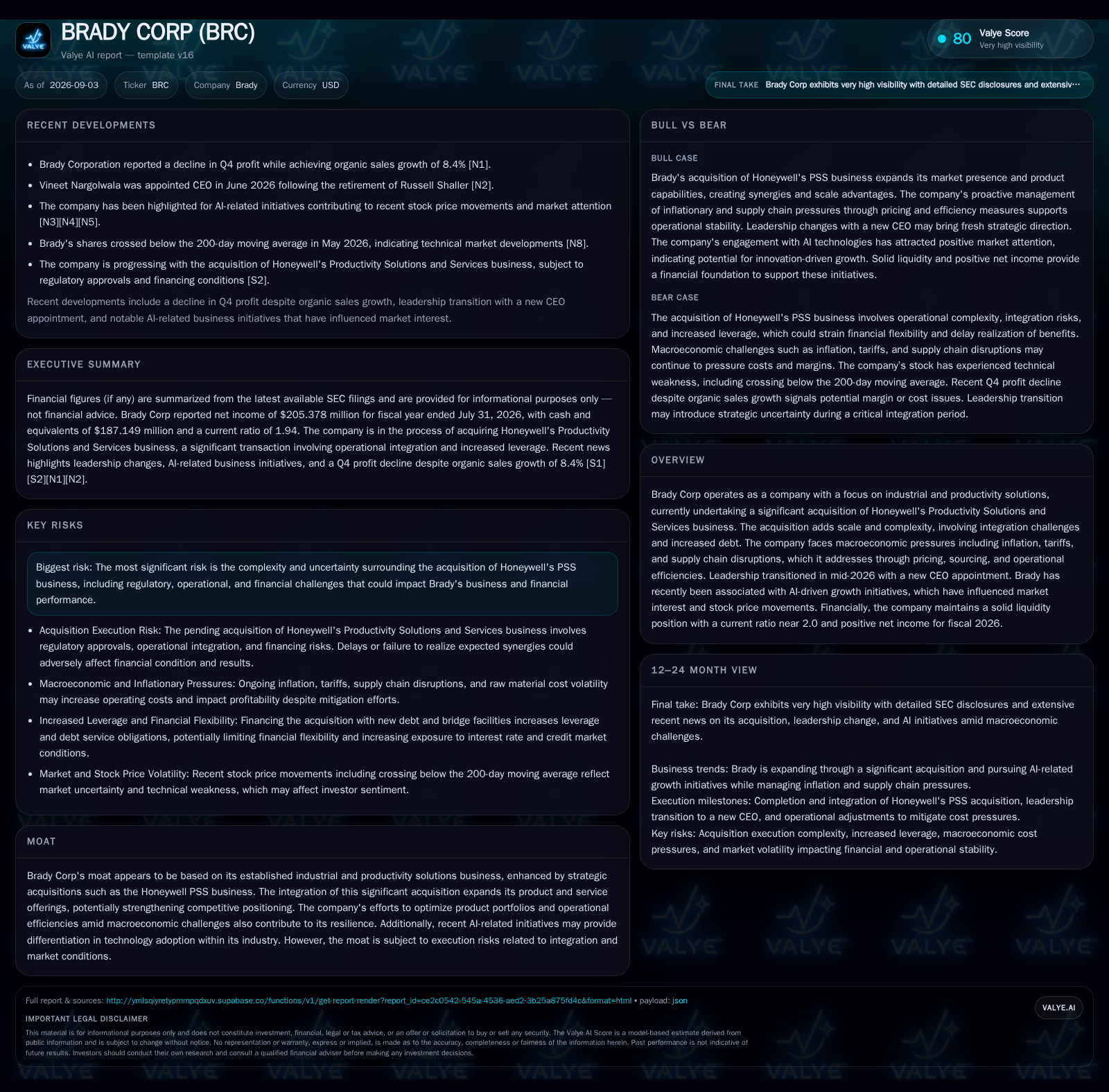
Brady Corp reported solid net income for fiscal 2026 but faces a pivotal period characterized by the pending acquisition of Honeywell's Productivity Solutions and Services business, leadership transition, and macroeconomic pressures. The acquisition could unlock scale and innovation synergies but entails significant integration and financing risks. Brady’s AI-driven initiatives present growth opportunities and market differentiation, yet recent profit decline and stock technical weakness signal margin pressures and investor caution. The company’s financial position remains stable, though increased leverage requires scrutiny. Brady's trajectory depends on successful acquisition integration, cost management, and sustaining innovation momentum.
Brady Corp stands at a strategic inflection point as it pursues growth through a major acquisition of Honeywell’s Productivity Solutions and Services business while navigating inflationary pressures and supply chain challenges. The $205 million net income and reported liquidity position underpin its financial resilience, yet increased leverage and operational complexity introduce risk. Simultaneously, Brady is investing in AI-driven initiatives that have garnered market enthusiasm, potentially positioning it for technology-led expansion. The leadership transition and recent profit softness inject uncertainty, making the coming 12-24 months critical for execution, integration, and sustainable margin improvement.
Latest Operating Snapshot
Brady Corp reported a net income of $205.378 million for the fiscal year ended July 31, 2026, supported by a current ratio of 1.94 and cash equivalents of $187.149 million, indicating solid liquidity and operational cash flow generation [S1]. Despite this, the company experienced a decline in Q4 profit even while achieving 8.4% organic sales growth, signaling emerging margin pressures potentially linked to inflation and cost volatility [N1][S1].
Strategically, Brady is undertaking a significant acquisition of Honeywell’s Productivity Solutions and Services business, expected to close in the second half of calendar year 2026 pending regulatory and financing approvals [S2]. This transaction is substantial relative to Brady’s existing scale and introduces integration complexity, operational transition challenges, and increased leverage through a mix of cash and bridge financing [S2]. Additionally, Brady appointed Vineet Nargolwala as CEO in June 2026, marking a leadership transition at a critical juncture [N2].
Business Model and Unit Economics
Brady operates primarily by providing industrial and productivity solutions, generating revenue through product sales, services, and increasingly through technology-enabled offerings. Pricing power is influenced by cost pass-through capability, product mix, and customer switching costs inherent in industrial labeling, safety, and identification products. Volume growth is linked to macroeconomic industrial activity and capital expenditures across sectors.
The pending Honeywell PSS acquisition expands Brady’s product and service portfolio, likely increasing fixed costs through integration investments and potentially enhancing operating leverage if scale efficiencies are realized. However, the acquisition also raises capital intensity and debt service obligations, which may pressure margins if synergies are delayed. Brady’s efforts to mitigate inflation through price increases and sourcing optimization partially offset rising variable costs, but the interplay of pricing, volume, and mix will be critical to margin sustainability.
Moat, Competition and Counterforces
Brady’s moat derives from its established reputation and broad industrial product offerings, augmented by strategic acquisitions like Honeywell’s PSS business. The expanded portfolio enhances customer value through integrated solutions and may increase switching friction due to bundled products and services, particularly in regulated environments requiring compliance and safety labeling. Operational efficiencies and AI-driven innovations could further differentiate Brady from peers.
However, this moat is challenged by execution risks inherent in complex integrations, exposure to raw material cost volatility, and competitive pressures from both legacy industrial suppliers and emerging technology players. The industrial solutions market is fragmented, with competitors ranging from global conglomerates to niche specialists. Brady must navigate macroeconomic headwinds and maintain innovation pace to prevent erosion of its competitive positioning.
Bull Case
In the bull scenario, Brady successfully completes the Honeywell PSS acquisition, integrating operations smoothly and realizing targeted synergies that boost scale, cross-selling, and operational efficiency. This expands Brady’s addressable market and product differentiation while enhancing pricing power through broader solution offerings. Concurrently, Brady’s AI initiatives catalyze innovation in product development and customer engagement, generating new revenue streams and improving margins.
Effective management of inflationary pressures via dynamic pricing and supply chain optimization preserves margin expansion. The leadership change energizes strategic focus on technology adoption and global expansion. Positive market sentiment, reflected in renewed stock price strength and multiple expansion, further supports investment capacity. Confirmation would be visible through accelerating organic sales growth, margin improvement, successful acquisition milestones, and growing AI-driven revenue contributions; failure to deliver these would falsify this scenario.
Base Case
Under the base case, Brady completes the acquisition with moderate integration delays but ultimately captures partial synergies. Organic growth continues at a steady pace around mid-single digits, supported by price increases that offset inflationary cost pressures. AI initiatives contribute incrementally to product differentiation without material disruption or breakthrough growth.
Margins stabilize but do not significantly improve due to ongoing macroeconomic headwinds and increased operational complexity. Leadership transition proceeds smoothly, maintaining strategic continuity. Financial leverage rises but remains manageable within Brady’s liquidity profile. The stock price reflects mixed investor sentiment balancing growth potential against integration risk. Key indicators include steady revenue growth, margin maintenance, successful refinancing of acquisition debt, and moderate AI impact.
Bear Case
In a downside scenario, Brady’s acquisition faces significant integration challenges, delays, and cost overruns, preventing realization of expected synergies and straining cash flows. The increased leverage limits potential financial flexibility, exacerbated by rising interest rates or credit market tightening. Inflation and raw material cost volatility continue to pressure margins despite attempted price increases, contributing to sustained profit declines even amid nominal sales growth.
Leadership transition creates strategic uncertainty, leading to execution lapses and competitive losses. AI initiatives fail to gain traction or materially impact revenue, leaving Brady vulnerable to more nimble technology-enabled competitors. Market sentiment deteriorates, reflected by continued stock price weakness below technical support levels. Confirmation would be persistent margin contraction, missed acquisition milestones, and deteriorating credit metrics; conversely, stabilization in these areas would challenge this bear thesis.
What Matters Next
Key performance indicators to monitor include: (1) Completion timing and regulatory approval status of the Honeywell PSS acquisition, (2) Progress on integration milestones and realization of synergy targets, (3) Organic sales growth rates with segmentation by product line and geography revealing AI contribution, (4) Gross and operating margin trends reflecting cost management effectiveness, (5) Debt levels and interest coverage ratios tracking financial leverage and refinancing progress, (6) CEO communication on strategic priorities and operational adjustments post-transition, (7) Stock price behavior relative to technical indicators like the 200-day moving average as a barometer of investor confidence, and (8) Macroeconomic indicators such as raw material prices and tariff developments impacting cost structure.
Disclosure on AI initiative revenues or R&D investment trends would be particularly useful for assessing innovation impact. Additionally, updates on pricing actions and supply chain adaptations will help gauge Brady’s ability to navigate inflationary pressures. Close attention to quarterly earnings calls for management tone and guidance adjustments will provide timely insights into evolving risks and opportunities.
Disclaimer: This is research-only, informational analysis and not investment advice. It may include AI-generated interpretation and general industry context. Always verify important details using primary sources.

Comments