
REX American Resources Corp: Ethanol Production Amid Commodity Volatility and Regulatory Dynamics
REX operates as a holding company with majority and minority stakes in ethanol production facilities, navigating a volatile commodity environment and shifting regulatory landscape. Its business model hinges on efficient feedstock sourcing, federal incentives, and risk management, balancing operational leverage against exposure to corn and ethanol price swings.
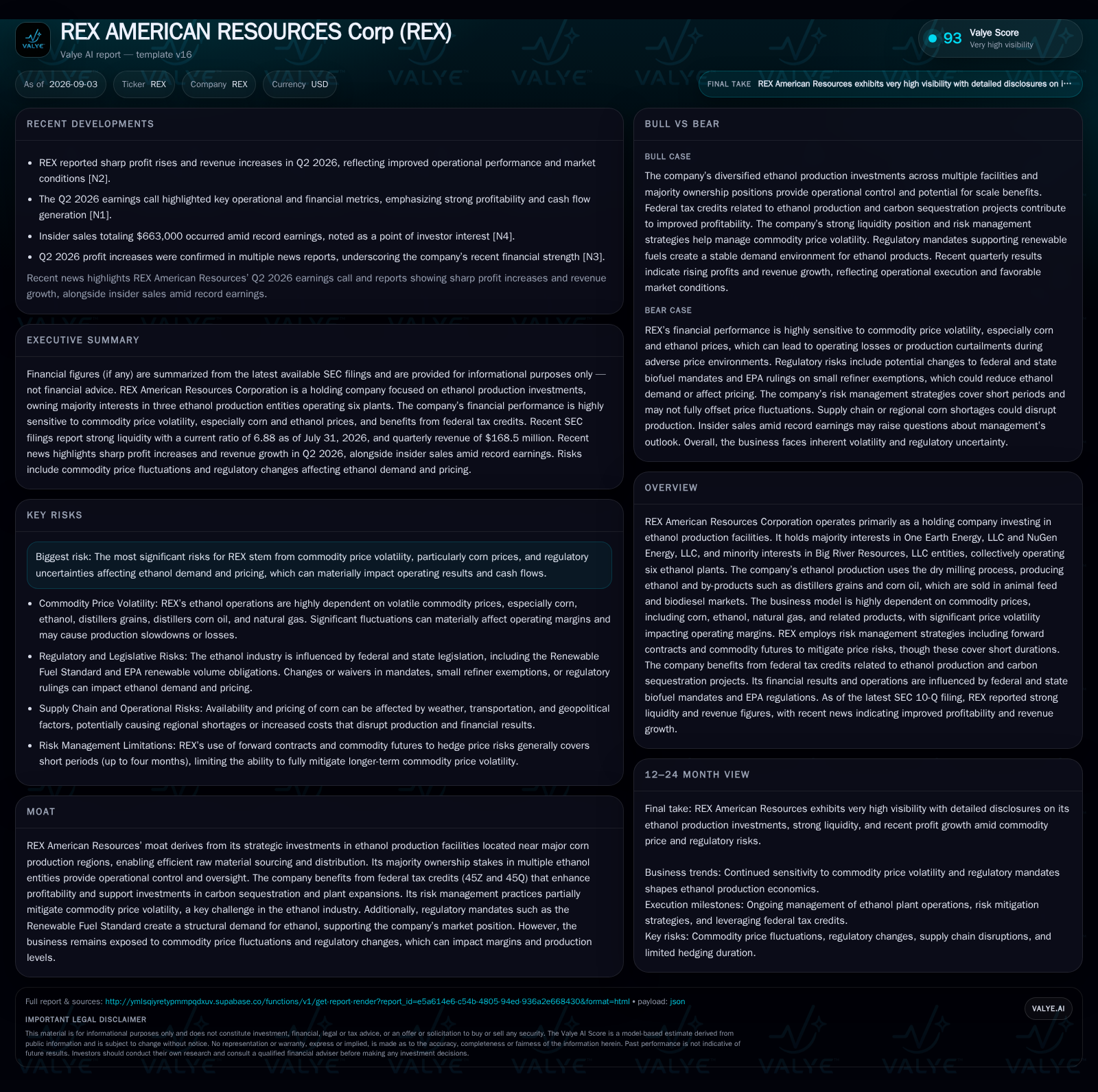
REX American Resources leverages majority ownership in multiple ethanol plants to capture scale and control, benefiting from federal tax credits and regulatory mandates supporting biofuels. Despite reported liquidity position and recent profit growth, the company faces significant risks from commodity price volatility and regulatory changes. Its moat is anchored in geographic positioning and federal incentives, but execution depends on managing short-duration hedges and navigating policy shifts. Key near-term focus includes sustaining operational efficiency, expanding credit-backed carbon sequestration projects, and monitoring regulatory developments on ethanol demand.
REX American Resources Corp operates as a holding company investing in ethanol production businesses strategically located near corn-growing regions. Its portfolio includes majority interests in One Earth Energy and NuGen Energy, plus minority stakes in Big River Resources entities, collectively operating six ethanol plants. The company’s financial performance is highly sensitive to commodity input and output price fluctuations, primarily corn and ethanol, which drive operating margins and production economics. Federal tax credits for ethanol production and carbon sequestration provide a regulatory hedge supporting profitability. Recent quarterly reports reveal rising earnings and revenues, yet REX faces significant risks from commodity volatility and evolving biofuel policy mandates. The firm’s ability to navigate these factors will shape its medium-term trajectory.
Latest Operating Snapshot
As of the quarter ended July 31, 2026, REX reported revenue of $168.5 million with basic and diluted EPS of $1.06, marking a sharp rise in profitability compared to prior periods [S2][N1]. The company’s ethanol entities shipped approximately 722 million gallons during the twelve months ended January 31, 2026, with REX’s effective ownership representing about 294 million gallons [S1]. reported liquidity position is evident from a current ratio of 6.88 and cash plus short-term investments exceeding $379 million, positioning the company with potential financial flexibility to manage commodity price turbulence and invest in operations [S2]. Insider sales totaling approximately $663,000 were disclosed amid this record earnings period, highlighting potential management portfolio rebalancing or signaling to watch [N4].
REX’s ethanol production remains geographically concentrated near major corn-producing states, facilitating raw material access and cost advantages [S1]. Recent earnings calls emphasized operational cash flow strength and the contribution of federal tax credits, including 45Z and 45Q programs tied to carbon capture initiatives, which materially bolster margin stability amid volatile corn and natural gas prices [N1][S1]. However, risk management strategies currently cover only short durations (generally up to four months), leaving earnings sensitive to longer-term commodity swings [S1]. Regulatory support through the Renewable Fuel Standard and EPA renewable volume obligations continues to underpin ethanol demand, but policy uncertainty persists [S1].
Business Model and Unit Economics
REX’s business model centers on ethanol production via dry milling, converting corn into ethanol fuel and co-products like dry distillers grains with solubles (DDGS) and distillers corn oil. Revenue streams derive from ethanol sales, by-product sales (animal feed and biodiesel inputs), and monetizing federal tax credits related to ethanol production and carbon sequestration investments [S1]. Production economics depend heavily on the “crush spread,” the margin between ethanol and distillers grains prices versus corn and natural gas input costs. This spread is volatile and can materially impact operating results, as seen in past periods [S1].
Operating leverage arises from fixed plant costs and relatively stable facility throughput, enabling incremental volume or cost improvements to disproportionately boost profits. However, REX’s holdings are spread across six plants with varying ownership percentages, complicating consolidated unit economics. Capital intensity is moderate, with ongoing investments needed to maintain plant efficiency, comply with environmental standards, and expand carbon capture capabilities to qualify for tax credits [S1]. Short-term hedging mechanisms reduce commodity price risk, but their limited duration leaves profitability exposed to unexpected price shocks beyond the hedge horizon. Pricing power is constrained by commodity market dynamics and regulatory mandates influencing ethanol demand and blending volumes.
Moat, Competition and Counterforces
REX’s moat derives primarily from its strategic geographic positioning near large corn production regions, reducing feedstock logistics costs and supply risk. Majority ownership in key ethanol entities enables operational control and coordination across multiple plants, facilitating scale efficiencies and consistent execution [S1]. The company’s participation in federal tax credit programs (45Z for carbon sequestration, 45Q for carbon capture) adds a regulatory moat element by enhancing profitability through government incentives that competitors without such projects cannot access easily [S1]. The Renewable Fuel Standard underpins structural ethanol demand, creating a relatively stable market environment compared to less regulated commodities.
Competitive pressures stem from a fragmented U.S. ethanol production landscape with nearly 200 plants nationwide, and from alternative fuel technologies including electric vehicles and advanced biofuels. Commodity price volatility and regulatory uncertainty constitute significant counterforces restricting sustainable margin expansion. REX’s risk management practices provide partial insulation but are limited in duration, exposing the company to swings in corn and ethanol prices. Additionally, ongoing EPA rulings around small refiner exemptions and potential changes to biofuel mandates inject unpredictability into demand and pricing. Thus, while REX’s assets and tax credits constitute barriers, the competitive environment and regulatory landscape require continuous adaptation.
Bull Case
In an optimistic scenario, REX leverages its majority stakes in multiple ethanol plants to achieve operational scale and efficiency gains, driving margin expansion as crush spreads remain favorable or improve. The company’s proactive investments in carbon capture projects qualify it for lucrative federal tax credits (45Z and 45Q), substantially augmenting cash flows beyond commodity-driven earnings. reported liquidity position and disciplined short-term hedging enable REX to manage commodity price volatility effectively. Concurrently, robust federal and state biofuel mandates, including firm Renewable Fuel Standard volumes and tightened EPA small refiner exemptions, maintain or increase ethanol blending demand, supporting ethanol price stability or growth.
Confirming evidence for this scenario includes consistent revenue and profit growth, expansion or renewal of carbon sequestration tax credit programs, stable or rising ethanol demand driven by policy support, and limited commodity price shocks beyond hedge coverage. A falsification test would be significant erosion in ethanol mandates, widespread commodity price collapses, or failure to execute carbon capture projects diminishing tax credits, leading to margin compression and depressed profitability.
Base Case
The base case envisions REX delivering stable to modestly growing ethanol production volumes with profitability fluctuating in line with commodity price cycles but generally supported by federal tax credits and regulatory mandates. The company maintains its existing operational scale and risk management strategies, with incremental improvements in feedstock sourcing and plant efficiency helping offset periodic commodity cost pressures. Carbon capture projects continue generating moderate incremental cash flow, though expansion is paced conservatively. Regulatory policies remain generally favorable but subject to occasional uncertainty, causing short-term demand variability without structural disruption.
Confirming evidence includes earnings and revenue tracking commodity-driven seasonal patterns, successful maintenance of tax credit eligibility, no major policy reversals, and moderate volatility in commodity prices accommodated by hedging. Falsification would occur if commodity price volatility sharply worsens, regulatory mandates weaken materially, or operational disruptions impair production volumes, leading to significant margin deterioration or cash flow constraints.
Bear Case
Under downside conditions, REX faces sustained commodity price volatility with corn and ethanol prices moving adversely, compressing crush spreads and forcing production slowdowns or operational losses. The short duration of its hedging strategies proves insufficient to mitigate extended price swings. Regulatory risks materialize through EPA rulings granting broader small refiner exemptions or reductions in mandated ethanol blending volumes, substantially reducing ethanol demand and price support. Supply chain disruptions or regional corn shortages further increase input costs and constrain production. The combined effect erodes profitability, potentially triggering asset impairments or liquidity pressures despite strong current cash balances. Insider sales amid record earnings may be interpreted as management signaling caution on forward outlook.
Confirming evidence includes persistent low crush spreads, regulatory rollbacks on biofuel mandates, negative policy developments on carbon sequestration tax credits, and operational disruptions. Falsification would require a rebound in commodity prices, restoration of regulatory support, or operational improvements reversing margin declines.
What Matters Next
Key performance indicators to monitor include ethanol production volumes and capacity utilization rates across REX’s six plants, as these directly affect revenue and operating leverage. Tracking crush spread metrics—ethanol and distillers grain prices relative to corn and natural gas costs—is crucial to assess margin sustainability. The pace and scale of federal tax credit utilization, particularly 45Z and 45Q, will influence profitability and capital investment returns. Regulatory developments around Renewable Fuel Standard volumes, EPA rulings on small refiner exemptions, and state biofuel mandates must be watched closely for impact on ethanol demand.
Additional milestones include the company’s hedging effectiveness and duration, which determine exposure to commodity price swings beyond the short-term. Monitoring insider trading activity and management commentary during earnings calls provides qualitative insight into forward expectations. Finally, supply chain factors such as corn availability, transportation infrastructure stability, and energy pricing volatility are important external conditions shaping operational continuity and cost structure.
Disclaimer: This is research-only, informational analysis and not investment advice. It may include AI-generated interpretation and general industry context. Always verify important details using primary sources.

Comments