
DICK'S SPORTING GOODS, INC. (DKS) — Navigating Competitive and Macroeconomic Crosswinds with Omni-Channel and Brand Differentiation
DICK'S SPORTING GOODS leverages omni-channel retailing, vertical brand products, and experiential concepts to differentiate amid intense competition and macroeconomic volatility. Strategic investments and real estate optimization offer potential upside, but geopolitical risks and execution challenges create material uncertainty.
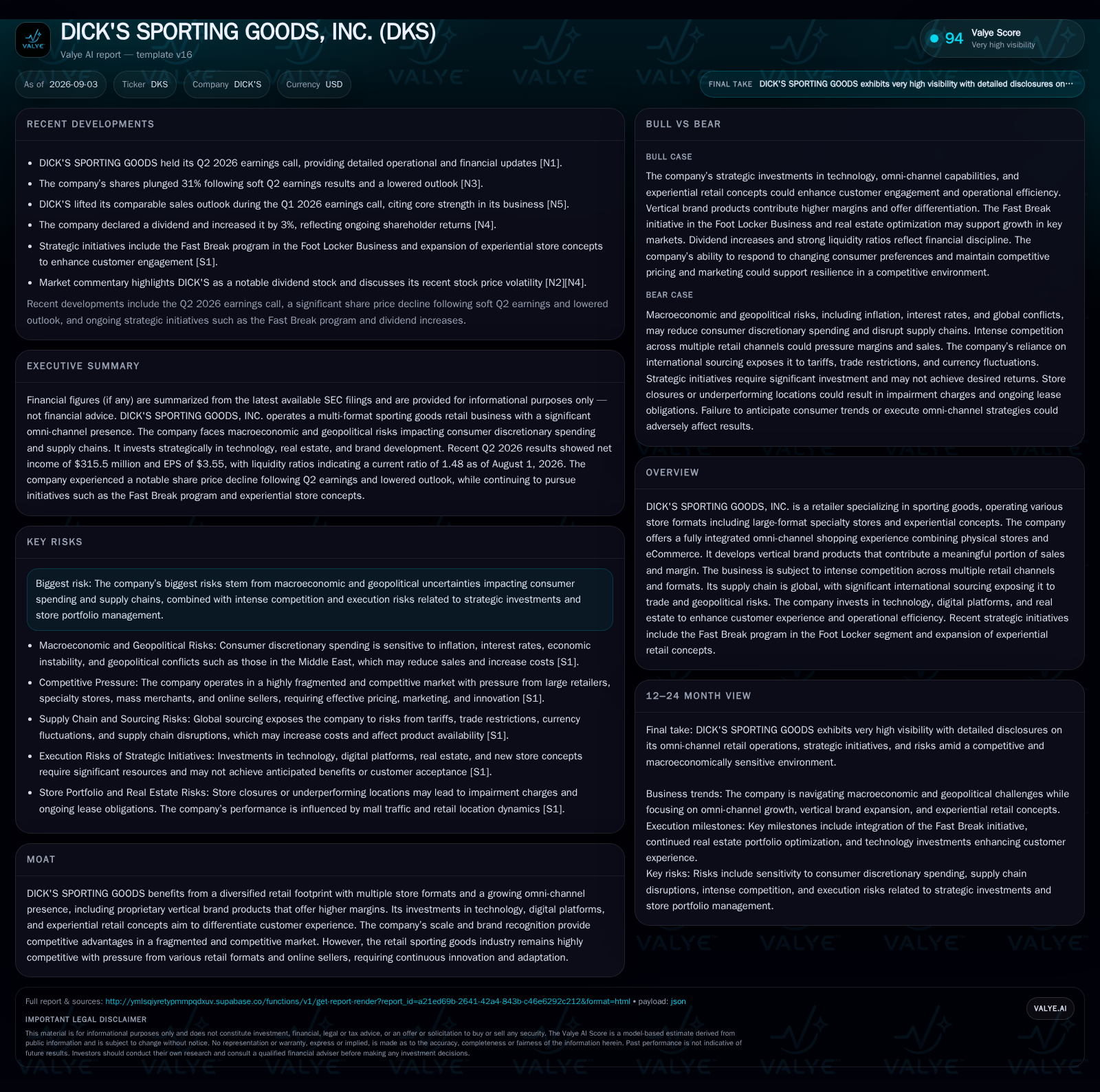
DICK'S SPORTING GOODS operates a multi-format sporting goods retail business integrating physical stores and eCommerce. About 13% of sales come from higher-margin vertical brand products. The company faces a fragmented competitive landscape and macroeconomic headwinds affecting discretionary spending and supply chains. Recent Q2 2026 earnings showed solid net income but triggered a 31% share price drop due to a lowered outlook. Strategic initiatives including the Fast Break program and experiential retail expansion aim to drive growth and differentiation. Key risks include global sourcing challenges, competitive pressure, and execution of strategic investments.
DICK'S SPORTING GOODS, a leading multi-format sporting goods retailer, operates a fully integrated omni-channel platform combining physical stores and digital sales, with vertical brand products contributing a meaningful margin premium. Despite delivering solid Q2 2026 earnings, the company’s shares plunged 31% on a lowered outlook amid challenging macroeconomic conditions and intensified competition. Strategic initiatives such as the Fast Break program in the Foot Locker segment and expansion of experiential retail concepts represent efforts to differentiate and drive profitable growth. However, global supply chain vulnerabilities and execution risks of these investments pose significant challenges. This analysis examines DICK’S business model, competitive positioning, and potential future trajectories amid evolving industry and economic dynamics.
Latest Operating Snapshot
As of Q2 2026, DICK'S SPORTING GOODS reported net income of $315.5 million with a basic EPS of $3.55 and diluted EPS of $3.50, reflecting operational profitability despite a soft earnings environment that led to a 31% share price decline post-announcement [S2][N1][N3]. The company’s liquidity position remains robust with cash and equivalents of $913.7 million and a current ratio of 1.48 as of August 1, 2026, signaling short-term financial stability [S2].
DICK'S continues to expand its omni-channel capabilities, integrating physical and digital channels, while about 13% of its sales are derived from vertical brand products that generally carry higher margins, serving as a key differentiator [S1]. Strategic initiatives such as the Fast Break program in the Foot Locker business, along with expansion of experiential retail formats (climbing walls, batting cages), reflect a push to enhance customer engagement and drive traffic [S1]. Dividend increases of 3% in early 2026 underscore ongoing shareholder return policies amid operational challenges [N4].
Business Model and Unit Economics
DICK'S SPORTING GOODS generates revenue primarily through the sale of sporting goods and apparel via a multi-format retail network, including large-format specialty stores and omni-channel platforms that integrate in-store and eCommerce experiences. The vertical brand product line, accounting for around 13% of sales, tends to deliver higher gross margins due to greater control over design, pricing, and supply chain efficiencies [S1]. Pricing strategy balances competitive pressures and inventory management across channels, with volume driven by consumer demand and marketing effectiveness.
Operating costs combine relatively fixed elements—such as store leases, salaries, and technology investments—with variable costs tied to inventory procurement and fulfillment. The global supply chain exposes the company to variable input costs and logistical risks, imposing a level of cost unpredictability. Capital intensity is moderate, primarily driven by real estate and technology investments, including digital platforms and experiential store upgrades. Operating leverage could emerge if sales scale improves fixed cost absorption, particularly in eCommerce and proprietary brand sales, but may be offset by ongoing investments and competitive discounting.
Moat, Competition and Counterforces
DICK'S moat is anchored in its diversified retail footprint combining physical and digital channels, complemented by a growing portfolio of vertical brand products that enhance margin structure and customer loyalty. Investments in experiential retail formats and technology platforms aim to differentiate the shopping experience and build switching friction by fostering customer engagement beyond mere transactions [S1]. Scale advantages provide bargaining power with suppliers and support marketing reach.
However, the sporting goods retail industry is highly fragmented and intensely competitive. Major competitors include large-format specialty retailers, department stores, mass merchandisers, and digitally native eCommerce players. These competitors apply pressure on pricing, assortment, and innovation. Global sourcing risks and geopolitical tensions create vulnerability to supply chain disruptions and cost inflation. The absence of significant switching costs in retail limits customer lock-in, requiring continuous marketing and innovation to maintain market share.
Bull Case
Under a favorable scenario, DICK'S successfully leverages its omni-channel integration and expands vertical brand penetration, driving higher-margin sales growth. Strategic initiatives such as the Fast Break program optimize Foot Locker’s performance, while experiential retail concepts boost foot traffic and customer dwell time, enhancing basket size. Investments in AI and machine learning improve inventory management and personalized marketing, increasing operational efficiency and customer retention.
Confirmation of this scenario would include sustained comparable sales growth, expanding gross margins from vertical brands, and improving eCommerce contribution margins without increased promotional discounting. The company would also demonstrate successful real estate optimization with rising returns on invested capital. Share price recovery reflecting renewed investor confidence and stable or growing dividends would further validate the bull case. Conversely, failure to meet sales or margin targets or inability to scale digital initiatives would falsify this outlook.
Base Case
In the base case, DICK'S maintains stable but modest growth amid a challenging macroeconomic environment. Vertical brand products continue to represent a steady share of sales, supporting margin resilience. The Fast Break initiative and experiential retail expansion deliver incremental but moderate contributions to revenue and customer engagement. Omni-channel integration sustains the existing customer base with gradual digital sales penetration improvements, offsetting some brick-and-mortar softness.
Supply chain costs and geopolitical risks cause margin fluctuations but remain manageable through sourcing diversification and cost pass-through where feasible. Competitive pressures constrain pricing power, resulting in stable gross margins overall. The company maintains dividends and liquidity, balancing reinvestment in technology and real estate with capital discipline. This scenario is confirmed by flat to slightly positive comparable sales trends, steady margin profiles, and limited deviation in operating earnings. Significant deterioration in these metrics would challenge the base case assumptions.
Bear Case
In a downside scenario, sustained inflation, rising interest rates, and geopolitical conflicts depress consumer discretionary spending, leading to declining sales and elevated promotional activity. Supply chain disruptions and tariffs inflate costs, compressing margins. Strategic initiatives such as Fast Break and experiential retail fail to gain traction or generate expected returns, burdening the income statement with impairment charges or underutilized investments.
Store closures or underperforming locations generate further losses and lease obligations, weakening cash flow. Intensifying competition from mass merchants and online pure-plays erodes market share, while the company’s omni-channel strategy falters due to execution missteps or technology gaps. Dividend cuts or liquidity strain could signal distress. Evidence supporting this case would be consecutive quarters of negative comps, margin erosion, inventory write-downs, and deteriorating cash metrics. Conversely, any signs of operational stabilization or renewed growth would argue against this pessimistic trajectory.
What Matters Next
Key performance indicators to monitor include comparable store sales growth, particularly within vertical brand categories, which reflect consumer acceptance and pricing power. Gross margin trends and mix shifts provide insight into cost management and product differentiation. ECommerce revenue as a percentage of total sales and digital customer engagement metrics gauge omni-channel execution effectiveness.
The pace of rollout and customer response to experiential retail formats, as well as results from the Fast Break program in the Foot Locker business, are critical milestones for growth potential. Inventory turnover rates and supply chain cost trends reveal operational efficiency and risk exposure. Finally, liquidity ratios and dividend policy changes offer signals on financial health and capital allocation discipline in a volatile environment.
Disclaimer: This is research-only, informational analysis and not investment advice. It may include AI-generated interpretation and general industry context. Always verify important details using primary sources.

Comments