
NeOnc Technologies Advances NEO212 Development Amid Regulatory Feedback and Liquidity Pressures
Clinical-stage NeOnc Technologies pushes forward with oncology pipeline, emphasizing regulatory progress and strategic capital raises.
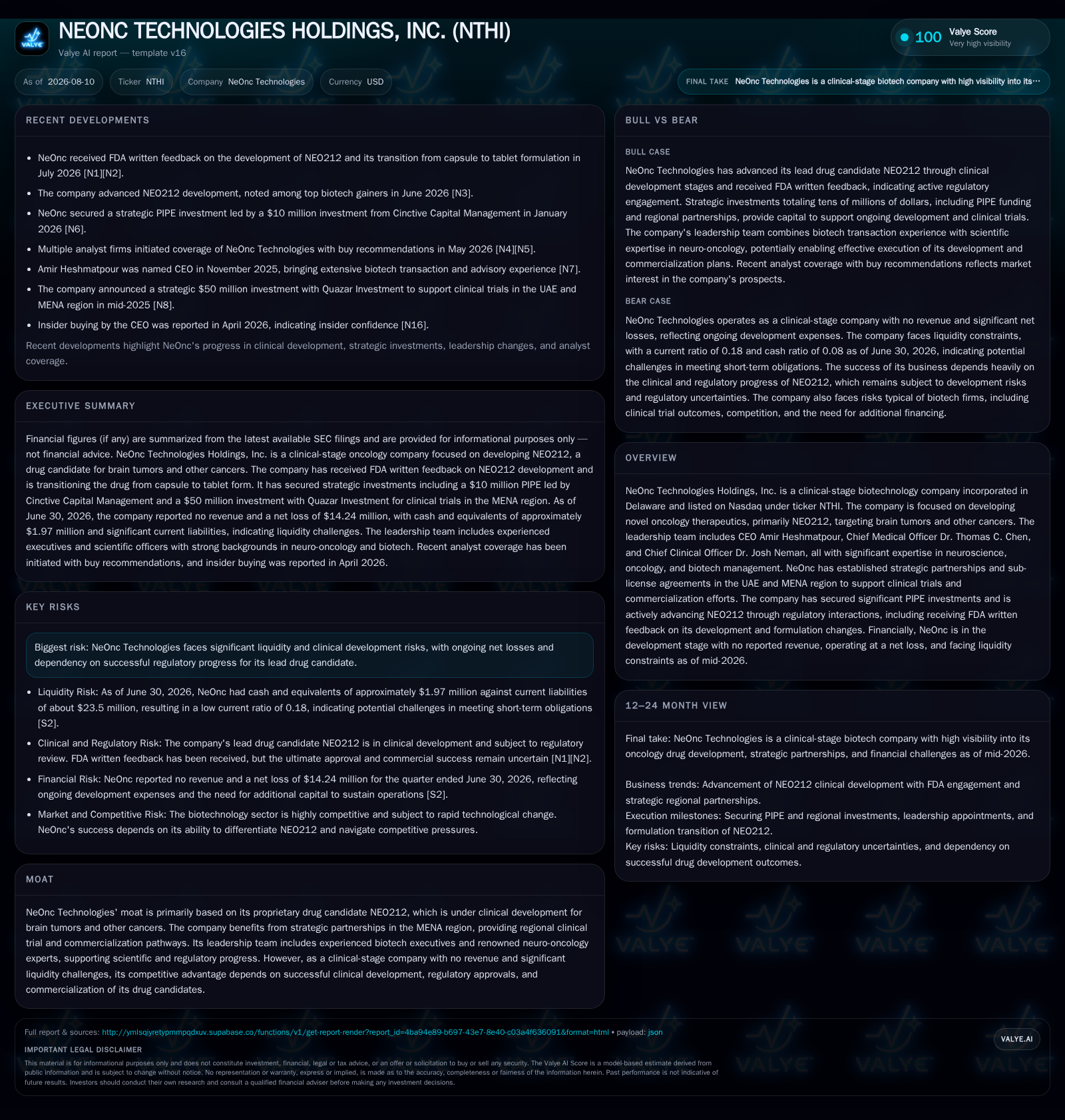
NeOnc Technologies Holdings, Inc. is a clinical-stage biotech company focused on oncology therapeutics, principally its lead candidate NEO212 targeting brain tumors. Recent FDA feedback on chemistry, manufacturing, and controls (CMC) for NEO212 marks a key regulatory milestone during the complex path to approval. The company’s financial position reveals constrained liquidity and a stretched current ratio, underscoring dependency on continued PIPE financings and partnerships for advancement. Strategic agreements in the MENA region provide regional trial and commercialization pathways, though successful clinical progression and regulatory clearance remain critical uncertainties governing NeOnc’s value creation trajectory.
Recent Operating Update: Regulatory Milestone Anchoring Development
NeOnc Technologies’ latest quarterly filing dated August 10, 2026 [S2] highlights the receipt of detailed written feedback from the U.S. Food and Drug Administration concerning the chemistry, manufacturing, and controls (CMC) aspects of its lead investigational drug NEO212 [S3][N1]. This temozolomide-perillyl alcohol conjugate represents their flagship oncology therapeutic candidate targeting brain tumors—a notoriously challenging indication with significant unmet medical need. CMC feedback typically shapes formulation stability requirements, manufacturing scale validation, and quality controls essential for phase progression under FDA scrutiny. Such correspondence indicates meaningful progress toward aligning product development with regulatory expectations but also underscores complexity in formulation transitions highlighted by the FDA’s capsule-to-tablet transition discussions [N1].
This regulatory exchange is a vital gating factor as NeOnc navigates from preclinical/early clinical stages toward pivotal trials that can demonstrate efficacy in humans. Positive regulatory interaction usually reduces uncertainty around clinical trial design acceptability and helps chart efficient pathways toward investigational new drug (IND) applications or phase escalations.
Business Model: Innovation Through Proprietary Oncology Therapeutics
NeOnc operates in the biotechnology subsector that centers on discovering, developing, and commercializing novel biologic or chemically composed drug candidates addressing critical diseases—in this case aggressive brain cancers [S1]. The company’s business model exhibits typical biotech archetypes: reliance on cutting-edge licensed intellectual property (IP), extensive clinical R&D investment cycles without current revenue generation, and monetization contingent on successful milestone attainment followed by potential licensing or direct product sales later.
Their principal asset is NEO212—derived through an exclusive license agreement with the University of Southern California (USC), which confers rights to patented technology involving monoterpene solvents like perillyl alcohol believed to enhance CNS penetration of chemotherapeutic agents [S1]. As part of this arrangement, NeOnc has issued stock-based payments to USC along with negotiated royalty commitments totaling 2% of net sales once commercialized—standard structuring that aligns IP value capture with future product success.
Revenue generation at this stage is expected to be nonexistent or nominal since no drug approvals or sales exist yet; primary value accrual depends on progressing product candidates through FDA-regulated clinical trials to generate data supporting marketing authorization or lucrative licensing agreements. The company also emphasizes strategic regional partnerships within the UAE and broader Middle East-North Africa (MENA) region aimed at facilitating localized clinical testing infrastructure and preparing channels for eventual market entry—a critical move given diverse market dynamics globally [S1]. These partnerships can accelerate patient enrollment rates—a pivotal KPI—and open pathways to milestone payments or upfront licensing revenue if properly structured.
Industry Structure and Competitive Positioning
NeOnc is positioned among clinical-stage biotechnology companies focused on oncology indications—a sector typified by protracted timelines, high R&D expense profiles, elevated regulatory hurdles, and significant attrition risk from both scientific setbacks and market competition. Peers like Karyopharm Therapeutics and Iovance Biotherapeutics provide benchmark context as they navigate similar clinical-development gauntlets with molecularly targeted cancer therapies.
Unlike fully commercialized pharmaceutical entities such as Bristol-Myers Squibb or Merck that yield revenues from mature oncology franchises while investing in new pipelines externally or internally, firms like NeOnc remain highly leveraged to early-phase trial outcomes. Contract research organizations (CROs) play crucial roles here too—for executing multi-center studies—but NeOnc's disclosed info does not specify CRO partners.
Strategically leveraging licensed proprietary technology based on conjugated monoterpenes provides theoretical differentiation by potentially enhancing blood-brain barrier penetration compared to competing chemotherapy agents. However, tangible competitive advantage hinges on demonstrating safety and superior efficacy in carefully designed clinical trials validated by regulators.
Growth Drivers
The primary growth levers for NeOnc lie in:
- Successfully advancing NEO212 through FDA-mandated development stages—demonstrated via regulatory milestones such as IND approvals, phase initiation/completion announcements, and positive interim/endpoint data releases.
- Expanding geographic reach via regional licensing deals allowing access to underserved markets where conventional treatments underperform or are limited.
- Securing additional capital injections through PIPE offerings or other mechanisms to extend operational runway sufficiently until value-inflection points materialize.
- Potential broadening of pipeline beyond NEO212 by leveraging platform technologies centered on perillyl alcohol derivatives targeting other oncology parameters.
Tracking KPIs like patient enrollment velocity, number of active trials across geographies, R&D spend versus burn rate effectiveness, frequency of positive regulatory interactions including breakthrough therapy designations would insightfully inform progression quality.
Risks and Watchpoints
NeOnc confronts typical but acute risks encountered by developmental biotechs:
- Clinical Trial Risk: Failures or delays can erode investor confidence sharply; brain tumor indications often involve complex patient populations complicating recruitment/retention.
- Regulatory Setbacks: FDA feedback demanding reformulations or additional data prolong timelines significantly; CMC uncertainties remain material despite recent communications.
- Liquidity Constraints: Cash terminal levels nearing $2 million against sizable current liabilities (
$23.5 million) produce a disconcertingly low current ratio (0.18), spotlighting funding sustainability issues absent timely capital raises or partnership milestone receipts [F1][S2]. - Intellectual Property Risks: Dependence on USC license terms alongside potential patent expiration timing may affect exclusivity horizon.
- Market Adoption Uncertainties: Even post-approval reimbursement challenges or competitive alternatives emergence could modulate ultimate commercial viability.
- Dilution from Capital Raisings: Multiple recent PIPE transactions dilute existing equity holders but are tactically needed to maintain developmental momentum [S19][S21].
Remaining vigilant on these factors alongside technology validation results will be paramount for interpretation of forward prospects.
What To Watch Next
Near-term milestones shaping NeOnc’s trajectory include:
- Continued iterative FDA dialogues refining CMC packages—achievement here facilitates transition from capsule to tablet formulations possibly improving administration compliance [N1].
- Enrollment progress markers in planned or ongoing phase studies involving NEO212; early efficacy/safety signals could substantially de-risk value proposition.
- Additional licensing agreements expanding Middle Eastern foothold or other international collaborations enhancing global reach.
- Quarterly updates detailing cash usage rates versus capital intake; any signs of refinancing challenges would warrant caution given existing liquidity metrics.
- Management commentary on forthcoming R&D priorities outlining pipeline breadth enhancements beyond core assets.
Collectively these offer actionable reference points aligned with biotech-sector KPI frameworks emphasizing development progression speed against funding adequacy.
Financial Profile Discussion
As of June 30, 2026, NeOnc reported approximately $1.97 million in cash and equivalents juxtaposed against total debt around $320 thousand—resulting in an apparent net cash position but overshadowed by current liabilities totaling about $23.5 million leading to a troubling current ratio near 0.18 [F1]. This metric evidences pronounced short-term liquidity strain reflective of high operating cash burn typical at this stage absent top-line inflows from product sales or licensing fees yet realized.
Operating losses persist significantly; full-year 2025 net income showed a substantial deficit exceeding $62 million largely driven by R&D expenses integral to advancing its experimental drug pipeline without offsetting revenues recorded except nominally [$39 thousand reported revenue attributable likely to minor license fees] [F1]. This profile reflects standard early-stage biotech economics where extensive investment precedes possible inflection events tied to clinical trial success or licensing monetization.
Capital strategy has centered on multiple PIPE financings completed through early-mid 2026 at fixed share price points ($7.20/share plus warrants exercisable at $9.00), raising requisite funds albeit diluting share base—underscoring both the urgent need for financing inflows but also confidence from private investors willing to participate under these terms [S19][S21]. Such placements must continue effectively locking adequate runway otherwise operational continuity faces jeopardy due to misaligned liability maturities versus liquid asset availability.
Overall financial positioning necessitates careful cash flow management supplemented heavily by ongoing successful equity raises coupled with milestone-driven infusion potential inherent within partnership agreements limiting overreliance solely on equity issuances over time.
Disclaimer: This analysis is prepared solely for informational purposes based on publicly available SEC filings, news reports, and industry knowledge as of August 10, 2026. It does not constitute investment advice nor endorse any securities discussed herein.
Disclaimer: This is research-only, informational analysis and not investment advice. It may include AI-generated interpretation and general industry context. Always verify important details using primary sources.

Comments