
Corpay Strengthens Corporate Payments Traction with Robust Global Digitization
Q2 results highlight accelerating transaction volume growth and technology modernization, reinforcing Corpay's competitive positioning amid regulatory and liquidity challenges.
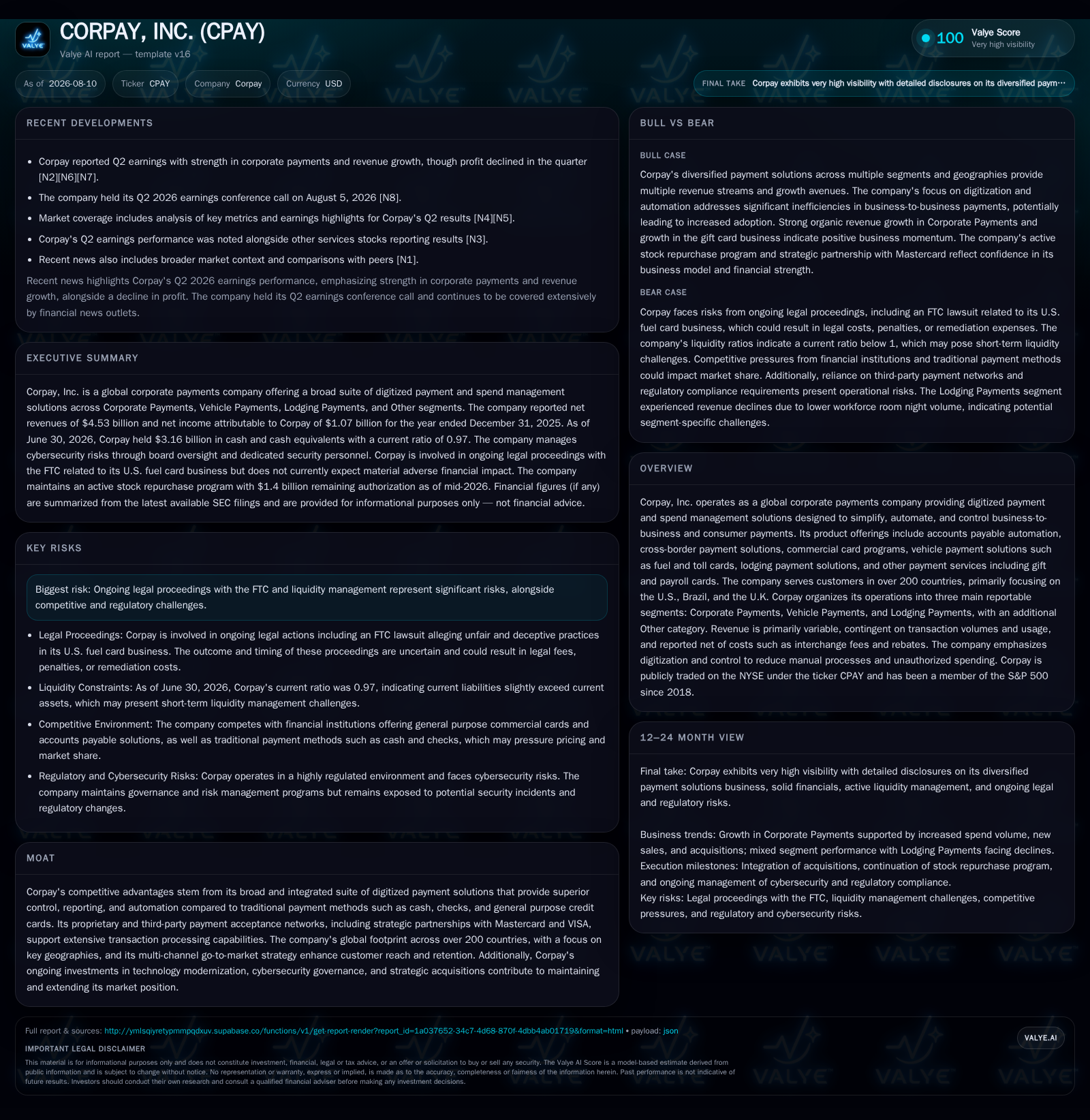
Corpay’s Q2 2026 operating results reveal marked growth in Corporate Payments transaction volumes, driving revenue beats in a business model heavily reliant on variable fees tied to usage intensity. The firm leverages a broad global footprint across payment segments—Corporate, Vehicle, Lodging—and strategic partnerships with Mastercard and VISA to enhance payment network reach. While ongoing FTC litigation and liquidity management represent persistent risks, Corpay’s focused technology modernization and spend management capabilities underpin solid execution. Key upcoming milestones include further client penetration and platform scalability metrics that will test sustainability of recent momentum.
Q2 Review: Corporate Payments Momentum Drives Transaction Volume Expansion
Corpay's second quarter of 2026 results showcase robust growth momentum predominantly driven by its Corporate Payments segment, where transaction volume surged substantially. This escalation translated into revenues that surpassed consensus estimates, reflecting the inherently variable nature of the company's revenue streams, which are tightly linked to client usage intensity rather than fixed fees [S2][N2][N6]. Such dynamics underscore the scalable potential of Corpay's transaction fee-based model, similar to that seen in larger global processors like FISV or Worldline. However, while volume uplift supports top-line acceleration, it also places margin performance under pressure as interchange fees and rebates absorb part of the revenue generated.
Expanding Reach via Integrated Payment Platforms Amid Variable Revenue Dynamics
Corpay operates an integrated portfolio consisting of Corporate Payments solutions—including accounts payable automation and cross-border payments—as well as specialized Vehicle Payments (fuel cards, toll programs) and Lodging Payments (hotel-related spending), supplemented by gift and payroll card services under an Other category [S1][F1]. This diversification provides resilience yet keeps revenue variability high due to dependence on transactional flows across segments. The company's revenue reporting net of interchange fees reflects industry-standard practices in payment processing but complicates direct margin comparability. Customer adoption benefits from bundled offerings that enhance stickiness by streamlining spend control and reporting across multiple expense categories.
Competitive Pressures and Advantage: Payment Network Partnerships and Automation Depth
A cornerstone of Corpay's moat resides in its extensive card acceptance network supported through strategic partnerships with global payment giants Mastercard and VISA [S1][S2]. These alliances enable broad merchant acceptance essential for seamless transaction processing worldwide. Governance structures involving an Information Technology and Security Committee provide board-level oversight on cybersecurity strategy and technology modernization initiatives—key in maintaining operational resilience against escalating cyber threats prevalent in fintech [S1]. Compared with peers such as Coupa (focused on spend automation) or commercial card issuers like American Express, Corpay demonstrates a hybrid model marrying platform depth with network breadth.
Growth Catalysts: Cross-Border Transactions and Spend Management Adoption Trends
International expansion is a significant vector for Corpay, supported by operations spanning over 200 countries—with core markets being the U.S., Brazil, and the U.K.—that leverage cross-border payment capabilities integrated within its corporate payment platforms [S1][S2]. Increasing globalization of supply chains elevates demand for frictionless foreign currency management and compliant transaction processing. Furthermore, rising market emphasis on spend visibility, control tools, and fully digitized payables workflows fuels adoption of Corpay's accounts payable automation products. KPIs such as cross-border transaction volume growth and customer retention serve as vital leading indicators for sustained expansion.
Regulatory Headwinds, Legal Risks, and Liquidity Management Challenges to Monitor
Notwithstanding operational progress, Corpay navigates ongoing legal challenges encapsulated by FTC litigation concerning advertising practices tied mainly to its North American fuel card business [S13][S14]. Although the company contests claims vigorously—citing favorable appellate developments—the associated legal costs and potential settlement consequences inject uncertainty into the financial outlook. Coupled with these are liquidity management complexities inherent in transaction-driven businesses requiring working capital buffers to fund settlement timing mismatches.
At quarter-end June 30, 2026, reported cash & equivalents stood near $3.16 billion juxtaposed against current liabilities exceeding $16.95 billion—resulting in a current ratio just below one (0.97) [F1]. Total debt remains sizeable at approximately $7.76 billion (as of late 2024), leaving net debt near $4.6 billion when offsetting cash holdings [F1]. The company maintains access to revolving credit lines alongside a securitization facility supporting receivables financing, positioning it cautiously but adequately against short-term obligations.
What to Watch: Upcoming Milestones in Customer Penetration and Platform Upgrades
Forward-looking execution will hinge on sustaining active corporate client growth rates validated through trailing bookings or net new clients. Monitoring payment authorization success rates alongside cross-border transactions will illuminate platform scalability under rising volumes [S2]. Technology modernization efforts overseen by dedicated IT governance frameworks should yield measurable uptime improvements essential for uninterrupted service delivery—an increasingly critical factor amid intensifying competition from both fintech disruptors and incumbent banks.
Additionally, resolution or advancements related to the FTC litigation could significantly influence risk perception and capital allocation strategies going forward [S14].
Financial Profile Discussion: Capital Structure Stability Amid Volume-Driven Revenue Growth
Corpay's balance sheet reflects a structured approach balancing liquidity needs with leverage parameters customary within fintech payment processors reliant on large working capital pools due to settlement flows [F1]. Approximately $3.16 billion held in cash reserves aids coverage of current liabilities (~$16.96 billion), yielding a current ratio close to parity but signaling tight working capital management at this scale [F1]. Total debt stood at about $7.76 billion as of September 2024, with net debt near $4.6 billion after accounting for cash holdings [F1]. The company maintains access to revolving credit lines alongside a securitization facility supporting receivables financing, positioning it cautiously but adequately against short-term obligations.
Debt maturities are staggered between revolving facilities expiring mid-2027 through term loans due as late as 2032 [S4][S21], affording room for refinancing or strategic capital maneuvers if necessary.
The credit agreement terms incorporate interest rates indexed largely to SOFR with modest margins reflective of investment-grade financing conditions [S15][S24].
This analysis synthesizes available public filings as of August 2026 to articulate Corpay’s evolving corporate payments business context within a complex regulatory environment. It highlights how transaction volume scaling alongside technology investments underpin competitive defenses while flagging key risk domains requiring continued monitoring.
Disclaimer: This article does not constitute investment advice or research views but aims to provide an informed analytical perspective based on publicly available data.
Disclaimer: This is research-only, informational analysis and not investment advice. It may include AI-generated interpretation and general industry context. Always verify important details using primary sources.

Comments