
MNTN Drives CTV Performance Marketing Growth Despite Customer Concentration Risks
Q2 results affirm traction in connected TV performance marketing, while risk from client concentration and competitive pressures remain central.
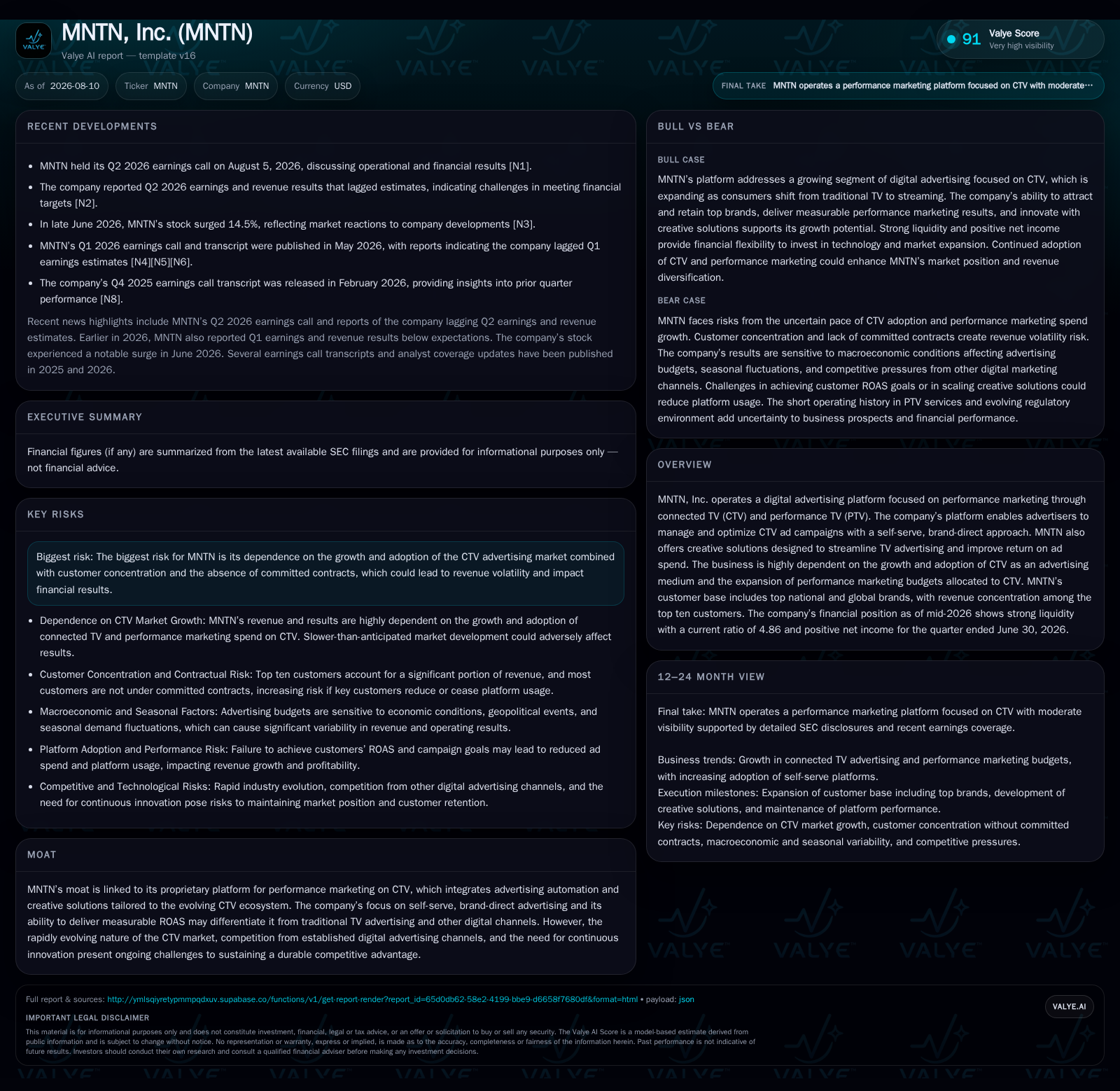
MNTN’s latest quarterly filing shows measurable growth in its connected TV (CTV) and performance TV (PTV) advertising platform, reflecting rising adoption of CTV as an addressable medium for performance marketing. The company leverages proprietary campaign automation and attribution technology to deliver targeted, self-serve advertising solutions primarily aimed at SMBs and enterprises. Despite solid liquidity and positive operational signals, MNTN continues to face revenue volatility risks due to concentration among its top customers and uncommitted contracts. Industry dynamics including competition from established DSPs and regulatory uncertainties also pose ongoing challenges.
Q2 Operating Update Validates Performance Marketing Traction Amid Market Dynamics
The operating update highlighted strong customer adoption supported by the platform’s ability to deliver measurable return on ad spend (ROAS). However, management also acknowledged persistent concentration risks: the top ten customers accounted for roughly 20% of revenue for the six months ended June 30, 2026. Furthermore, most contracts remain non-committed or short-term, amplifying sensitivity to budget shifts or client churn. This dynamic signals that while demand for CTV performance marketing is growing — helping MNTN scale campaigns — revenue quality remains vulnerable to fluctuations tied to a limited pool of large advertisers [S22], [S23].
Unpacking MNTN’s Self-Serve CTV Platform: Innovation Meeting Performance Demands
At its core, MNTN operates a software platform blending TV's expansive reach with direct response marketing's precision. The proprietary PTV technology empowers marketers — spanning small-mid businesses through global enterprises — to target audiences on large-screen formats using automated campaign optimization algorithms focused on ROAS goals. Central to this offering is "MNTN Matched" technology which attributes consumer actions to specific ad views across numerous OTT/CTV inventories, a key differentiator from traditional linear TV advertising lacking such granular measurement capabilities [S1].
Revenue mechanics hinge largely on fees derived from performance marketing budgets migrated from traditional channels into CTV/PTV campaigns run through MNTN’s platform. Advertisers pay based on managed spend volumes subject to pricing models driven by demand for addressable ad inventory and effectiveness in achieving targeted outcomes. Creative solutions offered by MNTN further streamline campaign execution by reducing friction associated with TV ad production—enabling swift iteration intended to enhance ROAS — thereby supporting customer retention and expansion tactics.
This self-serve model contrasts with conventional agency-led linear TV buys by offering brands immediate control over campaign parameters via an intuitive interface—a factor facilitating rapid SMB adoption alongside enterprise usage. Platform uptime reliability, scalability across increasing campaign volumes, audience targeting precision, and continuous attribution accuracy are fundamental operational KPIs underpinning long-term value creation.
CTV Ecosystem Growth Shapes Competitive Landscape and Customer Behavior
MNTN’s market sits at the nexus of longstanding brand-driven linear TV dollars shifting rapidly toward addressable digital channels and programmatic automation. Large-scale players like The Trade Desk offer broad demand-side platform (DSP) capabilities including extensive programmatic access into supply-side partners such as Magnite or PubMatic. Similarly, Roku Advertising integrates proprietary CTV content networks with advanced audience segmentation tools—a dual threat combining inventory control with DSP features.
Compared to these peers, MNTN focuses heavily on performance-based outcomes leveraging attribution strengths absent from many generalist DSPs or linear broadcasters transitioning digitally. This specialization caters well to advertisers seeking direct sales lift over brand awareness alone but limits scale since many large advertisers maintain hybrid strategies blending brand + performance objectives across multiple platforms.
Consumer viewing behavior increasingly favors streaming AVOD services that expand available ad impressions but introduce complexity around fill rates due to fragmented supply sources. As such, maintaining robust ad inventory fill rates while delivering consistent targeting accuracy challenges all participants including MNTN—impacting pricing power and margin sustainability.
Growth Catalysts: Expansion of CTV Adoption, AVOD, and Programmatic Automation
Growth prospects stem strongly from secular trends reshaping media consumption. Accelerating cord-cutting diminishes legacy linear subscriptions driving migration toward streaming platforms accessible via CTV devices. AVOD services’ rise further opens up premium content environments monetized by ads instead of subscription fees—boosting total addressable market for digital TV advertising.
Higher broadband penetration facilitates smoother streaming experiences broadening user bases geographically. Simultaneously, improvements in advertising automation software bolster campaign efficiency by optimizing spend allocation dynamically against performance targets ensuring escalating advertiser ROI satisfaction.
Consequently, advertisers increasingly integrate CTV-focused campaigns managed via platforms like MNTN alongside search and social channels within holistic performance marketing budgets—reallocating funds away from less measurable media types incrementally.
Addressing Risks: Customer Concentration, Competitive Pressures, and Budget Sensitivities
Despite promising operational momentum, risks loom materially around concentrated revenue streams—with no individual client exceeding 10% revenue threshold but collectively top ten representing a meaningful portion of sales without binding long-term contracts—this leaves financials exposed to discretionary cuts or strategic shifts among marquee clients causing outsized volatility effects [S22]
Competitive threats arrive from entrenched DSP incumbents scaling their CTV offerings faster than niche platforms due to larger balance sheets or integration into broader ecosystems benefiting advertisers seeking one-stop solutions. Big-tech players wield dominant data assets raising barriers for mid-tier competitors such as MNTN unless continuous innovation keeps pace.
External factors including macroeconomic tightening could pressure overall marketing budgets causing advertisers to pull back selectively on experimental channels like CTV PTV despite longer term promise. Ongoing regulatory developments around data privacy laws (e.g., GDPR-like regimes), AI algorithm transparency requirements impacting attribution modeling validity also add compliance costs potentially eroding margin profiles if not managed proactively [S20], [S24], [S25].
Forward Indicators: Key Metrics to Watch in Platform Adoption and Revenue Diversification
Monitoring active advertiser growth will be paramount in judging whether the platform expands beyond initial SMB focus successfully capturing enterprise spends post-validation phases. Likewise, tracking average ROAS upward movement per campaign reflects improved algorithmic efficiency or better creative integration enhancing advertiser economics.
Revenue concentration metrics warrant close attention; diversification across sector verticals or geographies would reduce reliance on handful of large accounts thereby smoothing income streams against fluctuating client decisions typical in digital advertising markets.
Creative offering penetration rates serve as bellwethers for product stickiness since their uptake indicates reduced friction for customers managing frequent campaign refresh cycles—a factor boosting lifetime value.
Incremental indicators like platform uptime metrics ensuring stable user experience amid scaling load also influence reputation impacts critical in highly competitive ecosystems.
Financial Profile Discussion: Strong Liquidity Supports Scale Amid Execution Challenges
MNTN enters H2 2026 with robust financial health underscored by a current ratio approximating 4.86 as of June fiscal period-end indicating significant short-term asset coverage over liabilities supporting operational flexibility amidst market uncertainties [F1]. Cash holdings near $237 million combined with a negligible debt position affords ample runway for continued investment in product development or targeted go-to-market initiatives.
In summary, MNTN’s balance sheet strength underpins capacity to innovate yet reinforces imperatives around accelerating diversified revenue expansion while navigating intensifying competition within the rapidly evolving connected TV advertising ecosystem.
Disclaimer: This analysis is provided solely for informational purposes based on publicly available filings and does not constitute investment advice or research views.
Disclaimer: This is research-only, informational analysis and not investment advice. It may include AI-generated interpretation and general industry context. Always verify important details using primary sources.

Comments