
BancFirst Strengthens Regional Banking with Stable Margins and Diversified Financial Services
BancFirst's latest quarterly report illustrates resilience amid interest rate shifts, leveraging a diversified product mix to navigate liquidity and regulatory challenges.
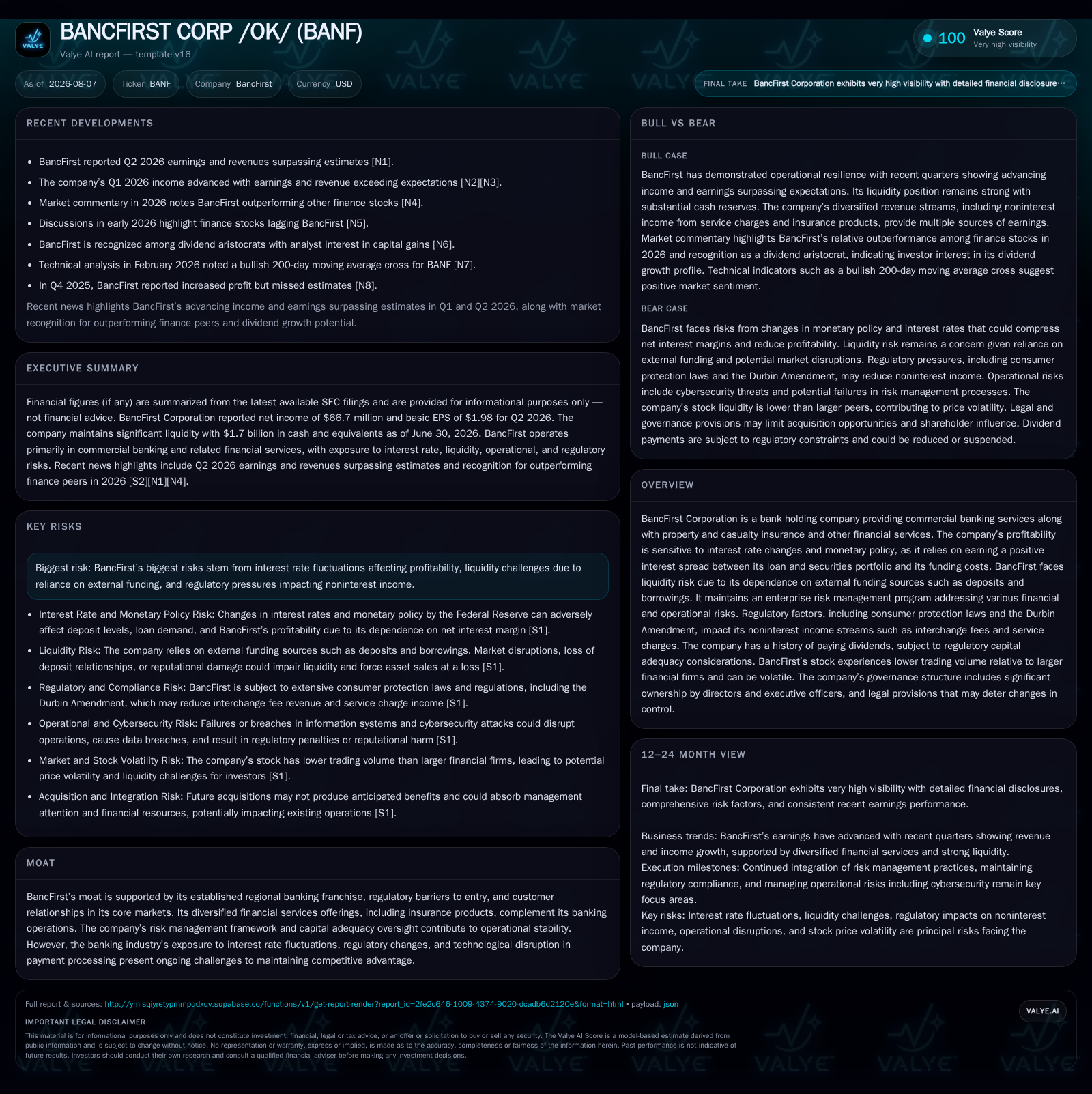
In its Q2 2026 filing, BancFirst Corporation reported continued net interest margin stability supported by favorable loan and deposit growth in its Oklahoma-centric markets. The company’s revenue model combines traditional commercial banking with complementary property and casualty insurance products, cushioning margin pressure from regulatory constraints such as the Durbin Amendment. BancFirst faces typical regional bank risks including interest rate sensitivity, liquidity management, and evolving regulatory frameworks. The firm's established regional franchise and prudent enterprise risk management underpin operational stability while positioning it for measured growth through cross-selling and market expansion initiatives.
Latest Quarterly Performance Highlights
BancFirst Corporation’s Q2 2026 filing confirms steady financial performance underpinning its role as a leading regional bank in Oklahoma. According to the latest Form 10-Q dated August 7, 2026, the company maintains a stable net interest margin (NIM), reflecting an ability to earn a positive spread between yields on loans and securities versus deposit and borrowing costs despite prevailing monetary policy uncertainties [S2][N1]. BancFirst’s revenues surpassed analyst estimates for the quarter, driven primarily by healthy growth in its commercial lending portfolio and sustained deposit inflows within its core regional markets. This outcome suggests that fundamental demand drivers such as local economic activity and credit appetite remain intact.
In addition to traditional lending activities, BancFirst continues leveraging its property and casualty insurance operations as an ancillary source of noninterest income [S2][S1]. This diversification partially offsets pressures on fee-based revenues stemming from evolving regulatory landscapes such as the Durbin Amendment's impact on interchange fees. The company reported no material changes in risk factors compared to prior disclosures in its annual report, indicating consistent risk management practices addressing credit exposure, liquidity needs, and compliance obligations
Business Model Specifics: Diverse Revenue Streams Anchored in Regional Franchise
BancFirst operates as a bank holding company primarily serving commercial clients alongside retail customers within Oklahoma. Its core revenue engine is net interest income generated through commercial loans priced at spreads above funding costs derived mainly from deposits supplemented by borrowings. This business archetype reflects the classic regional bank profile where NIM is both a sensitive indicator of profitability and a barometer for monetary policy impact.
Crucially, BancFirst extends its value proposition beyond lending by bundling property and casualty insurance products through subsidiaries. These offerings produce commission-based fees augmenting overall noninterest income [S1]. Fee components also include interchange fees from debit card transactions; however, these are susceptible to regulatory capping under the Dodd-Frank Act's Durbin Amendment provisions. The company benefits from localized customer relationships enabling effective cross-selling between banking and insurance services.
Revenue growth dynamics derive from increasing loan volumes—supported by robust demand among small-to-medium enterprises—and expanding deposit bases that fund loan originations. BancFirst carefully manages the loan-to-deposit ratio to maintain liquidity balance while optimizing asset yields. Cost efficiency hinges on controlling operating expenses relative to revenue generation as quantified by the efficiency ratio metric.
Industry Context: Regional Banking Networks Under Regulatory and Market Pressure
In the highly regulated American banking landscape, regional banks like BancFirst face multi-dimensional challenges. Interest rate risk is paramount; fluctuations driven by Federal Reserve open market operations and discount rate adjustments influence margins directly since lending yields and deposit/funding costs do not always move synchronously.[S1] Given that BancFirst cannot fully control these macroeconomic variables, maintaining NIM stability requires deft asset-liability management.
Liquidity risk arises because regional banks transform short-term deposits into longer-term loans—a maturity mismatch vulnerable during depositor withdrawals or market disruptions [S1]. BancFirst relies largely on stable local deposit relationships but must remain vigilant against adverse sentiment or credit-rating downgrades that could restrict access to external borrowing sources.
Regulatory constraints further influence noninterest income patterns. The Durbin Amendment caps debit interchange fees for banks over $10 billion in assets—a category into which BancFirst narrowly qualifies or nears based on scale comparisons—potentially compressing fee-based revenues.[S1] Proposed adjustments reducing cap rates could further affect revenue unless mitigated by increased transaction volumes or new fee structures.
Competition includes larger national banks with broader product suites but less localized engagement, community banks cultivating niche customer bases, credit unions focusing on member loyalty incentives, and fintech companies disrupting payment processing channels directly impacting card transactions.
Growth Drivers: Organic Expansion Supported by Insurance Cross-Selling
BancFirst’s primary growth trajectory centers on organic loan portfolio expansion fueled by economic vitality in Oklahoma’s commercial sector. Continued deposit growth underpins funding stability essential for sustaining this expansion without incurring excessive liquidity risk.[S2] Increasing NIM via rising interest rates also bolsters profitability metrics when appropriately managed.
Cross-selling insurance offerings enhances customer value propositions while providing diversification away from cyclically sensitive interest income streams.[S1] BancFirst’s established brand recognition within its geographic footprint strengthens client retention rates allowing deeper wallet share capture.
Strategically, selective acquisitions augment geographic reach or product breadth but introduce integration complexity risks acknowledged in filings.[S3] Technology investments aimed at improving digital delivery channels aim to enhance customer acquisition cost efficiency amid mounting fintech competition.
Risks and Watchpoints: Interest Rate Exposure and Regulatory Uncertainty Remain Key Challenges
BancFirst openly discloses key risks including:
- Interest Rate Fluctuations: Changes affecting lending yields or deposit/funding costs can compress NIM if spread narrows persistently.[S1]
- Liquidity Risk: Reliance on deposits complemented by borrowings leaves vulnerability to sudden funding disruptions.[S1]
- Credit Risk: Economic downturns localized to regional portfolios may elevate nonperforming assets requiring higher loan loss provisions.[S1]
- Regulatory Impact: Pending Federal Reserve proposals could reduce interchange fee ceilings further negatively impacting noninterest income streams.[S1]
- Acquisition Integration Risk: Future expansions carry operational execution uncertainties potentially diverting management focus or straining capital resources.[S3]
Emerging cybersecurity threats also pose operational risks given reliance on complex IT infrastructure managing customer information systems.[S1]
What To Watch Next
Key forthcoming operational markers include monitoring quarterly loan-to-deposit ratios signaling liquidity health alongside sequential NIM variations reflective of monetary policy impacts.[S2] Depository trends—growth rates or concentration shifts—serve as proxies for funding stability critical in regional bank cash flow models.
Regulatory developments surrounding debit interchange fee adjustments warrant close attention since realized impacts remain speculative pending final rulings.[S1] Additionally, observing expense control measures reflected by efficiency ratios will indicate balancing between growth investments (e.g., technology) versus operational discipline.[N1]
Updates on acquisition activity or integration milestones disclosed through event filings would shed light on corporate strategic priorities affecting medium-term earnings trajectories.[S3]
Financial Profile Discussion
These financial contours supplement operational insights suggesting that BancFirst maintains robust capital adequacy favorable for dividend distributions while provisioning for credit losses prudently adjusting against cyclical risks.[S1][S2] Monitoring quarterly results will clarify whether recent monetary tightening supports continued net interest margin expansion without compromising credit quality or forcing deleveraging actions.
This analysis integrates the latest public disclosures up to August 2026 without speculative forecasting beyond documented evidence. It emphasizes how BancFirst navigates common industry challenges with a differentiated mix of banking services while keeping a strong foothold in its core regional markets supported by comprehensive risk management frameworks.
Disclaimer: This is research-only, informational analysis and not investment advice. It may include AI-generated interpretation and general industry context. Always verify important details using primary sources.

Comments