
Gencor Industries Battles Inflation and Tariffs While Managing Robust Backlog
Q3 2026 update reveals operational pressures amid strong order backlog and solid liquidity.
Gencor Industries Inc, a U.S. manufacturer of highway construction equipment, reported Q3 2026 results showing solid net income and a strong liquidity position despite headwinds from inflation and ongoing tariffs impacting supply chains. The company faces challenges passing increased costs to customers, which could pressure future margins and cash flow. Gencor's record backlog indicates sustained demand, but operational risks including geopolitical tensions and economic uncertainty remain key constraints. The company’s business is cyclical with seasonally concentrated order intake and depends on efficient project execution and supply chain resilience.
Recent Operating Update
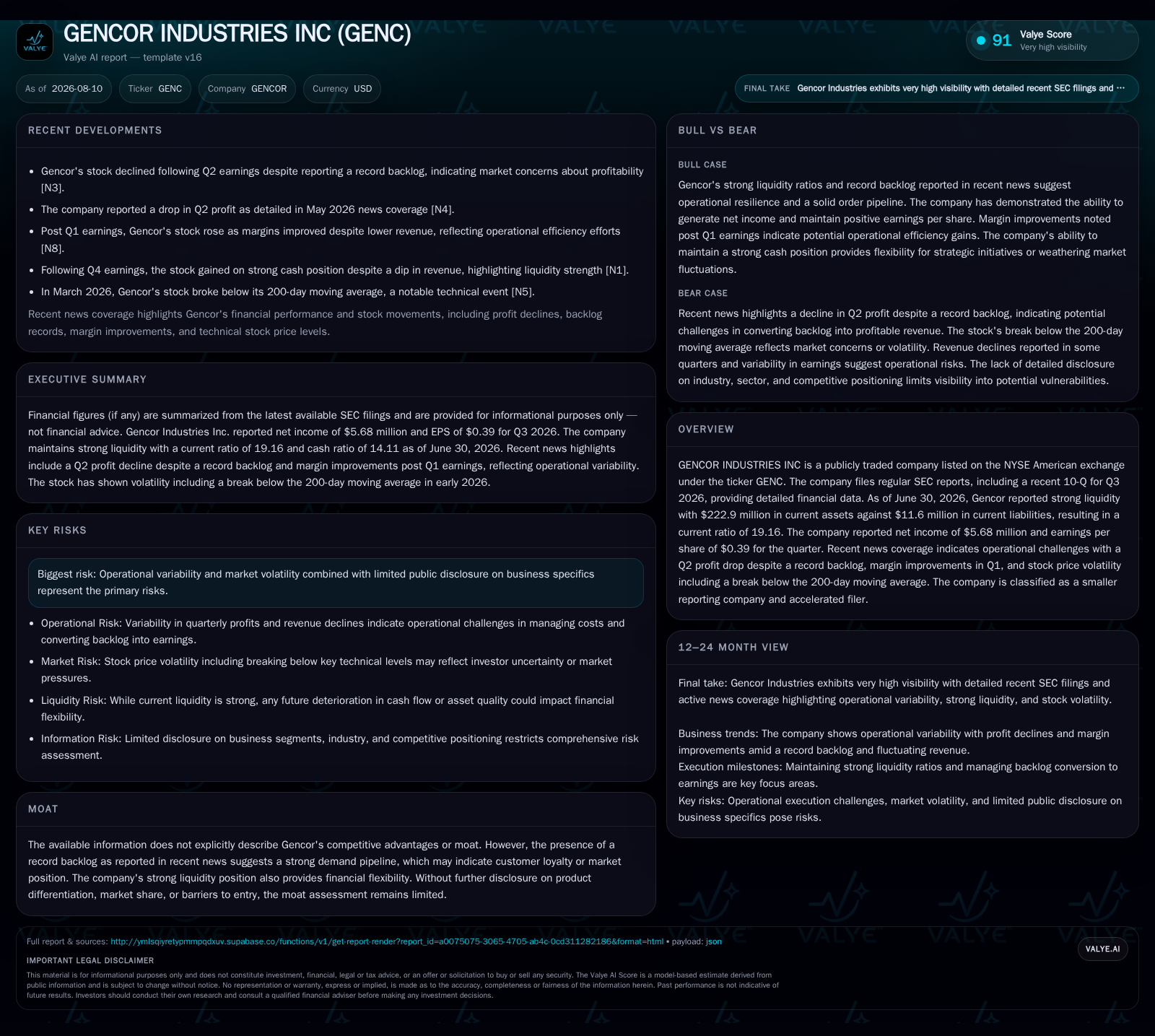
Gencor Industries' latest quarterly filing for Q3 ended June 30, 2026, presents a nuanced operating environment marked by both strong financial health and significant external pressures [S2]. The company reported net income of approximately $5.68 million and earnings per share of $0.39 during the quarter, continuing its capability for profitable operations amid macroeconomic uncertainty [F1]. Notably, Gencor maintains an exceptionally healthy liquidity profile with $222.9 million in current assets against only $11.6 million in current liabilities, producing a current ratio exceeding 19x — a rare buffer that provides substantial flexibility to manage supply chain shocks or unforeseen operational disruptions [F1].
However, the company flags major challenges originating from inflationary trends and tariffs enacted by the U.S. government on parts sourced from or sales made to certain countries [S2]. While Gencor manufactures domestically at three U.S. locations, its exposure extends through imported components vulnerable to these tariffs, introducing complexity in cost recovery strategies. The company acknowledges that failure to fully pass on increased input costs to customers could materially impact revenue growth trajectories, cash flow generation, and overall financial position [S2]. This tension between rising input costs and customer price tolerance highlights a critical margin conversion risk.
Business Model Specifics
Gencor operates exclusively within the heavy machinery manufacturing segment dedicated to the highway construction industry [S10]. Its core product lines encompass hot mix asphalt plants, asphalt pavers, combustion systems for industrial heating applications, and fluid heat transfer systems mainly serving environmental control and petrochemical markets [S10]. This focused product portfolio positions Gencor as a specialized provider rather than a broad industrial conglomerate.
The business model centers on designing and producing capital-intensive equipment sold primarily via direct orders rather than through dealers or distributors. Revenue streams derive largely from new equipment sales supplemented by aftermarket parts and service revenues which help stabilize cash flows across seasonal volatilities inherent to construction cycles [S10]. Because downstream customers taper new purchases during summer/fall periods to avoid disrupting their peak construction seasons, Gencor experiences significant order cadence swings with most demand concentrated in the October through February timeframe [S12]. This cyclical pattern demands agile capacity utilization planning and inventory management to reconcile production schedules with fluctuating order intake.
Industry Structure and Competitive Position
Within the industrial equipment manufacturing space focused on highway infrastructure support, Gencor is relatively smaller compared with heavyweights like Caterpillar or Deere & Company but serves a critical niche in asphalt plant technology and related combustion solutions. The value chain positions Gencor as a domestic assembler sourcing raw materials and components—some subject to tariff regimes—which it integrates into technologically engineered equipment tailored for robust industrial applications.
The single reporting segment approach used internally reflects a strategic focus aiming at consolidating managerial oversight on profitability while locking resource allocation toward enhancing product engineering quality and service excellence [S10]. However, this singular focus exposes the company more directly to industry cyclicality driven by public infrastructure spending patterns rather than providing diversification buffers seen in peers with broader geographic or product footprints.
Growth Drivers
Despite economic uncertainties outlined by management—including geopolitics fueling inflationary pressures—the company's record backlog reported in recent news coverage points towards resilient demand momentum [N1], [N2]. This backlog serves as an important forward-looking KPI indicating near-term revenue visibility provided project execution proceeds as planned.
Further growth opportunities may arise from ongoing investments in product innovation aimed at enhancing equipment efficiency or environmental compliance features—a growing end-market priority. Expansion into adjacent petrochemical sectors via combustion system offerings also diversifies customer exposure beyond traditional highway contractors [S10]. In addition, incremental penetration of aftermarket parts sales offers margin enhancement potential given higher profitability of services relative to new machinery sales.
Government infrastructure bills supporting highway rebuilding efforts could provide structural tailwinds fostering capacity utilization improvements across the sector while favorable trade policy developments or tariff rollbacks would alleviate current cost headwinds.
Risks and Constraints
Gencor faces several material risks typical for capital-intensive industrial manufacturers but amplified by its scale and operational profile. First is the uncertain impact of tariffs not only on cost structures but also timing of reimbursements following recent U.S. Supreme Court rulings concerning International Emergency Economic Powers Act (IEEPA) tariffs refunds — recovery amounts remain unpredictable [S17].
Supply chain disruptions remain a continuous vulnerability; delays or shortages in key parts can extend production lead times adversely impacting delivery timing—a critical customer KPI driving repeat business in this sector. Inflation-driven wage increases along with rising commodity prices challenge margin preservation especially if competitive dynamics constrain pricing power.
Seasonality concentrates risk over narrower windows; failure to ramp production efficiently in peak order periods may deteriorate capacity utilization rates leading to cost overruns or quality escapes risking customer satisfaction.
Additionally, concentration of sales predominantly within North America limits geographic diversification benefits exposing Gencor more heavily to regional economic downturns or regulatory shifts impacting infrastructure budgets.
Management transitions—exemplified by the recent CFO retirement—add another layer of potential disruption although interim leadership appointments aim for continuity [S17]. Lastly, temporary delisting risks surfaced mid-2026 due to earlier delayed filings but have since been addressed through timely compliance efforts minimizing near-term regulatory uncertainties [S3].
What to Watch Next
Key milestones will include monitoring quarterly backlog updates which will shed light on durability of order intake amidst inflationary pressures. Observing gross margin trends will be critical to assess ability to recover increased input costs through pricing or productivity gains.
Supply chain resilience initiatives such as alternative sourcing strategies or inventory buffers will serve as practical execution indicators mitigating production bottlenecks.
The resolution status surrounding tariff refunds under IEEPA could materially influence working capital dynamics and net cost structures.
Further leadership stability through recruitment of permanent CFO will be relevant for financial stewardship confidence.
Finally, tracking geographic revenue mix shifts or new aftermarket service contracts can provide clues about diversification progress or incremental profit base expansion.
Financial Profile Discussion
As of June 30, 2026, Gencor reported zero debt outstanding—a rare strength given the capital-intensive nature of its industry—and $26.3 million in cash equivalents safeguarding against liquidity shocks [F1]. The exceptionally high current ratio of 19.16 underscores conservative working capital management though could also signal investment into inventories or receivables linked with backlog execution plans [F1].
Net income remains positive at $5.68 million for Q3 with historic operating income levels around $14 million suggesting stable core profitability alongside ongoing reinvestment cycles [F1]. Capital expenditures are moderate relative to cash flows generated reflecting cautious capacity expansion aligned with order visibility.
Overall financial health appears robust enabling the company to navigate macroeconomic volatility without immediate refinancing concerns while investing selectively in growth-enhancing projects.
This analysis is based purely on publicly available filings without direct investment research view intention. Readers should evaluate additional sources for comprehensive decision making.
Disclaimer: This is research-only, informational analysis and not investment advice. It may include AI-generated interpretation and general industry context. Always verify important details using primary sources.

Comments