
Zhanling International's Prolonged Dormancy Highlights Transition Challenges in Industrial Hardware Sector
A Nevada-incorporated company since 2009, Zhanling International Ltd remains non-operational with significant liquidity constraints and regulatory uncertainties.
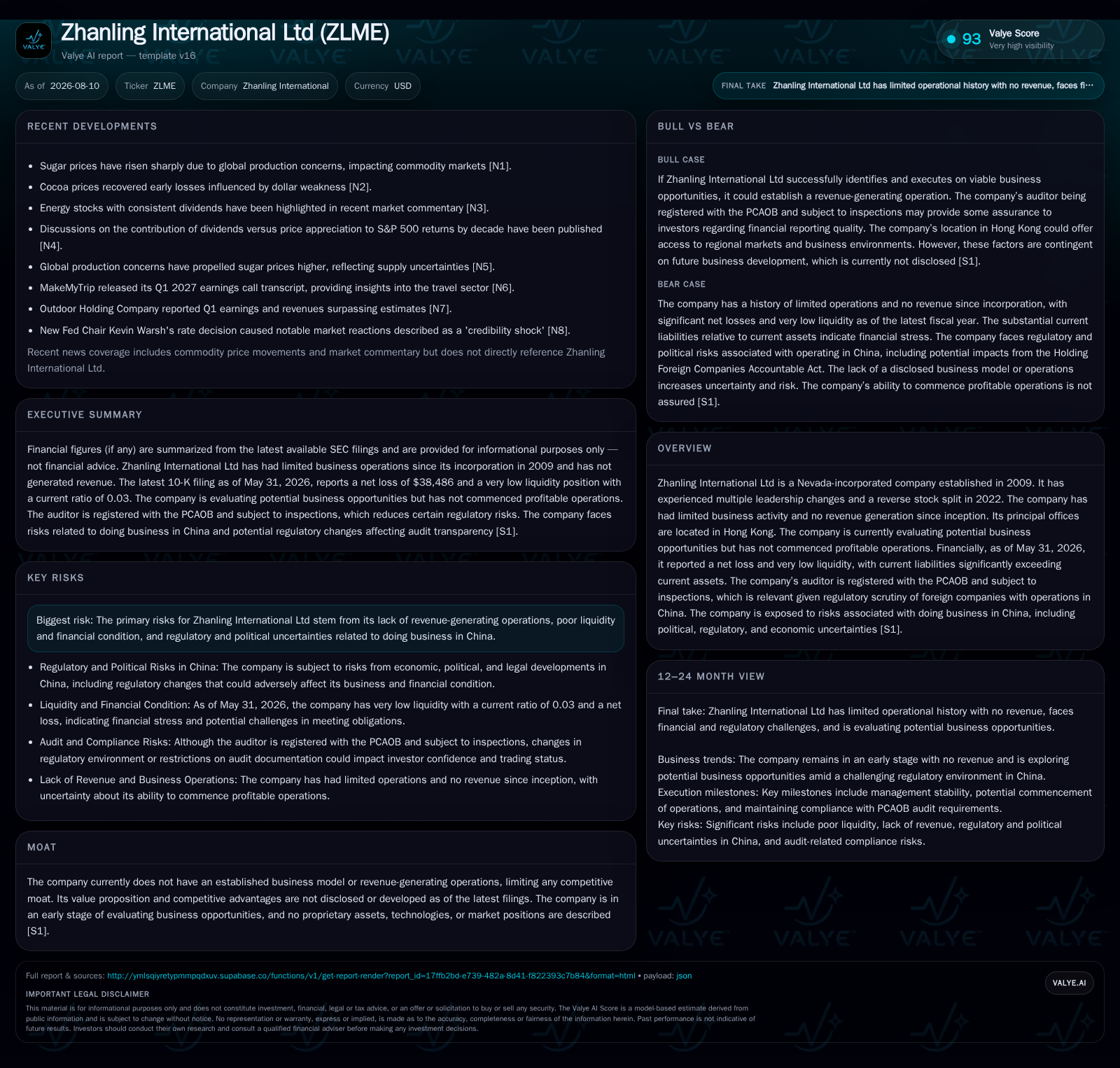
Zhanling International Ltd continues to report no revenues or active business operations as of its latest filings through May 2026, maintaining a precarious financial profile marked by negligible current assets against substantial liabilities. Despite leadership changes and a reverse stock split aimed at restructuring, the company remains mired in exploration without concrete business initiatives. Operating within the industrial hardware sector nominally, Zhanling faces typical industry hurdles including high capital expenditure needs, competitive acquisition landscapes, and increased U.S.-China regulatory scrutiny — all exacerbated by its limited resources and lack of operational scale.
Recent Operating Update: Continuing Dormancy Amid Structural Constraints
Zhanling International Ltd’s April 2026 quarterly filing confirms ongoing absence of active business operations or revenue generation since its incorporation in 2009 [S2],[S5]. The latest reported operating income stands at a negative $38,486 matched by an equal net loss, underscoring zero progress toward profitability or scale [F1]. With current assets of only $183 against liabilities exceeding $6,322, the firm’s current ratio plummets to an alarming 0.03—a level consistent with near insolvency absent an immediate capital infusion or business combination [F1]. This persistence of minimal operating activity despite over a decade of existence signals material challenges in transitioning from an exploratory status.
The quarter also reflects no new disclosures signaling secured contracts or concrete advancement on strategic frontiers. Management continues to hold limited full-time commitment to company affairs due to resource constraints and competing personal obligations [S26]. This pattern corroborates a profile typical for early-stage entities unable to scale production volume or establish manufacturing capacity critical within the industrial hardware ecosystem.
Business Model: Exploratory with Undefined Revenue Mechanics
Zhanling is yet to define or execute on any operational business model beyond seeking a prospective acquisition or merger candidate to catalyze growth [S1]. It does not currently engage in designing, manufacturing, or selling any tangible industrial hardware products. As such, traditional industrial hardware revenue drivers—product sales to OEMs or end-users, after-sales services with associated maintenance contracts—do not apply.
This absence leaves the company dependent entirely on management’s ability to identify a profitable target business for combination. The firm’s stated intent covers general geographical focus on China but remains industry-agnostic formally without disclosed product strategies or customer engagement frameworks [S18]. Thus, value-chain positioning remains undefined as Zhanling has neither sourcing nor manufacturing activities underway nor channel partnerships.
The company’s reverse stock split completed in March 2022 reduced issued shares from 3.66 million to about 73,200 shares in an effort likely aimed at market stabilization rather than operational improvement; it leaves liquidity challenges essentially unaddressed [S5]
Industry Structure and Competitive Position
Within the broadly classified industrial hardware sector where companies typically manufacture machinery, tools, or equipment serving construction, manufacturing, or automation applications, Zhanling's absence of tangible operations places it outside competitive peer set relevance. Established players such as Caterpillar and Honeywell possess entrenched manufacturing capacity characterized by high capital expenditures and robust supply chain management able to meet cyclical demand with scalable production volume.
Industrial hardware firms differentiate on reliability, innovation cycles spanning product lifecycle management, aftermarket service portfolios providing recurring revenue streams through maintenance contracts, and capacity utilization metrics indicating demand strength [S26]. None of these structural attributes currently apply to Zhanling whose asset base is undeveloped while facing stiff competition for viable acquisition targets from better-resourced players (venture funds, operating businesses) pursuing similar objectives
Additionally, U.S.-listed firms with China-based operations encounter rising regulatory scrutiny tied to auditor inspection compliance under the Holding Foreign Companies Accountable Act (HFCAA), risk of trading prohibitions if audit transparency thresholds are unmet for consecutive years, and complex geopolitical dynamics affecting supply chains and investment flow [S1],[S24]. These factors accentuate risks inherent to establishing competitive footing particularly for financially fragile entities such as Zhanling.
Growth Drivers: Contingent on Business Combination Execution
Absent internal operations or product development pipelines, growth trajectories hinge on successful identification and consummation of business combinations that could provide immediate access to revenue-generating assets or operational platforms. Potential drivers post-combination include ramping manufacturing capacity aligned with order backlogs reflective of industrial production cycles; leveraging after-sales service contracts for steady cash flow; exploiting governmental infrastructure investment trends; and possibly integrating technological innovation such as automation solutions.
However, these remain speculative given no disclosed target engagements have crystalized into transactions since the initial letter of intent for AARC acquisition was terminated in late 2021 without closure [S3],[S4]. Performance benchmarks critical in this sector—including inventory turnover ratios indicating supply chain efficiency or gross margin improvements via quality control—are not attainable until commercial-scale operations commence.
Risks and Growth Constraints: Severe Liquidity and Regulatory Hurdles
Zhanling’s prolonged inability to progress beyond exploratory status magnifies typical burdens faced by early-stage industrial hardware firms. Liquidity constraints evidenced by a current ratio near zero limit expenditures necessary for capital-intensive requirements such as expanding manufacturing capacity or developing quality assurance processes [F1]. Concurrently, competition for attractive acquisition targets intensifies as better-capitalized entities pursue deals aggressively reducing available opportunities compatible with Zhanling’s financial bandwidth [S26].
Overlaying these operational difficulties are extensive risks related to doing business involving China-based subsidiaries: political volatility can swiftly alter economic environments; rapid policy shifts impose compliance burdens; cybersecurity regulations introduce listing obstacles abroad; audit inspections face restrictions complicating regulatory adherence under HFCAA frameworks — raising chances of U.S. market delisting which would severely impact shareholder value and fundraising ability [S1],[S24].
Governance instability marked by frequent executive resignations through recent years further complicates strategic continuity and investor confidence building efforts [S4],[S9],[S26]. The company also discloses minimal dedicated manpower devoted full-time pre-business combination which restricts organizational capacity required for navigating complex integration challenges associated with acquisitions [S26],[S27].
What To Watch Next: Milestones Dependent on Transaction Closure
Key upcoming markers include announcements around new target business identifications or executed mergers/acquisitions encompassing due diligence completions and shareholder approvals which could materially alter operational scope. Additionally, renewed disclosures addressing plans to bolster liquidity through equity raises or strategic partnerships would inform financial viability prospects.
Tracking PCAOB inspection outcomes relevant to the company's auditors will be critical given their direct impact on trading eligibility under HFCAA provisions. Equally important will be any shifts in U.S.-China political relations influencing cross-border investment climates affecting foreign-incorporated companies' listings.
Absent such developments within forthcoming quarters continuing patterns are likely: sustained non-revenue reporting coupled with deteriorating liquidity metrics unless managed funding injections occur alongside resolved strategic direction establishment.
Financial Profile Discussion
As of May 31, 2026, Zhanling International holds current assets totaling merely $183 against current liabilities approximating $6,322 resulting in an extremely low current ratio of roughly 0.03 highlighting acute short-term solvency issues [F1]. The operating income recorded was negative $38,486—consistent with net losses reflecting costs incurred primarily from administrative functions rather than productive activities [F1].
Without identified revenue streams or capital expenditures directed towards building manufacturing scale typical in the industrial hardware segment (which usually requires multi-million-dollar investment cycles), free cash flow generation remains unattainable. These conditions anchor the company's reliance on shareholder support or capital markets access that may be compromised due to the opaque regulatory environment impacting Chinese-associated issuers listed in the United States.
In summary, Zhanling's financial snapshot reveals survival contingent on external financing events tightly coupled with its ability to secure credible operational platforms able to deliver traditional industrial hardware KPIs such as sales growth acceleration and margin improvement through scaled production capabilities.
This analysis is based strictly on publicly available SEC filings through August 2026 and acknowledged industry context. It does not constitute investment advice but provides an informed examination of Zhanling International Ltd's structural position amid broader sector dynamics.
Disclaimer: This is research-only, informational analysis and not investment advice. It may include AI-generated interpretation and general industry context. Always verify important details using primary sources.

Comments