
Barrel Energy’s Financing Step Highlights Early-Stage Risks Amid Limited Operational Transparency
Recent debt and equity financing activity underscores Barrel Energy's capital constraints with no disclosed commercial operations.
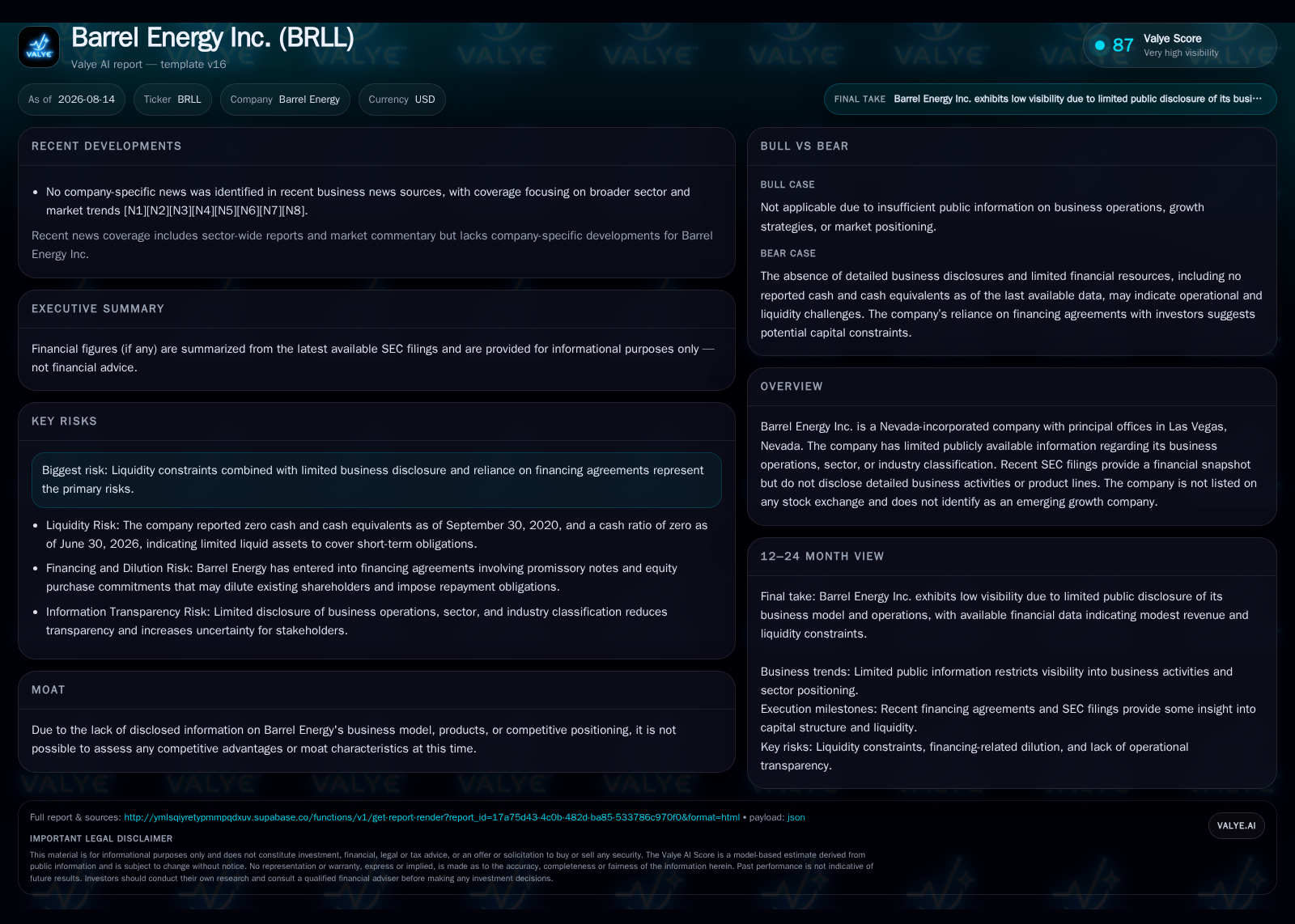
Barrel Energy Inc., incorporated in Nevada and operating with minimal public disclosure, recently closed a $150,000 note financing coupled with an equity purchase facility to support its business expansion and working capital needs [S3]. The company does not disclose substantive renewable energy projects or revenues beyond a nominal recent figure, reflecting an early developmental stage. Amid strong capital intensity typical of renewable energy project developers, this raises liquidity and execution risk for Barrel Energy. Without disclosed contracts, production capacity, or operational KPIs, the firm remains reliant on capital raises and equity dilution. Industry peers like NextEra Energy and Brookfield Renewable Partners offer contrasting scale and operational maturity benchmarks. Investors tracking Barrel Energy should closely monitor future project developments, financing draws, and any indication of commercial agreements or regulatory milestones.
Recent Operating Update: Financing as Primary News
Barrel Energy’s latest SEC filings center primarily around its August 2026 financing transactions rather than operational progress. On August 5, 2026, the company closed on a Note Purchase Agreement issuing a promissory note with an original principal of $150,000 but sold at a discount for $135,000. After deducting legal expenses of $10,000, net proceeds to the company were approximately $125,000 [S3]. The Note calls for twelve monthly repayments starting September 1, 2026 of about $13,750 each.
In parallel, Barrel Energy entered into an Equity Purchase Agreement granting the Investor rights to acquire up to $5 million in common stock over a three-year period at depressed pricing mechanisms tied to recent trading values [S3]. This structure provides ongoing access to capital but includes dilutive aspects from share issuance.
Beyond financing terms and related warrant issuances (including pre-funded warrants exercisable at nominal prices), the company did not disclose any tangible project developments or contracts in these filings. The latest quarterly Form 10-Q also omits risk factors or forward-looking statements typically related to project timelines or regulatory hurdles; its risk section simply states “None” [S2]. Thus the recent filings reveal Barrel Energy is currently more focused on capital raising than commercial operations or revenue generation.
Business Model Analysis: Early-Stage Development without Commercial Operations
Despite the "Energy" nomenclature suggestive of renewables involvement—likely solar or other clean power—the company's disclosures provide no specific information on products, services, technology adoption, or project ownership. The faint reported revenue figure of approximately $54,843 for the latest period ending June 30, 2026 strongly suggests no large-scale operational asset deployment; this revenue could be from incidental activities rather than meaningful energy sales [F1]
The business model archetype for established renewable energy firms involves either project development leading to ownership/operation (charging customers via long-term PPAs) or technology licensing offering solutions like energy storage systems. In contrast, Barrel Energy currently discloses none of the standard industry KPIs: no installed capacity (MW), no contracted capacity under PPAs, no pipeline metrics or regulatory progress reports.
This paucity reflects either very early-stage development pre-project approval or possibly a holding entity without active operations [S5]
Industry Structure and Competitive Positioning
Renewable energy remains highly capital intensive due to upfront CapEx for asset development plus regulatory compliance costs. Peer groups range from heavyweight independent power producers such as NextEra Energy and Brookfield Renewable Partners (which own diversified renewable portfolios generating steady cash flow) to smaller developers focused on specific geographic markets or technologies like First Solar.
Furthermore, established peers benefit from long-term contracted revenues through PPAs that regulate price and volume risks—a core value driver absent in Barrel’s current disclosures. Barrel also provides no insight into grid interconnection status or intermittency mitigation strategies such as energy storage integration.
Consequently, Barrel faces an uphill journey competing without visible scale advantages or demonstrated operational benchmarks.
Growth Drivers: Potentially Accessible but Undisclosed
General industry trends driving growth include accelerating government mandates for renewable adoption across U.S. jurisdictions (especially Nevada), declining LCOE for solar and wind technologies making new projects more attractive economically, plus corporate sustainability commitments fostering demand for green power.
If Barrel Energy can translate future equity drawings into successful project pipeline expansion with secured off-take agreements—typically formalized through PPAs—and achieve requisite regulatory approvals to establish grid interconnections safely and cost-effectively, it could tap these drivers effectively.
Additional stimuli like access to renewable energy credits (RECs) markets and carbon offset programs could supplement revenues once physical assets are operational. However without current disclosures on any such contracts or assets these remain speculative possibilities.
Risks and Growth Constraints: Liquidity Pressure and Execution Uncertainty
Barrel faces several immediate financial concerns:
- Reliance on dilutive financing instruments (convertible notes and equity purchase agreements) implies ongoing shareholder dilution risk.
- Limited cash on hand relative to current liabilities (~$110K current assets vs ~$81K liabilities) yields marginal liquidity cushion with no revealed cash equivalents noted since 2020 [F1].
- Small principal note size ($150K) signals very constrained funding runway against typical multi-million-dollar downstream CapEx needs common in renewables.
- Absence of disclosed material contracts or PPAs prevents validation that underlying projects exist or will reach construction/commercial phases.
- Elevated default interest provisions on the note (up to 22% per annum) penalize payment delays significantly [S11], creating refinancing pressure.
- Lack of transparent operational metrics leaves investors blind to technical execution capabilities or pipeline milestones crucial in capital allocation decisions.
Regulatory risk is inherently material in renewables owing to permits required for land use and grid connection; while unmentioned here it likely remains an ongoing challenge without evidence that approvals have been secured.
What To Watch Next: Milestones To Track For Operational Validation
Given Barrel Energy’s current profile centered around financial engineering rather than clear project advancement metrics:
- Monitor quarterly updates regarding usage of proceeds from raised funds toward actual project development expenses or asset acquisitions.
- Watch for announcements of executed PPAs or binding customer/offtake arrangements that substantiate commercial viability.
- Observe drawdowns under the Equity Purchase Agreement capped at $5 million over three years as markers of fundraising success and planned scaling activity [S12].
- Track timely repayments on the promissory note starting late Q3 2026 to assess operational cash flow sufficiency.
- Regulatory filings demonstrating approvals or permits would signal reduction in major development risk barriers.
- Any management commentary clarifying business strategy shifts toward specific renewable segments (solar/wind/storage) would aid valuation clarity.
Absent these markers future performance visibility will stay limited with continued reliance on external funding rounds expected given typical sector CapEx dynamics.
Financial Profile Discussion
This analysis relies exclusively on available SEC disclosures as of August 14, 2026 combined with normative renewable energy industry context. Given limited company-specific data beyond financing documents and sparse operational detail this profile emphasizes caution regarding liquidity constraints and nascent business development status common among early-stage renewable entities seeking market entry funding rounds. Peers cited serve only as illustrative benchmarks reflective of developed renewable energy players’ scale and operational breadth rather than direct competitors within precise market niches.
Disclaimer: This is research-only, informational analysis and not investment advice. It may include AI-generated interpretation and general industry context. Always verify important details using primary sources.

Comments