
AEI Income & Growth Fund XXI’s Distribution Strategy Hinges on Stable Rental Cash Flow and Opportunistic Property Sales
The Partnership maintains stable distributions supported by rental income and selective asset disposals while managing unit repurchases under capital preservation constraints.
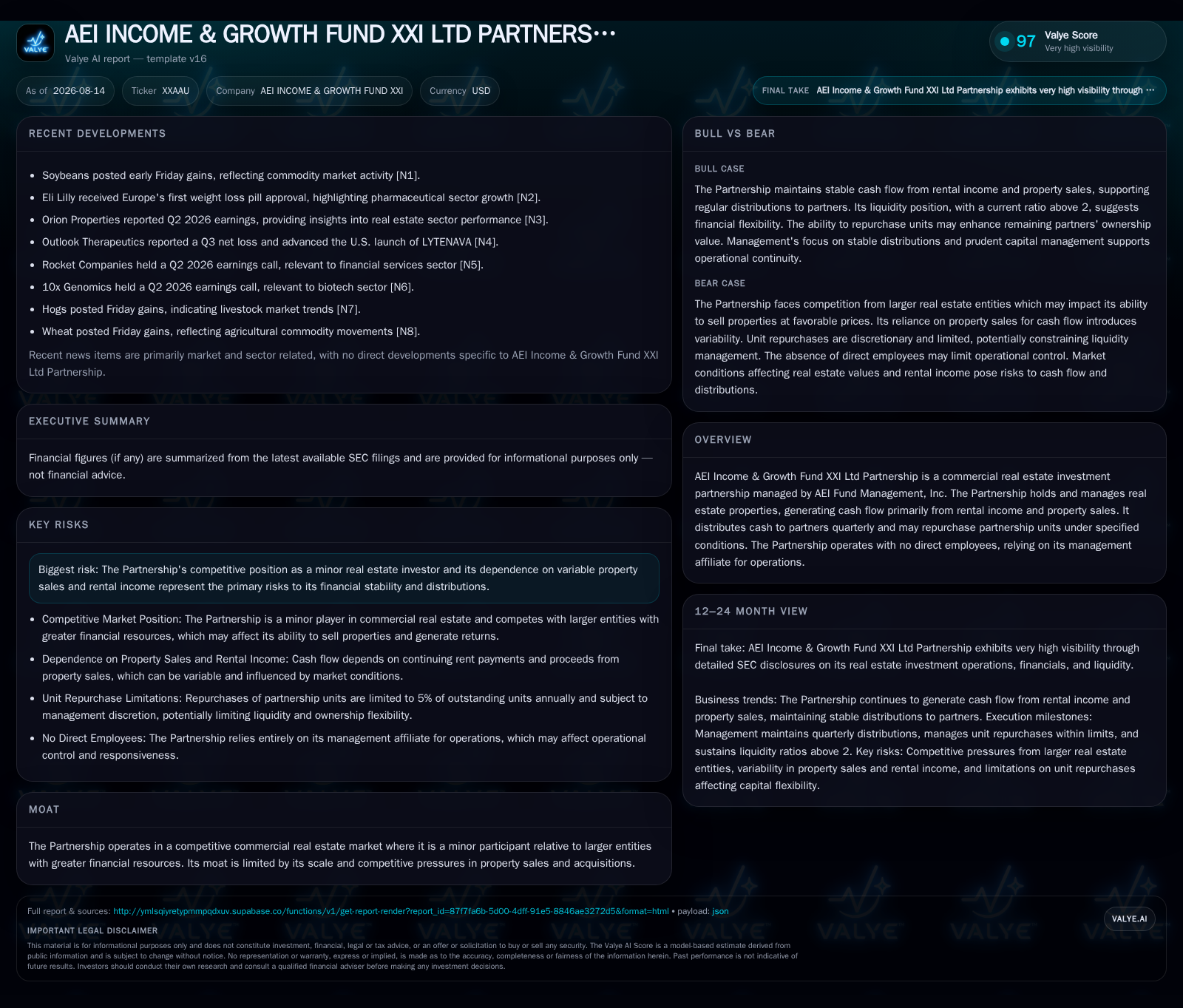
AEI Income & Growth Fund XXI Ltd Partnership operates as a minor player in the commercial real estate investment sector, generating cash flow primarily through rental income from its property portfolio and opportunistic sales. The latest quarterly filing highlights stable distribution payments to partners and no unit repurchases in the first half of 2026, signaling prudent capital management amidst competitive pressures. The partnership relies on AEI Fund Management, Inc. for operations and retains no employees directly. Risks persist around market competition and scale limitations impacting capital allocation decisions and distribution sustainability.
Recent Operating Update: Stability Amid Conservative Capital Moves
AEI Income & Growth Fund XXI's latest quarterly report as of June 30, 2026 confirms that the Partnership continues to support stable quarterly distributions from recurring rent payments augmented by strategic use of proceeds from previous property sales [S2]. For the six months ended June 30, 2026, declared distributions totaled approximately $329,505—down from $541,013 in the comparable period of 2025—highlighting some variability possibly tied to fluctuations in cash flow timing or asset dispositions [S2]. Notably, the Partnership did not repurchase any Units from Limited Partners during this period [S2], despite contractual authority to buy back up to 5% of outstanding Units annually subject to Managing General Partner discretion aimed at avoiding impairment of capital or operations.
The lack of repurchases through mid-2026 contrasts with activity in 2025 when about 1,095.87 Units were acquired for $787,350 using net sales proceeds from property transactions [S2], [S11]. This prior buyback enlarged remaining Limited Partners’ proportional interests. That strategic repurchase execution in a favorable period underlines how AEI Income & Growth Fund XXI selectively recycles capital—from realized gains on asset sales—towards enhancing per-unit value without jeopardizing liquidity.
Business Model: A Classic Commercial Real Estate Investment Partnership
Operating as a limited partnership structure typical within commercial real estate investment, AEI Income & Growth Fund XXI generates revenue primarily via two channels: rental income from leased properties and cash inflows from asset sales [S1]. It distributes net cash flow quarterly, allocating 99% of distributions to Limited Partners while retaining a minimal 1% share for General Partners [S1]. Such allocation aligns financial incentives well while preserving operational discipline.
Critical operational functions—including acquisition analysis, leasing oversight, maintenance coordination, and disposition decisions—are outsourced exclusively to its management affiliate AEI Fund Management, Inc., allowing the Partnership itself to maintain virtually no direct employees [S1]. This arrangement promotes cost efficiency but introduces dependency risks on third-party management quality.
Rental income stability is essential for predictable distribution capacity whereas property sales serve more opportunistically as sources of one-time cash inflows facilitating liquidity and potential unit repurchases [S1], [S2]. The Partnership's ability to sustain distributions hinges on maintaining occupancy rates adequate enough to cover fixed costs plus margin requirements.
Industry Positioning: Small Scale Limits Moat Amid Competitive Market
AEI Income & Growth Fund XXI operates within a fiercely competitive commercial real estate investment landscape dominated by larger REITs like Boston Properties or Vornado Realty Trust that benefit from scale advantages in deal sourcing, financing terms, and portfolio diversification. The Partnership openly acknowledges its status as a minor participant with limited financial resources relative to major players [S1], which constrains its bargaining power both when acquiring new properties and finding buyers upon disposition.
The relatively modest size affects access to premium assets often sought after by institutions and limits ability to absorb temporary market shocks or tenant defaults without impacting cash flows [S1]. As the Partnership competes with numerous entities for buyers or tenants at exit points or lease renewals respectively, price discovery remains challenging. This dynamic underscores why management employs disciplined selection criteria for investments and exercises caution around unit repurchases—balancing shareholder returns with capital preservation
Growth Drivers: Rental Market Pull and Selective Capital Recycling
Growth potential stems largely from two structurally distinct levers: rising commercial lease rates driven by increased demand for space in target markets (office, retail etc.) plus proactive recycling of capital through asset sales timed with favorable pricing environments. Rental income growth contributes incremental net operating income (NOI), offering distribution stability; meanwhile, profits from strategic property dispositions generate readily deployable funds enabling acquisitions or returning capital via unit repurchases.
Further efficiency gains might arise if AEI Fund Management enhances leasing renewals or occupancy rates through superior asset management practices. Yet given scale constraints, growth remains measured rather than exponential.
Risks and Watchpoints: Concentration Risk and Market Sensitivities
The Partnership confronts notable risks including market competition pressures leading to compressed yields on acquisitions or challenges achieving premium sales prices necessary for profitable exits. Tenant credit risk resulting in defaults can depress rental income unpredictably; fluctuating interest rates could increase financing costs indirectly affecting return profiles.
Dependency on AEI Fund Management as sole operator constitutes operational risk: adverse changes in management personnel or strategic missteps could disproportionately affect performance given absence of internal staff diversification. Moreover, limitations imposed on annual unit repurchase volumes reflect cautious capital management but also highlight vulnerability when investors seek liquidity amid less liquid real estate holdings.
Given these factors, key metrics such as occupancy rate trends, rental income growth quarter-over-quarter, distribution per unit stability, and any shifts in unit repurchase activity serve as critical future indicators.
What To Watch Next
Investors should monitor upcoming quarterly distribution declarations closely for consistency relative to prior periods since these provide direct insight into cash flow sufficiency and partnership capital health. Any resumption or expansion of unit repurchases may signal renewed confidence but conversely could stress liquidity if not underpinned by adequate realized gains.
Developments within AEI Fund Management regarding staffing changes or announced shifts in investment strategy are important since they influence operational capability. Confirmation around continued absence of material off-balance sheet arrangements reassures about transparency in financial reporting [S2]. Finally, macroeconomic variables affecting commercial property demand will inherently impact portfolio performance metrics.
Financial Profile Discussion
At June 30, 2026, AEI Income & Growth Fund XXI reported cash and equivalents totaling approximately $595,734 alongside current liabilities of $255,401—yielding a strong current ratio of roughly 2.24 indicative of sound short-term liquidity [F1]. This balance sheet positioning supports manageable working capital needs and backs planned distribution commitments without encumbered funding concerns.
Capital allocation demonstrates prudence with distributions paid consistently exceeding prior-year totals ($872k versus $693k) while exercising selective buyback programs funded directly through net sale proceeds ensuring that cash returned does not undermine partnership solvency frameworks [S1], [S11].
This analysis integrates filings current through August 14, 2026. It abstains from speculation unsupported by public data regarding specific future investments or distribution guarantees. Readers should note inherent uncertainties tied to small-scale commercial real estate investors facing competitive dynamics and economic cycles.
Disclaimer: This is research-only, informational analysis and not investment advice. It may include AI-generated interpretation and general industry context. Always verify important details using primary sources.

Comments