
GRI Bio Secures Orphan Drug Status for GRI-0621 Amid Nasdaq Listing Risk
Clinical-stage biotech GRI Bio progresses GRI-0621 in IPF with positive Phase 2a data but faces capital and listing challenges.
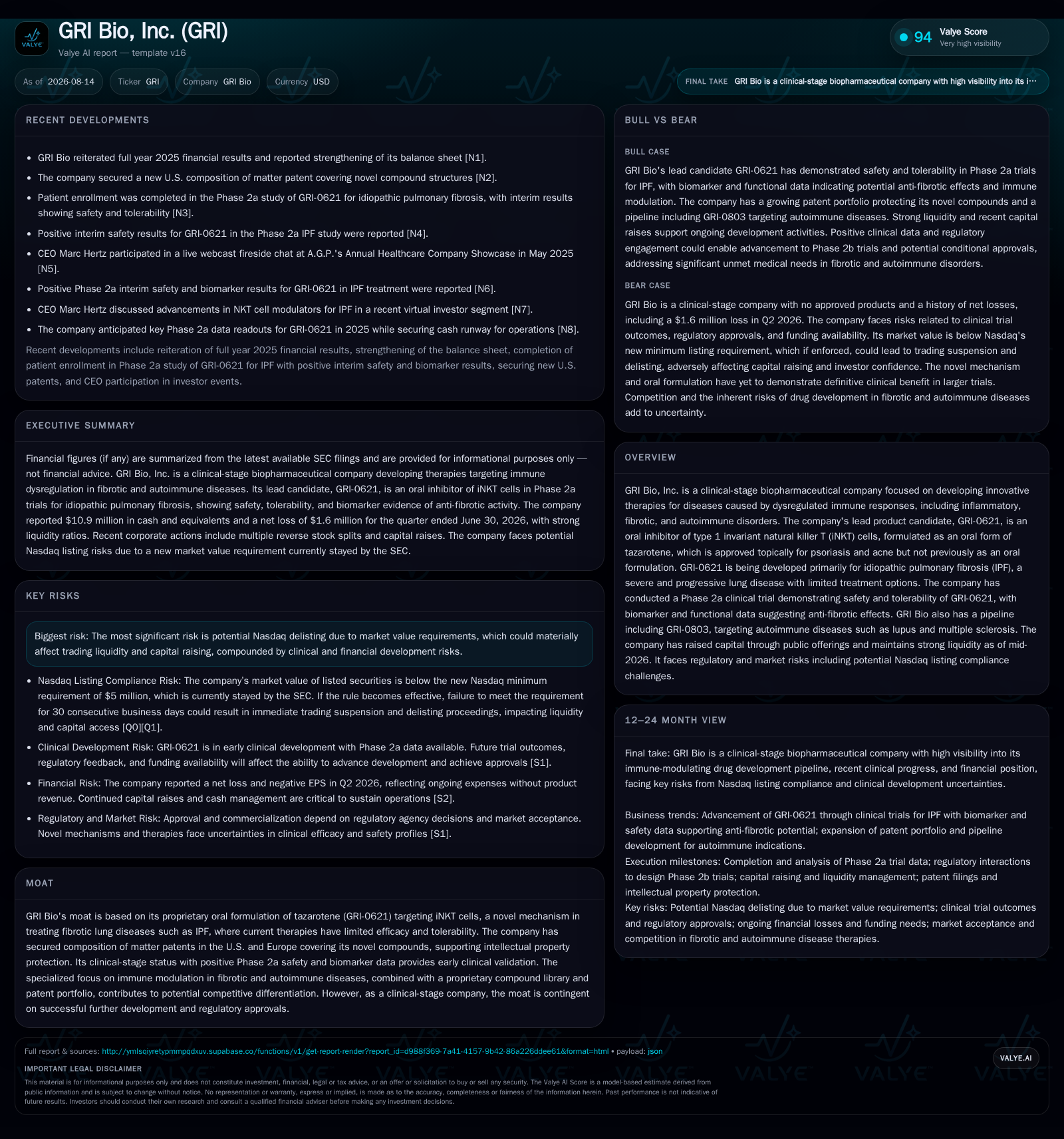
GRI Bio, Inc. disclosed continued advancement of its lead candidate, GRI-0621, an oral inhibitor targeting iNKT cells for idiopathic pulmonary fibrosis (IPF), with positive Phase 2a safety and biomarker signals from a recently completed trial. The company also achieved FDA orphan drug designation for GRI-0621 in IPF, enhancing regulatory and commercial positioning in this underserved indication. However, GRI Bio's market valuation remains below Nasdaq's proposed minimum requirement, posing material listing risks that could impact liquidity and capital access. The firm maintains a strong intellectual property base but needs substantial additional funding to progress into Phase 2b trials and beyond.
Recent Operating Update: Progress in Clinical Development and Regulatory Recognition
GRI Bio’s latest quarterly filing dated August 14, 2026, confirms ongoing advancement of its lead drug candidate GRI-0621 through clinical development for idiopathic pulmonary fibrosis (IPF) [S2]. The company recently completed a multi-center Phase 2a randomized, double-blind trial enrolling 35 IPF patients to primarily evaluate the safety and tolerability of oral GRI-0621 over a 12-week period [S1]. Topline data indicates that the trial met its primary endpoint without treatment-related serious adverse events reported; common adverse events were mild to moderate including dry skin and joint pain. Notably, subjects on GRI-0621 reported less cough compared to placebo and showed no worsening in gastrointestinal tolerability profiles relative to standard care background therapies pirfenidone or nintedanib used by 80% of enrolled patients [S1].
Moreover, exploratory biomarker signals including inhibition of iNKT cell activation and improvements in pulmonary function biomarkers hint at potential anti-fibrotic efficacy mechanisms emerging from the pharmacodynamic analyses underway [S1]. Concurrently with clinical data progression, GRI Bio received U.S. Food and Drug Administration orphan drug designation for GRI-0621 in IPF on June 18, 2026 — a key regulatory milestone enhancing its pathway through development by affording benefits like seven years of market exclusivity post-approval plus potential tax credits [S3]. This event underscores FDA recognition of unmet needs in this severe fibrotic lung indication.
Also disclosed is the significant risk posed by Nasdaq’s anticipated new Market Value of Listed Securities (MVLS) requirement set at a minimum $5 million valuation threshold for continued trading eligibility [S2]. As of the filing date, GRI Bio remains below this MVLS threshold thus risking immediate trading suspension without cure period if implemented — compounding financial development challenges ahead
Business Model: Focused Clinical-Stage Immunomodulatory Therapy Development
GRI Bio operates as a clinical-stage biopharmaceutical entity specializing in therapies targeting diseases driven by dysregulated immune responses — particularly fibrotic and autoimmune disorders. Its proprietary pipeline centers around small molecules that modulate immune cell subsets implicated in disease pathogenesis.
Its lead candidate, GRI-0621, is an oral formulation of tazarotene designed to selectively inhibit type 1 invariant natural killer T (iNKT) cells. Unlike topical versions approved for dermatologic conditions (psoriasis and acne), this systemic oral form targets immune-mediated fibrosis processes notably relevant to IPF — a progressive lung scarring disease with poor survival outcomes despite two approved therapies lacking survival benefit or favorable tolerability profiles [S1].
Revenue generation for companies at this stage typically relies on licensing deals, milestone payments linked to clinical/regulatory achievements, or eventual product commercial sales post-market approval. Until commercialization, biotech firms like GRI Bio incur substantial research and development expenses without product revenue streams. Success hinges on demonstrating clinical efficacy/safety to advance candidates through costly multi-phase trials toward regulatory approvals.
GRI Bio supplements its lead program with additional pipeline assets such as GRI-0803 targeting autoimmune conditions including lupus; however, these remain early stage requiring incremental capital deployment. Monetization depends heavily on securing partnerships or financing rounds given limited internal revenues.
Industry Structure and Competitive Positioning
GRI Bio sits within the mid-to-late clinical stage biotech segment—a sector distinguished by heavy capital intensity, scientific risk from trial results variability, regulatory uncertainty, and patent-driven intellectual property importance. Key competitors span large pharma addressing fibrosis with established drugs (e.g., Genentech/Roche’s Esbriet/pirfenidone; Boehringer Ingelheim’s Ofev/nintedanib) as well as emerging biotechs developing novel immunomodulators or antifibrotic agents.
Intellectual property exclusivity is critical since oral tazarotene formulations are novel chemical entities protected by composition of matter patents both in the U.S. and Europe—providing a moat against generic entrants pending successful commercialization. Furthermore, orphan drug designation may facilitate accelerated timelines and market protections uncommon in broader population indications.
Despite encouraging early-phase data indicating safety/tolerability superiority relative to existing treatments often hampered by side effects leading to poor adherence in IPF patients — the lack of large Phase 3 readouts means clinical validation remains limited versus established standards leading to cautious peer adoption.
Peer companies targeting fibrotic lung diseases or autoimmune subsets share similar profiles: progression through critical trial phases with milestone-based financing dependency covering high burn rates before revenue realization.
Growth Drivers: Advancing Clinical Trials & Regulatory Incentives
The principal growth driver is demonstration of therapeutic benefit translating into later-stage pivotal trials — enabling the company to unlock value inflection points through positive data readouts and subsequent regulatory submissions. Success in Phase 2b studies would validate dosing regimens, expand patient populations studied, refine pharmacodynamics/pharmacokinetics understanding, and enhance confidence among investors and partners [S9],[S16].
Additional catalysts stem from orphan drug designation benefits reducing development costs via fee waivers/market exclusivity incentives plus expedited review pathways potentially available. Successful progression could attract strategic partnerships providing non-dilutive capital or commercialization expertise.
Technological innovation embodied by an oral formulation addresses unmet patient preferences compared to injectable or inhaled therapies—heightening real-world uptake potential if approved.
Other drivers include pipeline diversification into autoimmune fields leveraging mechanistic overlap with iNKT cell modulation expanding long-term product portfolio value.
Risks and Constraints: Capital Limitations & Listing Compliance Concerns
Operationally, clinical development inherent risk includes adverse safety findings or insufficient efficacy results impeding further advancement or requiring costly program reforms. Manufacturing scale-up complexities for novel formulation add another layer of challenge.
Capital constraints dominate risk profile as current cash approximates $10.9 million at June quarter-end which finances only near-term operations into Q1 2027 absent new fundraising; absence of debt limits leverage options though equity dilution remains probable per past financing patterns raising proceeds via public offerings and ATM facilities [F1],[S8],[S6].
Regulatory uncertainties remain around timing/requirements for full approvals despite orphan designation; failure here would delay monetization horizons.
Finally internal dependencies on key scientific leadership retention factor into operational continuity risks alongside evolving reimbursement landscape impacting eventual commercial economics.
What To Watch Next: Clinical Milestones & Financial Trajectory
Key upcoming milestones include planned commencement or preparatory activities toward Phase 2b trial initiation for GRI-0621 that will materially determine continued development viability; updates on biomarker analyses related to Phase 2a may provide further insight into mechanism efficacy validation [S8],[S16].
Financially monitoring runway metrics against R&D spend increments will reveal capital sufficiency amid volatile biotech funding landscapes while any partnership announcements or licensing deals would signal external validation/support.
Regulatory engagement progress including FDA communications post-orphan designation offers clues regarding accelerated pathways availability.
Finally evolving status regarding Nasdaq MVLS rule implementation will critically affect market trading status reflecting immediate structural liquidity consequences [S2]
Financial Profile Discussion
As of June 30, 2026, GRI Bio reported cash and cash equivalents totaling approximately $10.95 million with zero debt outstanding—resulting in a strong current ratio exceeding 10x given current liabilities near $1.1 million indicative of healthy short-term liquidity but reflecting the nascent commercial stage nature without revenue streams [F1]
The firm's operating losses persistently deepen reflecting intensive investment in R&D programs focused on drug candidate advancement: fiscal year ended December 31, 2025 net loss stood at roughly $12 million compared to $8.2 million prior year highlighting escalating costs mainly due to expanded clinical activity including GRI-0621’s registration pathway preparations [F1],[S29],[S16],[S9]. General & administrative expenses increased moderately demonstrating scale-up associated corporate overhead growth necessary for public company compliance.
Cash burn trajectory necessitates successful capital raises imminently within next several quarters aligned with anticipated Phase 2b activities; historical reliance on equity financings via public offerings supplemented by ATM sales illustrates continuous need for equity markets access amid absence of product revenues [S5],[S6],[F1]. Failure to secure financing timely could force severe curtailments or cessation impacting pipeline momentum detrimentally.
Overall financial position supports near-term operations but underscores vulnerability typical of clinical-stage biotech firms pending de-risking via later phase successes or strategic collaborations.
This analysis is based solely on publicly available information as contained within recent SEC filings through August 14, 2026. It does not constitute investment advice but seeks to provide an informed operational perspective grounded in evidence accounting for industry context.
Disclaimer: This is research-only, informational analysis and not investment advice. It may include AI-generated interpretation and general industry context. Always verify important details using primary sources.

Comments