
Coherent Corp. Strengthens AI Datacenter Leadership Through Optical Innovation and Capacity Expansion
Coherent's 2026 results highlight robust growth in Datacenter & Communications fueled by AI demand and strategic NVIDIA partnership, offsetting industrial segment headwinds.
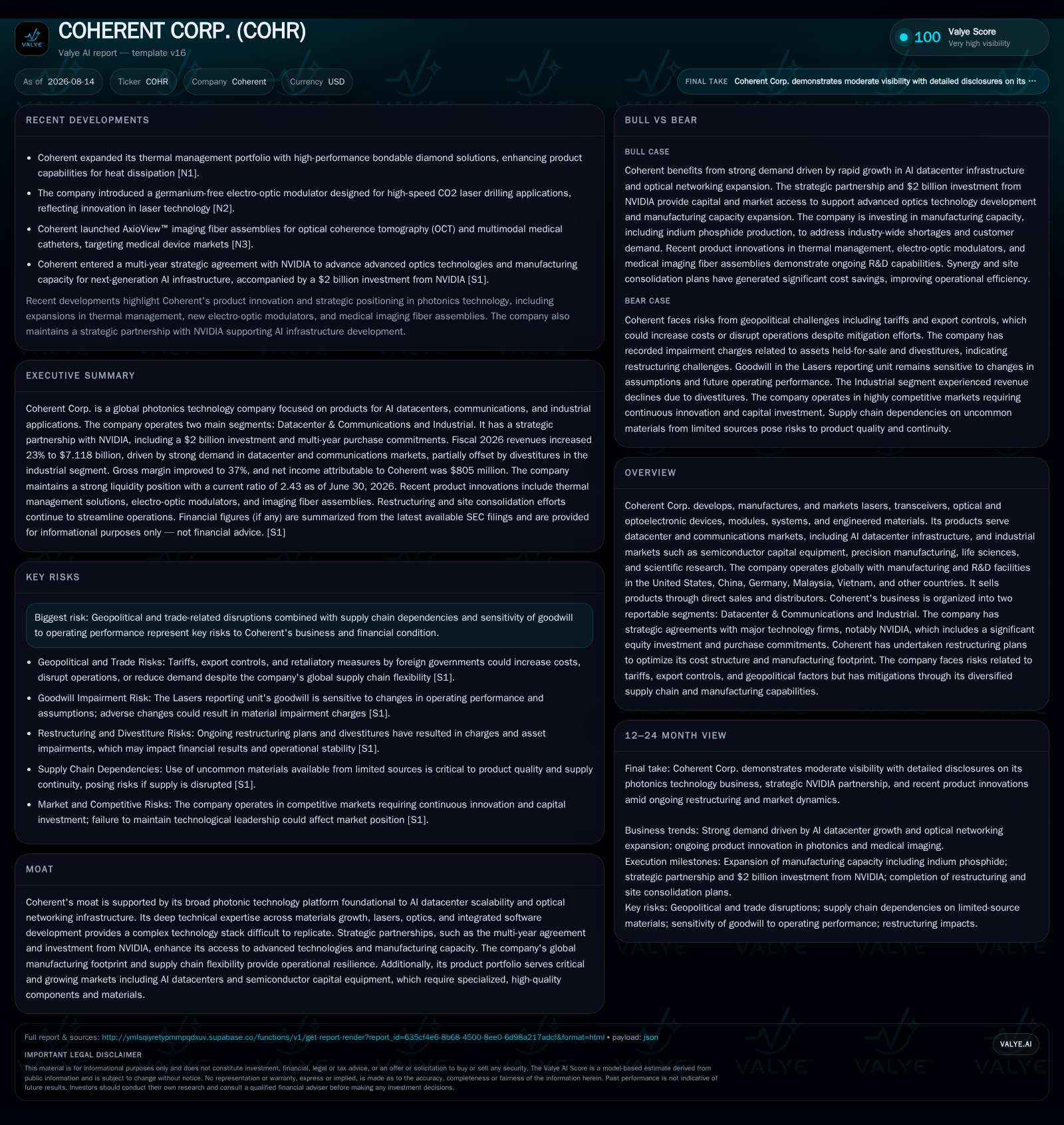
Coherent Corp. reported strong fiscal year 2026 performance driven by a 40% revenue increase in its Datacenter & Communications segment, reflecting soaring demand for optical transceivers in AI-enabled datacenters and telecom infrastructure. The company’s strategic alliance with NVIDIA, including a $2 billion equity investment and multi-year purchase commitments, underpins expanded manufacturing capacity and innovation in photonic technologies. Meanwhile, Industrial segment revenues declined due to business divestitures and macroeconomic softness. Coherent’s ongoing restructuring efforts have streamlined operations and enhanced gross margins despite higher R&D spending aimed at sustaining technological leadership. The company maintains a solid liquidity position but faces risks from geopolitical tensions and supply chain dependencies intrinsic to photonics manufacturing.
Recent Operating Update
Coherent also highlighted a transformative strategic partnership with NVIDIA formalized on March 2, 2026. This encompasses a multi-year collaboration with multibillion-dollar purchase commitments for next-generation photonic devices crucial to AI scalability, supplemented by NVIDIA’s $2 billion equity investment into Coherent through private placement shares necessitating ramped manufacturing capacity expansions including enhanced indium phosphide production at Sherman, Texas—a critical material platform for high-performance lasers and integrated photonic components foundational for optical interconnects [S1][S9]. Management has emphasized ongoing capacity investments aligned with this partnership to fulfill stringent supply agreements through 2030.
The company’s restructuring programs marked progress with fiscal 2026 restructuring charges pared back sharply to $63 million compared to $160 million the prior year as major site consolidations, workforce rationalization, and operational realignments initiated under the combined 2023/2025 Plans reached maturation milestones [S17][S24]. These cost rationalizations support a leaner business model focused on resilience amid cyclical uncertainty.
Business Model Overview
Coherent operates within the photonic technology sector providing highly specialized lasers, optical transceivers, optoelectronic devices, modules, engineered materials like indium phosphide wafers, and complete subsystems essential for scaling data transmission bandwidth efficiency in hyperscale datacenters and communication networks. The company monetizes through product sales via direct contracts complemented by distributor channels typically embedded within long-term supply agreements that often incorporate volume purchase commitments anchored by collaborative R&D initiatives with key customers [S1][S4]
Revenue generation hinges on shipment volumes of optical components whose unit values can fluctuate based on technology complexity—such as traditional vs advanced ZR/ZR+ transceivers—and contract pricing tied to scalability needs of large hyperscale datacenter operators or telecommunication carriers aiming to transition copper backhaul links into energy-efficient optical connectivity solutions.
Profitability drivers include manufacturing yields optimized through ongoing process engineering investments gained from proprietary technology stacks encompassing laser diode design through integrated module assembly facilitated by worldwide facilities strategically sited for supply chain diversity. R&D investments fund platform advancement targeting emerging modalities like co-packaged optics (CPO) designed for tighter integration between switching ASICs and photonics enabling higher bandwidth per rack while reducing power consumption—critical attributes defining customer procurement decisions today.
Segment reporting since July 2025 consolidates prior units into two pillars: Datacenter & Communications focused on high-growth AI datacenter optics systems alongside communications transport products; and Industrial addressing semiconductor capital equipment lasers plus precision manufacturing tools serving life sciences and scientific research markets [S5]. Each segment maintains dedicated sales forces managing direct OEM relationships or industrial systems integrators.
Industry Structure and Competitive Landscape
Photonic component manufacturers like Coherent operate at the nexus of materials science innovation (indium phosphide substrates), advanced device fabrication (lasers/optical transceivers), module/system integration (co-packaged optics), servicing robust end markets such as AI datacenters requiring scalable optical networking infrastructure and semiconductor equipment manufacturers demanding precision laser sources.
Peers include Lumentum Holdings specializing broadly in lasers/photonic components; Finisar (now part of II-VI Incorporated) focusing on optical transceivers; NeoPhotonics delivering telecom-focused optics; Broadcom with its expansive portfolio in optical networking ICs/transceivers; and Ciena operating largely at system-level optical networking solutions.
The sector is characterized by high capital intensity owing to cleanroom fabrication facilities across multiple geographies—including Coherent's owned plants spanning the U.S., China, Germany, Malaysia, Vietnam—plus persistent R&D outlays required to maintain performance leadership given the rapid pace of innovation such as moves toward co-packaged optics architectures departing from discrete optics reliance. Supply chain complexity is compounded by material sourcing challenges especially indium phosphide shortages driving capacity bottlenecks noted industry-wide this year which Coherent actively addresses via facility expansions [S1][S4]
Customer concentration risk is notable since hyperscale cloud providers command substantial order volumes exerting pricing pressure but also obligating multi-year commitments that provide predictable revenue streams if execution aligns.
Growth Drivers
The quintessential growth engine remains the explosive deployment of AI datacenters demanding ever-increasing bandwidth paired with reduced latency/power consumption achievable only through state-of-the-art photonics-based optical interconnects. The foundational role of Coherent’s lasers and transceivers underpinning 'AI running on compute but scaling on optical connectivity' underscores the strategic importance of its broad photonic platform across next-generation datacenter architectures [S1].
Additional growth vectors derive from transitioning network infrastructure from legacy copper channels towards fully optical transport embracing ZR/ZR+ standards enabling higher data rates over longer distances—as reflected by strong shipment growth of these transceiver types during FY26—and commoditization of multi-rail communication modules that boost throughput per fiber pair [S18][S24]
Technology shifts towards co-packaged optics integrated directly onto switching chips will expand addressable markets requiring complex high-yield packaging capabilities where Coherent’s steady investments position it favorably versus competitors still reliant on discrete optic designs.
Industrial markets offer moderate tailwinds via semiconductor capital equipment upgrades implementing lasers optimized for next-gen lithography at scale plus precision manufacturing systems for electronic displays/life sciences instruments albeit subject to macro softness as seen through recent revenue contraction post divestitures [S18]
Management’s continued R&D allocation (~10% revenue) focused heavily on Datacenter & Communications product portfolios supports sustained innovation pipeline critical for maintaining competitive differentiation particularly under dynamic customer requirements evolving alongside AI compute architectures [S24]
Risks and Watchpoints
Photonic hardware companies like Coherent face exposure from geopolitical trade restrictions impacting material flows notably rare semiconductor-grade substrates susceptible to tariffs as exemplified by recent U.S. Supreme Court rulings nullifying certain tariffs but leaving administrative refund processes uncertain—introducing cost volatility risks [S25].
Customer concentration concentrated among a handful of hyperscalers creates potential order variability though mitigated partially by long-term purchase commitments tied to strategic partnerships such as that with NVIDIA which itself has equity stakes enhancing mutual alignment but increasing dependency risk concentration metrics.
Rapid technological churn necessitates continuous investment in R&D; failure or delay in scaling new technologies such as co-packaged optics could erode market share given peer innovations.
Supply chain disruptions around critical materials like indium phosphide can impair manufacturing output temporarily affecting delivery schedules or margin profiles despite proactive capacity expansions at sites like Sherman.
Legal challenges including intellectual property disputes or cybersecurity incidents remain probabilities given the technological complexity involved though management demonstrates governance oversight detailed via board-level risk committees overseeing these exposures regularly [S1].
Further operational risk stems from restructuring execution complexity inherent in multi-site consolidations spanning multiple continents which if poorly managed could lead to transitional inefficiencies or talent attrition impacting capacity utilization metrics.
What To Watch Next
Investors will closely monitor quarterly shipment volumes of ZR/ZR+ transceivers along with emerging CPO product uptake for early commercial traction given their outsized contribution potential to revenue growth cycles.
Trailing orders backlog evolution mainly linked to NVIDIA-driven commitments will provide visibility into medium-term capacity utilization ramp prospects reflecting capital expenditure efficiency gains.
Gross margin trends reflecting benefits from yield improvements against raw material price fluctuations will serve as immediate indicators of operational leverage effectiveness amid scaling pressures.
Update disclosures about further restructuring progress or additional portfolio realignments post divestiture executed early FY26 will shed light on ongoing transformation success metrics.
Any commentary regarding tariff recovery timelines along with supply chain resilience initiatives will contextualize external headwinds faced.
Finally, incremental details about R&D breakthroughs or new technology partnerships may signal reinforcement or erosion of competitive moat rooted in photonic innovation leadership.
Financial Profile Discussion
As of June 30, 2026, Coherent maintained a healthy liquidity position highlighted by cash and cash equivalents totaling roughly $1.16 billion against current liabilities near $2.85 billion yielding a current ratio of approximately 2.43x indicative of short-term financial flexibility supportive of agile inventory buildup aligned with demand surges seen across Datacenter & Communications operations [F1]. Total debt was approximately $3.26 billion resulting in net debt around $2.1 billion after accounting for cash balances—reflecting active capital deployment including investments related to manufacturing capacity expansions mandated under strategic agreements such as that with NVIDIA alongside general operations financing needs [F1].
This analysis synthesizes Coherent Corp.’s latest SEC filings up through August 14, 2026 without predicting stock behavior or offering investment advice. It focuses strictly on business fundamentals supported by disclosed data points relevant for monitoring operational execution within the photonics manufacturing sector serving AI datacenter infrastructure growth dynamics.
Disclaimer: This is research-only, informational analysis and not investment advice. It may include AI-generated interpretation and general industry context. Always verify important details using primary sources.

Comments