
Paranovus Expands Specialty Apparel via $33M Heyviva Asset Acquisition While Scaling Social Commerce Platform
Recent asset purchase marks a strategic pivot integrating athletic wear retail with social commerce capabilities amid growing TikTok-driven e-commerce adoption.
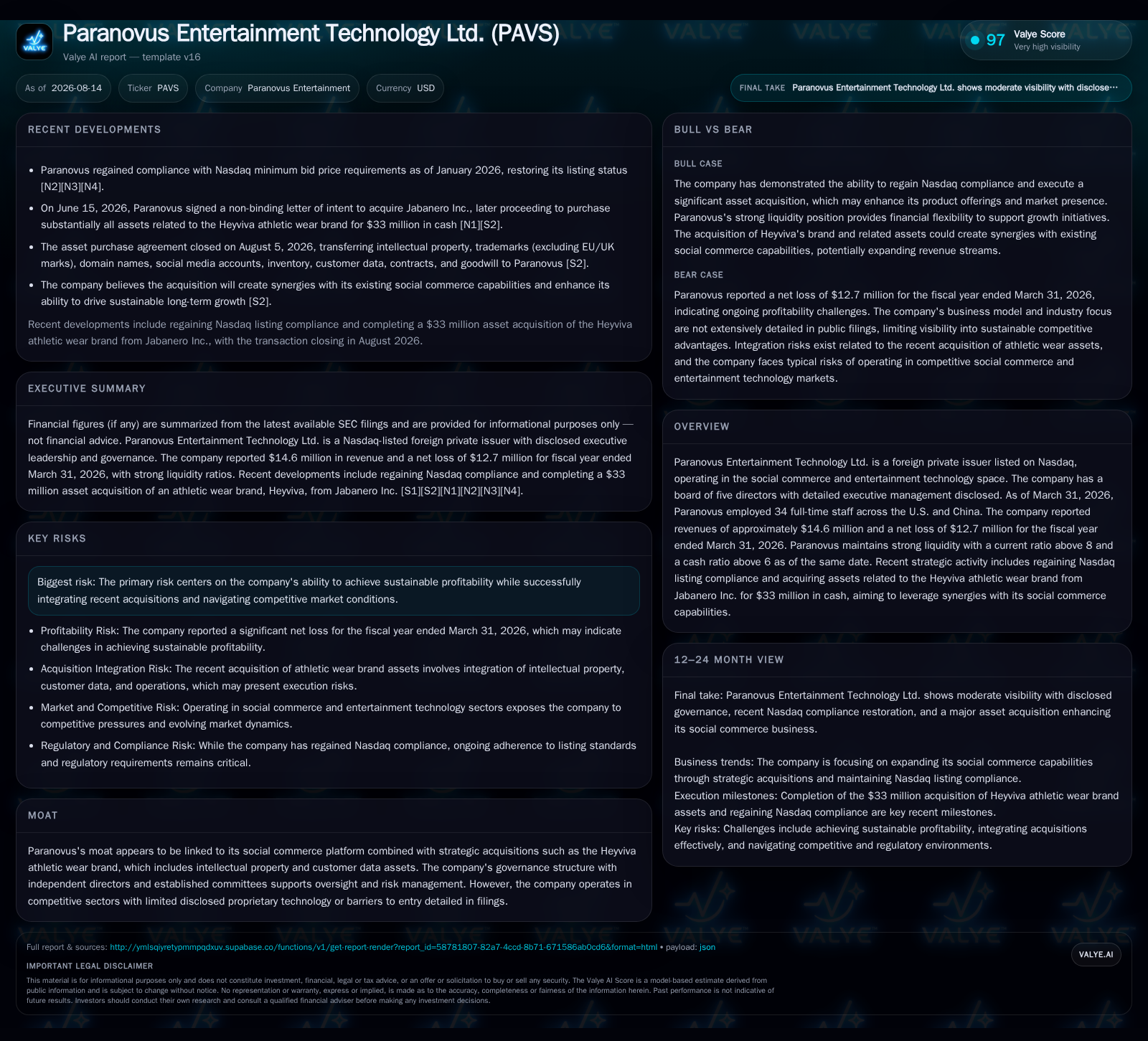
Paranovus Entertainment Technology Ltd. reported $14.6 million in FY2026 revenue driven by its majority-owned social commerce subsidiary BW, alongside a substantial net loss of $12.7 million reflecting significant goodwill and asset impairments. The company completed a $33 million cash acquisition of Heyviva’s U.S. athletic wear assets, including trademarks and customer data, aiming to synergize apparel retail with its existing e-commerce platform focused on TikTok Shops and livestreaming services. Paranovus operates at the intersection of digital social commerce and specialty apparel retail, emphasizing direct-to-consumer sales supported by brand design and content production services. Key risks include profitable integration of newly acquired assets, competitive pressure on margins, and reliance on third-party social media platforms.
Recent Operating Update
Paranovus Entertainment Technology Ltd. recently completed a transformative transaction that reshapes its business profile within the social commerce and specialty apparel sectors. On August 5, 2026, the company closed an asset purchase agreement acquiring substantially all U.S.-related assets of the Heyviva athletic wear brand from Jabanero Inc. for $33 million in cash [S2]. This acquisition includes trademark registrations in the United States (excluding EU/UK trademarks), trade names, know-how, internet domain names and websites, social media handles, inventory, customer data subject to legal permissions, contracts assigned by the seller, related records, and goodwill associated with these assets.
This deal follows an initial letter of intent signed mid-June 2026 concerning equity interests of Jabanero but pivoted toward purchasing specific Heyviva assets after due diligence [S2]. The staggered payment terms reflect customary transfer milestones for intangible asset registrations and domain assignments.
The acquisition is positioned to create synergies with Paranovus's existing social commerce capabilities operated through its majority-owned subsidiary Bomie Wookoo Inc. (BW), which focuses on TikTok Shops product sales combined with training, consulting, brand design, advertising, livestreaming and e-commerce enablement services [S1][S2]
Business Model Overview
Paranovus operates primarily through BW (51% owned), whose core revenue driver is product sales through TikTok Shops supplemented by offline store sales to business customers [S1]. The company complements this with diversified service offerings—brand design initiatives tailored to social commerce channels; advertising campaigns leveraging influencer marketing; content production including livestream shopping events; and training/consulting aimed at maximizing client e-commerce performance.
Revenue mechanics rely heavily on direct-to-consumer (DTC) online sales facilitated by TikTok's rapidly growing social commerce environment where community engagement via livestreaming converts into transactions [S1]. The monetization blends product margin capture from Heyviva apparel inventory with fee-based services provided to other merchants seeking access to digital shopping ecosystems enhanced by AI-powered marketing tools developed internally or through partnerships
The recent Heyviva asset acquisition reflects a strategic vertical integration move—Paranovus gains trusted specialty athletic wear IP rights along with valuable customer data assets that can be immediately channeled through BW's established TikTok Shop presence [S2]. This transfer potentially allows better control over brand messaging, inventory management efficiencies measured by inventory turnover rates and full-price sell-through rates critical in fast-cycle athleisure fashion retail.
Industry Structure and Competitive Position
Paranovus straddles two overlapping sectors: social commerce platform operation and specialty apparel retailing. Social commerce firms often depend on generating high engagement metrics such as livestream viewer counts and conversion rates aided by influencer marketing; meanwhile specialty apparel brands focus on brand freshness, inventory aging controls, promotional intensity moderation to preserve gross margins, return rate management, and AOV (average order value) growth.
Peers include companies such as Poshmark (social resale marketplace), Revolve (millennial-focused DTC fashion), and Lululemon (premium lifestyle athletic apparel), representing facets of Paranovus’s hybrid model albeit at much larger scale.
Growth Drivers
Key growth catalysts stem from broader trends favoring online athleisure products sold via integrated digital platforms harnessing livestream shopping—a trend gaining traction globally for its immediacy in driving impulse buying.
Acquiring Heyviva offers immediate expansion into owned branded products that capitalize on rising consumer preference for speciality apparel combining functionality and lifestyle appeal [S2]. This aligns neatly with BW's expertise in direct e-commerce channel utilization through TikTok Shops characterized by low frictions for shoppers.
Further organic growth potential lies in leveraging BW's consulting/training activities coupled with enhanced data analytics derived from newly acquired customer databases enhancing personalized marketing effectiveness. Expansion into cross-border markets may also generate incremental revenue streams given right-of-first-refusal provisions for EU/UK trademarks extending geographic footprint possibilities over seven years post-closing [S2]
Moreover, improving gross margin percentages will depend upon optimizing inventory turns while balancing promotional intensity—a vital factor as excessive discounting erodes yield especially significant in fast-moving consumer fashion segments.
Risks and Watchpoints
Integration risk is heightened by the cash-intensive nature of the Heyviva deal and complexities managing legacy Jabanero operations excluded from purchase potentially fragmenting brand consistency or supply chain uniformity.
Competitive intensity pressures pricing power especially as consumer attention shifts rapidly within crowded influencer-driven ecommerce ecosystems reliant heavily on TikTok algorithmic promotion where platform policy shifts pose systemic threats.
Customer acquisition cost volatility presents another risk vector given reliance on influencer marketing combined with high engagement demands for successful livestream shopping conversion—any reduction could materially impair growth cadence.
Data privacy regulations applicable to customer information inherited via Heyviva require vigilant compliance frameworks preventing costly breaches compromising reputation or incurring fines [S1].
What to Watch Next
Financial Profile Discussion
Going forward controlling operating expense trajectories aligned with revenue ramp-ups—especially converting acquired brand assets into positive gross margin contributions—will be critical levers influencing adjusted profitability profiles beyond headline GAAP figures overwhelmed by one-time charges.
This analysis synthesizes recent SEC disclosures up to August 14, 2026 focusing primarily on quarterly filings supplemented by annual report insights without providing investment advice or price guidance.
Disclaimer: This is research-only, informational analysis and not investment advice. It may include AI-generated interpretation and general industry context. Always verify important details using primary sources.

Comments