
Okta Q2 2026: Strengthening Identity Platform Amid AI and Customer Expansion
Okta’s Q2 2026 update highlights AI-driven identity management innovation and broad customer growth within a solid financial framework.
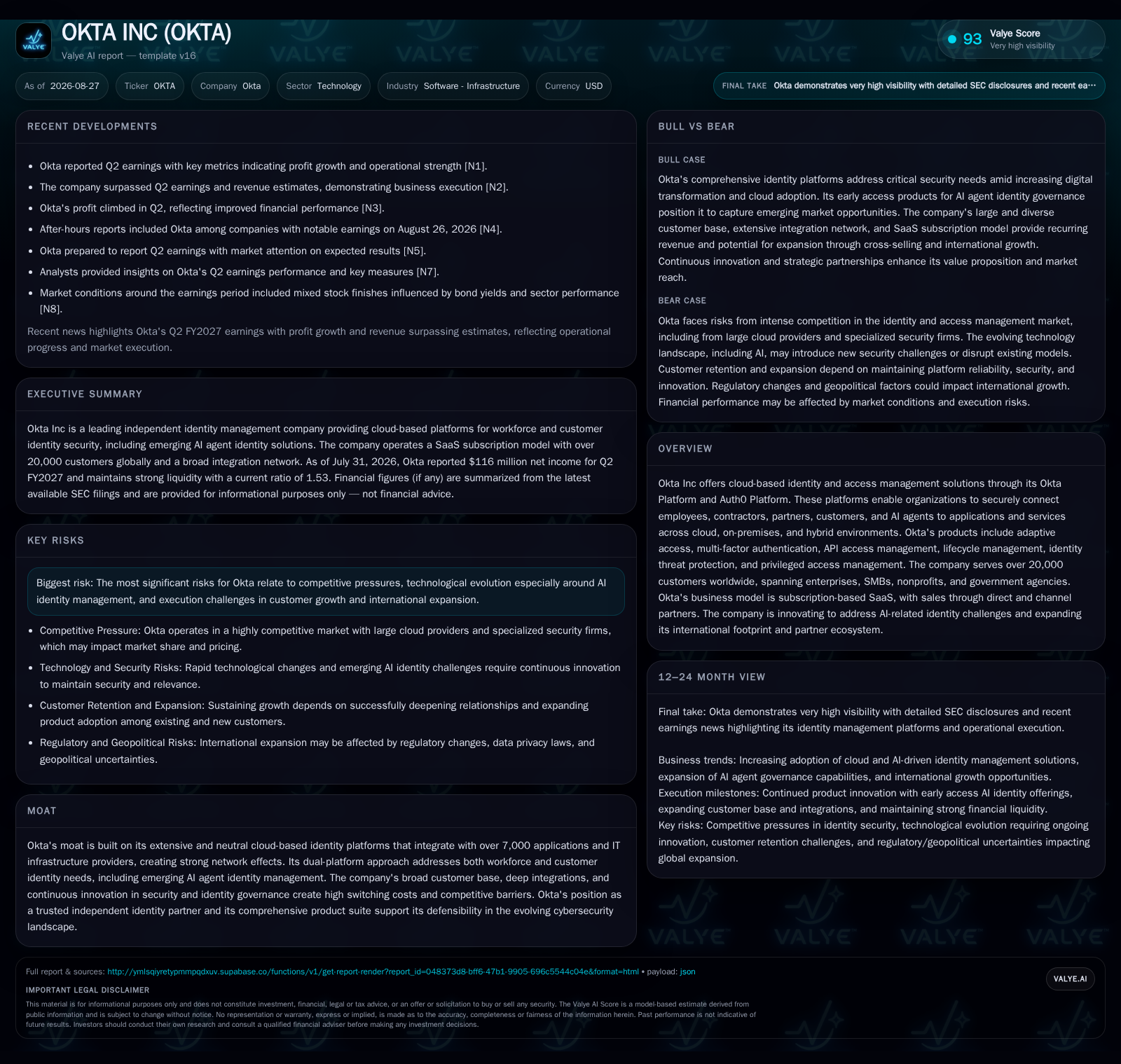
In its Q2 2026 operating update, Okta Inc emphasized its strategic focus on AI agent identity management, marking a significant product innovation aimed at capturing emerging non-human identity needs. The company continues to serve over 20,000 customers globally through its subscription-based SaaS identity platforms, benefiting from network effects and broad integrations. Okta’s balance sheet as of July 31, 2026, shows a current ratio of 1.53 with $763 million in cash and equivalents, supporting ongoing investments in platform innovation and international expansion. The risk profile remains stable with no material changes since the 2026 annual report.
Okta Inc’s Q2 2026 operating update, filed on August 27, 2026, reveals a strategic emphasis on AI agent identity management as a material product innovation within its identity platform offerings [S2][S1]. This focus on securing and governing non-human identities (NHIs) and AI agents reflects an adaptation to evolving digital security demands driven by artificial intelligence integration and the growing importance of Zero Trust security models. Okta positions its platforms as a unified control plane for both human and non-human identities, addressing the need for authenticated, scalable, and secure access to enterprise resources at speeds and volumes beyond traditional human user models [S1].
The company continues to serve a broad and diverse customer base exceeding 20,000 organizations worldwide, including enterprises, small and medium businesses, nonprofits, and government agencies as of January 31, 2026 [S1]. The platforms enable secure connection of employees, contractors, partners, customers, and increasingly AI agents to cloud, on-premises, and hybrid IT environments, facilitating seamless and context-aware access management [S1]. This extensive customer base underpins Okta’s recurring revenue stability and network effects, which are critical to sustaining growth and customer retention in the competitive identity management market.
Okta’s business model centers on delivering cloud-based identity and access management solutions primarily through a subscription Software-as-a-Service (SaaS) model. Organizations pay subscription fees to securely connect users and AI agents to applications and services, with revenue recognized over the service period [S1]. The company’s dual-platform approach—comprising the Okta Platform for workforce identity and the Auth0 Platform for customer identity—addresses diverse identity needs across multiple user types. This strategy is complemented by integrations with over 7,000 applications, creating network effects that enhance platform value and customer lock-in [S1].
The emergence of AI agents as a distinct identity class requiring secure, scalable access presents a new growth vector for Okta. The company’s explicit focus on developing AI agent identity management capabilities aligns with broader industry trends toward AI integration and Zero Trust security frameworks. This innovation could expand Okta’s total addressable market by addressing the unique governance and security challenges posed by non-human identities, which operate at scale and speed beyond traditional human user models [S1][S2].
As of July 31, 2026, Okta reported cash and equivalents of $763 million and a current ratio of 1.53, with current assets of $3.09 billion exceeding current liabilities of $2.03 billion [F1]. The subscription SaaS model may generate recurring revenue and cash flows that could support working capital needs and provide flexibility for investment in platform innovation and international expansion, depending on ongoing operational performance.
The company’s stable risk profile, with no material changes to risk factors since the 2026 annual report, suggests a consistent operating environment without new significant threats or operational challenges [S2][S1]. Key risks remain centered on competitive pressures from larger incumbents, potential customer churn, cybersecurity incidents, and regulatory compliance related to privacy and AI technologies. Okta’s ability to retain and grow its customer base is critical to sustaining revenue growth and profitability [S1][S2].
From a business economics perspective, Okta’s subscription model benefits from high gross margins typical of SaaS businesses and strong network effects derived from extensive application integrations. These factors contribute to customer retention and upselling opportunities, which are essential for expanding revenue within the existing customer base [S1]. The company’s dual-platform strategy and emerging AI identity solutions create switching costs and competitive barriers, potentially strengthening its moat in a rapidly evolving market.
Scenario analysis based on current evidence outlines three plausible outcomes for Okta’s near-term trajectory. In a bull case, successful leveraging of AI agent identity management capabilities could accelerate customer acquisition and revenue growth, supported by broad market adoption of AI agents and effective scaling of new products [S1][S2]. Confirmation of this scenario would include increased annual recurring revenue growth rates, customer announcements referencing AI identity solutions, and higher net retention rates driven by AI product adoption.
The base case envisions steady growth in Okta’s core identity management business with gradual integration of AI agent identity features without material disruption. This scenario is supported by the company’s large, diversified customer base and subscription model, with AI initiatives in early stages that may take time to impact materially. Confirmation would be consistent subscription revenue growth, incremental adoption of AI features, and stable or improving gross margins [S1][S2]. The bear case considers competitive pressures and execution challenges that could limit AI identity solution adoption and slow customer growth, pressuring revenue and margins [S1][S2]. This scenario is plausible given the competitive landscape, nascent AI identity market, and potential regulatory or technological hurdles. Confirmation would include declining ARR or net retention rates, negative customer feedback, and worsening liquidity or increased financing needs.
Investors should monitor subsequent quarterly filings for key metrics such as ARR growth and net retention rates, particularly related to AI identity product adoption. Customer announcements and product launch disclosures will provide additional insight into market traction. Changes in risk factors or competitive dynamics in future filings should also be watched closely.
In summary, Okta’s Q2 2026 update confirms continued execution on its subscription-based identity platform with a significant new emphasis on AI-driven identity management. The company’s large and diverse customer base, combined with reported liquidity metrics, may support ongoing innovation and international expansion efforts. The emerging AI agent identity focus could materially enhance Okta’s competitive positioning and growth prospects if adoption accelerates, while the stable risk profile reduces uncertainty in the near term. This could enable Okta to capitalize on the evolving identity management landscape shaped by AI and non-human identities, contingent on successful product development and market acceptance.

Comments