
Dollar Tree Q2 2026: Business Model Continuity and Operational Stability Amid Competitive Pressures
Dollar Tree's Q2 2026 report confirms steady liquidity and ongoing reliance on its fixed-price discount retail model, supporting operational resilience despite sector challenges.
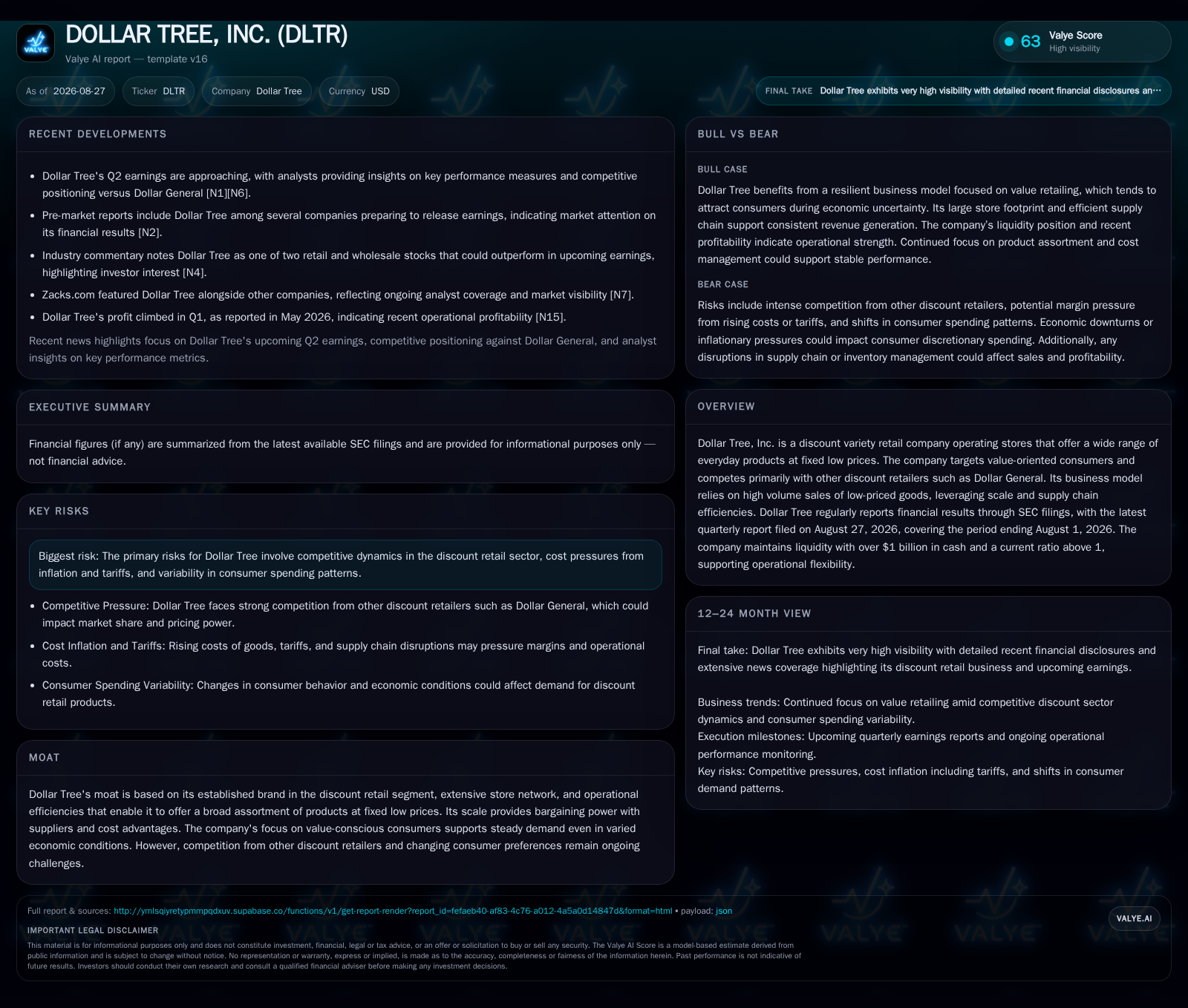
In its Q2 2026 filing ending August 1, 2026, Dollar Tree, Inc. reported no transformational changes to its core fixed-price discount retail business model, reaffirming its scale-driven operational efficiencies. The company maintained a stable liquidity position with a current ratio of 1.13 and cash and cash equivalents exceeding $1 billion, providing a buffer to manage working capital and operational needs. While competitive pressures and inflationary cost risks persist, Dollar Tree's established supply chain and store network continue to underpin its value proposition to price-sensitive consumers.
Dollar Tree, Inc. reported its second quarter 2026 results for the period ended August 1, 2026, confirming continuity in its core fixed-price discount retail business model [S2][S1]. The company did not disclose any transformational changes or new strategic initiatives in its latest 10-Q filing dated August 27, 2026, maintaining its established approach of offering a broad assortment of everyday low-priced merchandise to value-conscious consumers.
Business Model and Operational Continuity
Dollar Tree continues to operate under a fixed-price discount retail model, selling high volumes of low-priced goods including household items, food, and seasonal merchandise. This model relies heavily on operational efficiencies, supplier bargaining power, and inventory turnover to sustain margins. The company’s extensive store footprint and brand recognition support its cost advantages, although competitive pressures and inflationary cost inputs constrain pricing power and require ongoing operational discipline [S1][S2]. The absence of any reported strategic shifts or acquisitions in Q2 2026 confirms that Dollar Tree remains focused on leveraging scale and supply chain efficiencies to serve price-sensitive consumers [S2][S1]. Cash and cash equivalents stood at $1.058 billion at quarter end [F1]. This liquidity position provides a modest buffer to cover short-term liabilities and supports working capital needs, including inventory purchases and supplier payments.
The availability of over $1 billion in cash reduces reliance on external financing and underpins operational flexibility in a competitive discount retail environment [F1][S2]. Maintaining positive working capital is particularly important given the sector’s high inventory turnover and the need to manage seasonal merchandise effectively.
Risk Factors and Competitive Environment
Dollar Tree continues to face risks from competitive pricing pressures, inflationary cost increases, and variability in consumer spending, as outlined in its 2026 annual 10-K risk disclosures [S1]. These factors could impact future margins and sales but were not materially updated in the latest quarterly filing [S2].
Inventory management and markdown cadence during these periods are critical to avoid excess stock and margin erosion. No material changes in these operational dynamics were reported for Q2 2026.
Scenario Analysis and Investor Implications
The base scenario supported by current evidence is that Dollar Tree will maintain its fixed-price discount retail model and stable liquidity, navigating ongoing competitive and cost pressures without major strategic shifts [F1][S2][S1]. Confirmation of this scenario would come from future quarterly filings showing stable liquidity, consistent operating metrics, and absence of significant restructuring or divestitures.
A bear scenario could emerge if competitive pressures and inflation materially erode margins and liquidity, forcing strategic changes [S1][S2]. Indicators would include margin compression, liquidity deterioration, or management commentary highlighting cost or competitive challenges.
Investors should monitor upcoming quarterly liquidity ratios, same-store sales growth, margin trends, and any announcements related to acquisitions, divestitures, or restructuring to assess Dollar Tree’s ongoing operational resilience and financial health.
In summary, Dollar Tree’s Q2 2026 results affirm the company’s continued reliance on its fixed-price discount retail model supported by stable liquidity, with over $1 billion in cash and a current ratio of 1.13 as of August 1, 2026 [F1]. While sector risks remain, the company’s scale and supply chain efficiencies underpin its ability to maintain operational continuity amid competitive pressures.

Comments