
Canton Strategic Holdings Accelerates Institutional Blockchain Treasury and Validator Strategy Post-Biotech Divestiture
Canton Strategic Holdings has completed its exit from biotechnology, sharpening its focus on digital asset treasury management through Super Validator operations on the Canton Network and strategic ecosystem investments.
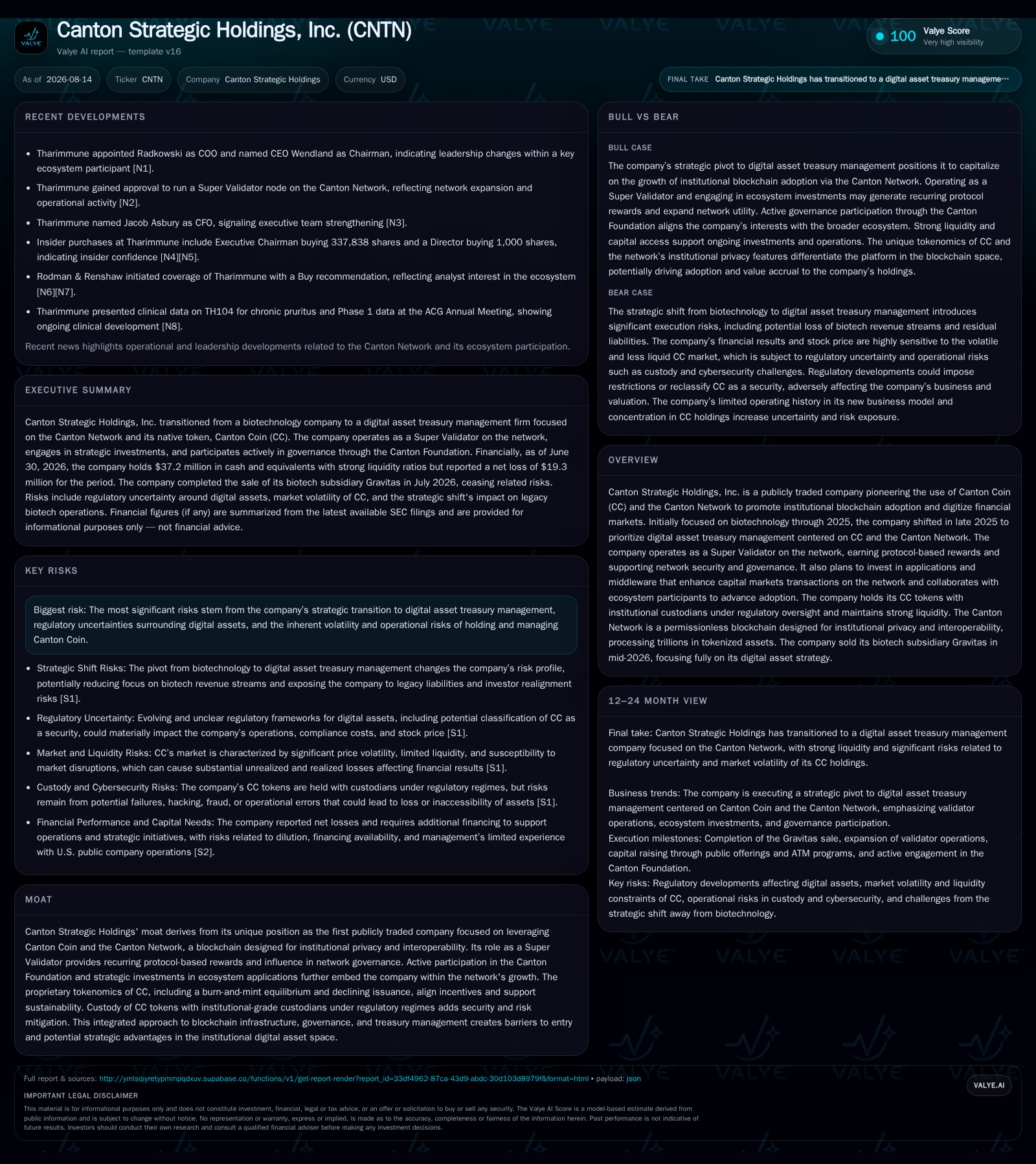
In its August 2026 quarterly filing, Canton Strategic Holdings finalized the divestiture of its biotech subsidiary, marking a decisive pivot to a blockchain infrastructure business model. The company now generates recurring revenue by operating as a Super Validator on the permissionless Canton Network, earning protocol-based CC token rewards while investing in applications and middleware to expand institutional adoption. Strong liquidity with over $37 million in cash underpins plans for validator expansion and ecosystem development. Key risks include regulatory uncertainty around digital assets, CC price volatility, operational uptime requirements, and legacy biotech liabilities.
Recent Operating Update: Completion of Biotech Divestiture Enables Full Digital Asset Focus
Canton Strategic Holdings’ August 14, 2026 quarterly report (10-Q) confirms the completion of its sale of Gravitas on July 17, 2026 [S2][S3]. This transaction marks a definitive exit from clinical-stage biotechnology activities that previously exposed the company to development failures and regulatory uncertainties. By divesting this segment, Canton has materially reduced operational risk and refocused executive resources entirely on its digital asset treasury strategy centered around Canton Coin (CC) and participation in the Canton Network blockchain infrastructure.
This shift was initiated in late 2025 with a rebranding reflecting the new business emphasis [S1]. The recent update underscores progress by clarifying the company’s risk profile and operational priorities exclusively toward blockchain network validation and treasury management.
Business Model: Recurring Revenue from Protocol-Based Rewards via Super Validator Operations
Today, Canton operates primarily as a Super Validator within the permissionless Canton Network blockchain [S1]. The company earns recurring revenue streams through protocol-based validation rewards paid in CC tokens for securing network consensus, validating transactions, supporting uptime reliability, and participating in governance processes [S1][S12]. These rewards depend largely on the number of validator nodes operated and prevailing network transaction volumes.
Beyond validation activities, Canton deploys capital strategically into applications and middleware that integrate tightly with the Canton Network’s capital markets use cases. These investments aim to accelerate ecosystem adoption by enhancing transactional throughput and operational workflows for institutional participants. Such initiatives position Canton to capture upside both from appreciation of invested equity/token holdings and from increased utility-driven demand within its digital asset treasury [S1].
Operationally, Canton's substantial CC holdings are managed under institutional-grade custody arrangements subject to regulatory compliance protocols. This custody framework addresses common crypto market risks related to safekeeping and aligns with institutional investor expectations for regulatory adherence [S1][S21].
The company’s tokenomics are designed around burn-and-mint equilibrium policies coupled with planned declining issuance schedules. This structure aims to reduce supply inflation over time while incentivizing long-term staking participation—factors critical to sustaining token value appreciation alongside continued protocol reward generation [S1].
Industry Context and Competitive Positioning
Canton occupies a specialized segment bridging blockchain infrastructure providers (notably validator operators) and institutional digital asset managers. Unlike peers focused solely on mining or custodial services—such as Marathon Digital Holdings or Coinbase—Canton integrates node operation with treasury management plus targeted strategic investments in ecosystem applications.
As the first publicly traded entity explicitly aligned with Canton Coin exposure, it enjoys early mover advantages including direct involvement in network governance frameworks. This participation enhances influence over tokenomics policy decisions and protocol upgrades while reinforcing trust critical for institutional adoption.
The company's privacy-enabled blockchain architecture combined with high validator node uptime underpins security assurances essential for institutional users demanding resilient transactional environments.
Growth Drivers
Key structural factors propelling Canton's growth prospects include:
- Institutional Blockchain Adoption: Rising demand for permissionless blockchains that offer configurable privacy alongside interoperability is driving interest in networks like Canton capable of atomic settlement across financial institutions.
- Transaction Volume Expansion: Increased integration of applications spanning payments, collateral management, and margin workflows is expected to boost network throughput—and thus protocol reward yields.
- Ecosystem Application Development: Capital investment in middleware platforms that streamline capital markets workflows will lower barriers for institutional onboarding.
- Regulatory Clarity: Progressive maturation of U.S. crypto regulations may reduce compliance uncertainty, facilitating broader institutional custody participation.
- Tokenomics Optimization: The burn-and-mint mechanism combined with declining new coin issuance supports sustainable value accretion incentives crucial for ongoing staking engagement.
Execution milestones relevant to these drivers include growing numbers of active validator nodes beyond initial deployments; regular reporting of CC tokens earned through staking; third-party disclosures evidencing rising network transaction volumes; announcements of new strategic investments; and updates on governance voting power reflecting enhanced influence.
Risks and Watchpoints
Transitioning fully into a digital asset treasury model exposes Canton to several material risks:
- Regulatory Uncertainty: Classification of CC under securities or commodities laws remains unresolved. Enforcement actions akin to prior SEC crypto probes could negatively impact token liquidity or valuation affecting treasury assets [S1].
- Asset Volatility: Fluctuations in CC price materially affect net income through unrealized gains/losses complicating earnings predictability relative to fiat-denominated businesses.
- Operational Dependence: Validator node uptime is critical; outages or security breaches directly reduce rewards accruals while damaging reputation vital for institutional partnership growth.
- Liquidity Considerations: Despite strong current liquidity ($37.2 million cash vs low debt), sudden market dislocations could impair efficient monetization of digital assets without incurring losses during illiquid periods [F1].
- Legacy Biotech Liabilities: Residual obligations from prior biotech operations may divert financial or managerial resources away from core blockchain initiatives [S1][S17].
- Investor Base Realignment: Shareholders attracted by former biotech prospects may reduce support or exit shares amid strategic transition uncertainty leading to stock price volatility [S1][S17].
What To Watch Next
Indicators signaling execution progress include:
- Quarterly disclosures quantifying active validator nodes operated alongside staking rewards received denominated in CC tokens.
- Announcements detailing new ecosystem investments or sponsorships highlighting sectors or applications targeted within the Canton Network.
- Updates on governance involvement specifying voting power held or influence exerted within foundation initiatives or tokenomics adjustments.
- Metrics evidencing growth in network transaction activity pointing to broader institutional adoption beyond pilot phases.
- Capital raises or balance sheet refinements earmarked for expanding CC treasury positions or funding strategic ecosystem ventures.
Management commentary addressing regulatory risk mitigation strategies will also be key qualitative insights.
Financial Profile Discussion
As of June 30, 2026, Canton maintains robust liquidity characterized by $37.2 million in cash and equivalents against approximately $2.6 million in current liabilities—a strong current ratio near 15.7x—demonstrating substantial short-term financial flexibility supportive of ongoing strategic initiatives [F1]. Total debt remains minimal at around $161 thousand reflecting conservative leverage relative to treasury assets held [F1].
This balance sheet strength underpins planned expansion of validator infrastructure alongside capital deployment into ecosystem investments without immediate refinancing concerns.
Operating losses persist primarily due to legacy biotech-related costs with net losses exceeding $35 million for the year ended December 31, 2025; future profitability will depend on scaling recurring protocol reward revenues combined with prudent management of digital asset valuation volatility inherent in CC holdings [F1][S1]. Monitoring net income variability driven by market price swings versus core operating income generated by validator activities will be essential for assessing financial sustainability.
This analysis synthesizes publicly available disclosures without making predictive judgments about stock price performance or investment suitability.
Disclaimer: This is research-only, informational analysis and not investment advice. It may include AI-generated interpretation and general industry context. Always verify important details using primary sources.

Comments