
NexPoint Diversified Real Estate Trust Navigates Affiliated Management Conflicts and REIT Qualification Amid Moderate Portfolio Scale
NXDT's latest quarter highlights stable revenue and structural governance tools, while affiliated management and REIT tax tests present ongoing operational challenges.
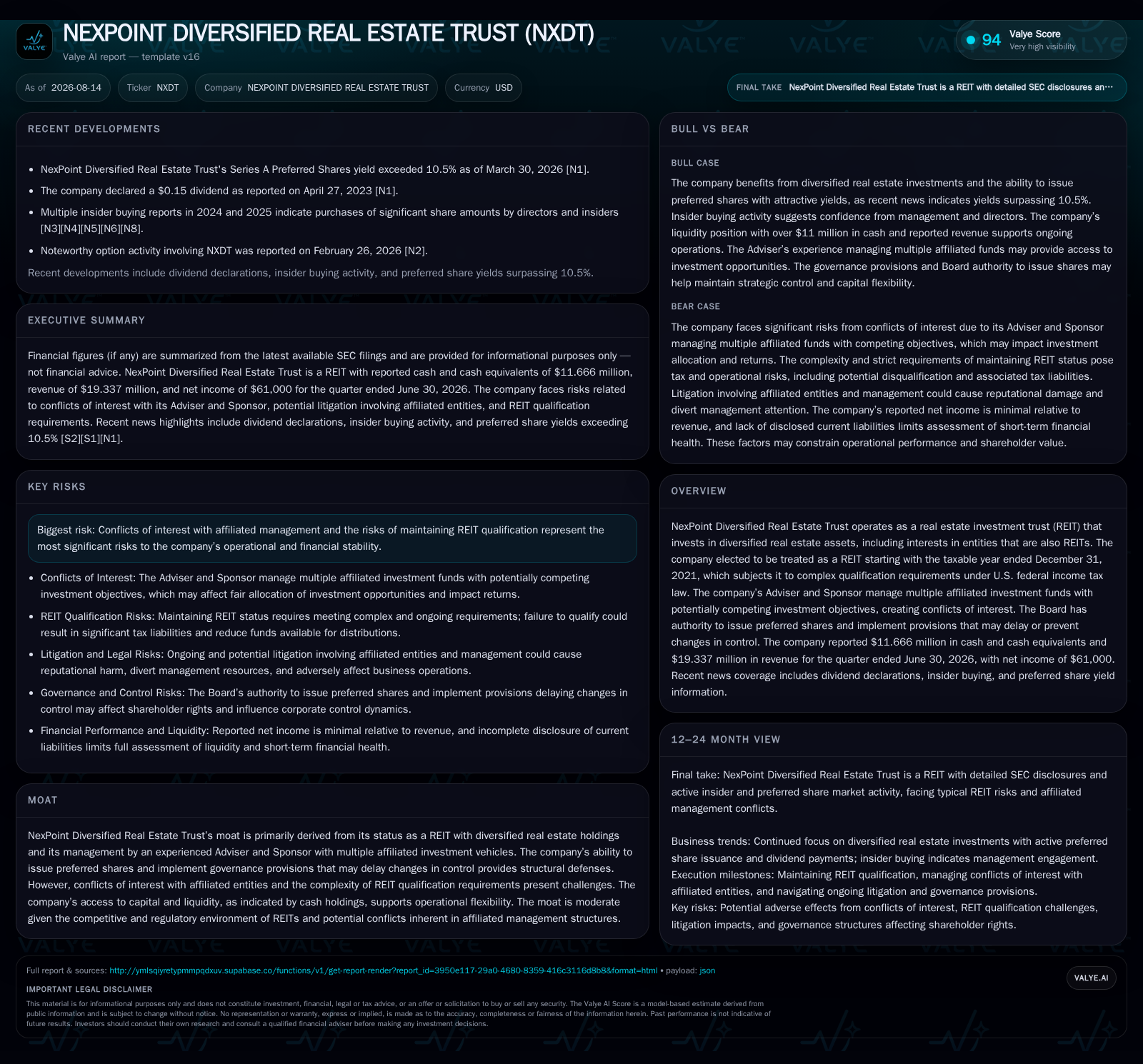
NexPoint Diversified Real Estate Trust reported $19.3 million in revenue and minimal net income of $61,000 in Q2 2026, maintaining steady cash reserves around $11.7 million [S2][F1]. The company’s diversified REIT structure relies heavily on affiliated advisers managing multiple funds, which introduces conflicts of interest risks that may affect investment allocations and returns [S1]. NXDT continues to wield preferred shares issuance and governance provisions to defend control changes [S3], but must carefully navigate complex IRS REIT qualification rules given its investment mix. With meaningful leverage near $284 million, optimizing capital efficiency amid interest rate fluctuations remains a key factor for sustainability. Absent material changes to risk factors in the quarter [S2], NXDT’s growth hinges on prudent asset diversification, disciplined capital access, and controlled management conflicts.
Recent Operating Update
Notably during mid-2026’s shareholder meeting formalized via an 8-K filing dated June 2, the company approved issuance arrangements allowing conversion or redemption of its Series B Preferred Shares into common stock [S3]. This governance flexibility enhances NXDT’s ability to manage capital structure proactively and defend against potential shifts in corporate control. At the same meeting shareholders approved a new Long Term Incentive Plan designed to attract and retain key executives—highlighting a deliberate focus on aligning management incentives with shareholder interests over time [S3].
Business Model Overview
NXDT operates as a diversified publicly traded REIT investing across various real estate sectors including equity interests in entities that themselves qualify as REITs under U.S. tax law. Since electing REIT status starting with fiscal year December 31, 2021, the company must adhere strictly to internal qualifying criteria regarding income source composition and asset requirements mandated by federal tax code sections applicable to REITs [S1]. The company profits primarily through rental income streams or returns on invested real estate-related assets such as mortgage loans.
Monetization hinges on effectively balancing diversified real estate ownership with debt financing: rental or investment income feeds through as revenue while large fixed obligations from debt service impact net profitability and cash flow available for dividends. Distributions dominate shareholder returns given REITs’ legal obligation to payout most taxable income—thus funds from operations (FFO) remain critical metrics underlying dividend sustainability even though NXDT’s filings do not explicitly state FFO figures currently available.
Crucially for NXDT’s business profile is reliance on an external Adviser who manages multiple affiliated publicly traded REITs including residential (NXRT), single-family rentals (VineBrook Homes), and mortgage-focused vehicles (NREF). This overlapping advisory ecosystem introduces inherent conflicts of interest risks that could influence the allocation of lucrative investment opportunities across related entities rather than prioritizing NXDT exclusively [S1]. Consequently investors face increased uncertainty on whether capital will be deployed optimally within NXDT rather than diverted toward higher-fee or preferred assets elsewhere within the Adviser’s sphere.
Industry Structure and Competitive Position
Within the market context of U.S.-listed diversified equity REITs—comparable broadly but not identically to large public groups like Brookfield Property Partners or industrial/warehouse specialists such as Prologis—NXDT occupies a moderate scale position with its holdings spread across sectors without dominant concentration in any single property type or geography. Its capital structure features preferred equity issuance as a tool permitting flexible financing alongside traditional secured debt sources; this approach is common for externally advised REITs seeking protective governance provisions.
NXDT's position as an externally advised vehicle differs notably from internally managed peers who often benefit from closer alignment between management teams and shareholders via direct employment relationships. External advisory models can generate cost inefficiencies due to advisory fees but also allow sponsors tradeoffs in pursuing multiple investment vehicles with potentially competing objectives. Such sponsor involvement creates governance complexities amplified by NXDT’s Board-authorized rights enabling issuance or redemption of preferred shares meant partially as defense mechanisms against hostile takeovers or abrupt strategic shifts [S3].
The company contends with typical sector headwinds: fluctuating commercial real estate valuations driven by economic cycles; interest rate sensitivity impacting both borrowing costs and cap rates; tenant occupancy dynamics; regulatory risk around maintaining strict adherence to IRS REIT qualification criteria; and operational exposures including lease renewals or defaults.
Growth Drivers
NXDT’s growth potential centers on seven interrelated vectors: rising rents and improved occupancy in target asset classes; prudent acquisition strategies focusing on accretive real estate investments with attractive capitalization rates; access to capital markets for funding expansion through debt or equity issuance; cost discipline enabled by operational oversight despite external advisory fees; increasing diversification across property types reducing concentration risk; a favorable interest rate environment unlocking leverage efficiencies; and possible internalization of management functions aiming to improve cost structures and investor alignment [S1]
Successful execution along these lines depends critically on maintaining robust liquidity and financial flexibility given sizable existing leverage, which heightens refinancing risk particularly if macroeconomic conditions deteriorate or credit spreads widen undesirably. Furthermore, growth is conditioned by effective resolution of the affiliation conflicts that potentially dilute NXDT's access to best-in-class investments within the Sponsor's broader fund family.
Risks and Watchpoints
Key risks intrinsic to NXDT involve its affiliated management model producing persistent conflicts of interest that could hamper shareholders’ returns if investment opportunities skew toward other Sponsor-affiliated funds with overlapping priorities [S1]. Maintaining compliance with complex IRS Section 856 gross income and asset tests poses another existential threat: failure here would jeopardize NXDT’s advantageous REIT tax treatment leading to significant financial consequences.
Additional systemic challenges arise from interest rate volatility affecting borrowing costs on its debt load plus valuation mark-to-market effects across property holdings. Asset illiquidity inherent in real estate markets may constrain timely capital redeployments or responses during downturns. Regulatory shifts or governance disputes over internalization attempts could also distract resources or impose additional costs.
Monitoring dividend coverage relative to funds generated from operations (FFO) will be critical since declared dividend payments must balance distribution requirements with sustainable cash flows — the current near-zero net income outcome underscores narrow margins of error for payout adjustments. Liquidity scrutiny should focus on cash reserves relative to financing maturities given NXDT's leverage scale.
What to Watch Next
Investors should track several key milestones: any announcement regarding internalization transactions that would shift management functions internally could materially alter expense profiles and reduce conflict risks but carries integration uncertainties [S1]. The evolution of preferred share conversion/redemption activities bears on share count dilution potential as well as recapitalization strategies approved recently by shareholders [S3]. Additionally, future quarterly updates revealing shifts in occupancy rates, lease renewals, rental rate trends or FFO guidance would provide directional clarity about core operating health.
Furthermore, given the static risk factor disclosure this quarter [S2], material changes anticipated would likely stem from macroeconomic shocks—such as abrupt interest rate hikes or recession-induced real estate downturns—that stress occupancy or refinancing capacities. Finally, corporate governance developments reflecting Board decisions addressing Sponsor allocation conflicts may shape investor perceptions about alignment quality over time.
Financial Profile Discussion
At quarter-end June 30, 2026, NexPoint Diversified Real Estate Trust maintained liquidity measured by roughly $11.7 million cash equivalents balanced against total indebtedness nearing $284 million—yielding net debt around $272 million [F1]. This significant leverage level mandates disciplined capital structure management given exposure to interest rate fluctuations that modify cost of capital directly impacting distributable earnings potential.
While reported net income was negligible at $61 thousand for Q2 2026 [S2], this figure alone does not capture normalized earning power since FFO—which adjusts for non-cash depreciation—is more relevant for dividend coverage analysis typical across REITs although not explicitly quantified here. The presence of preferred shares introduces additional obligatory dividend layers that squeeze retained earnings available for reinvestment or common distributions.
Absence of material balance sheet impairments or sizable revisions in risk factors during the quarter implies steady financial footing absent unforeseen market events but warrants close monitoring due to high leverage combined with limited earnings buffers. The recently approved Long Term Incentive Plan reflects management commitment toward enhancing value creation capabilities amidst governing constraints posed by affiliated sponsorship and regulation complexities [S3].
Disclaimer: This analysis is for informational purposes only based on publicly disclosed filings as cited (SEC filings S#; Financial data F#). It does not constitute investment advice or research views.
Disclaimer: This is research-only, informational analysis and not investment advice. It may include AI-generated interpretation and general industry context. Always verify important details using primary sources.

Comments