
Hubilu Venture’s Struggle with Scale and Financial Constraints in Student Housing Real Estate
As a micro-cap real estate firm focused on student housing in Los Angeles, Hubilu Venture faces operational challenges amplified by thin liquidity and limited management experience.
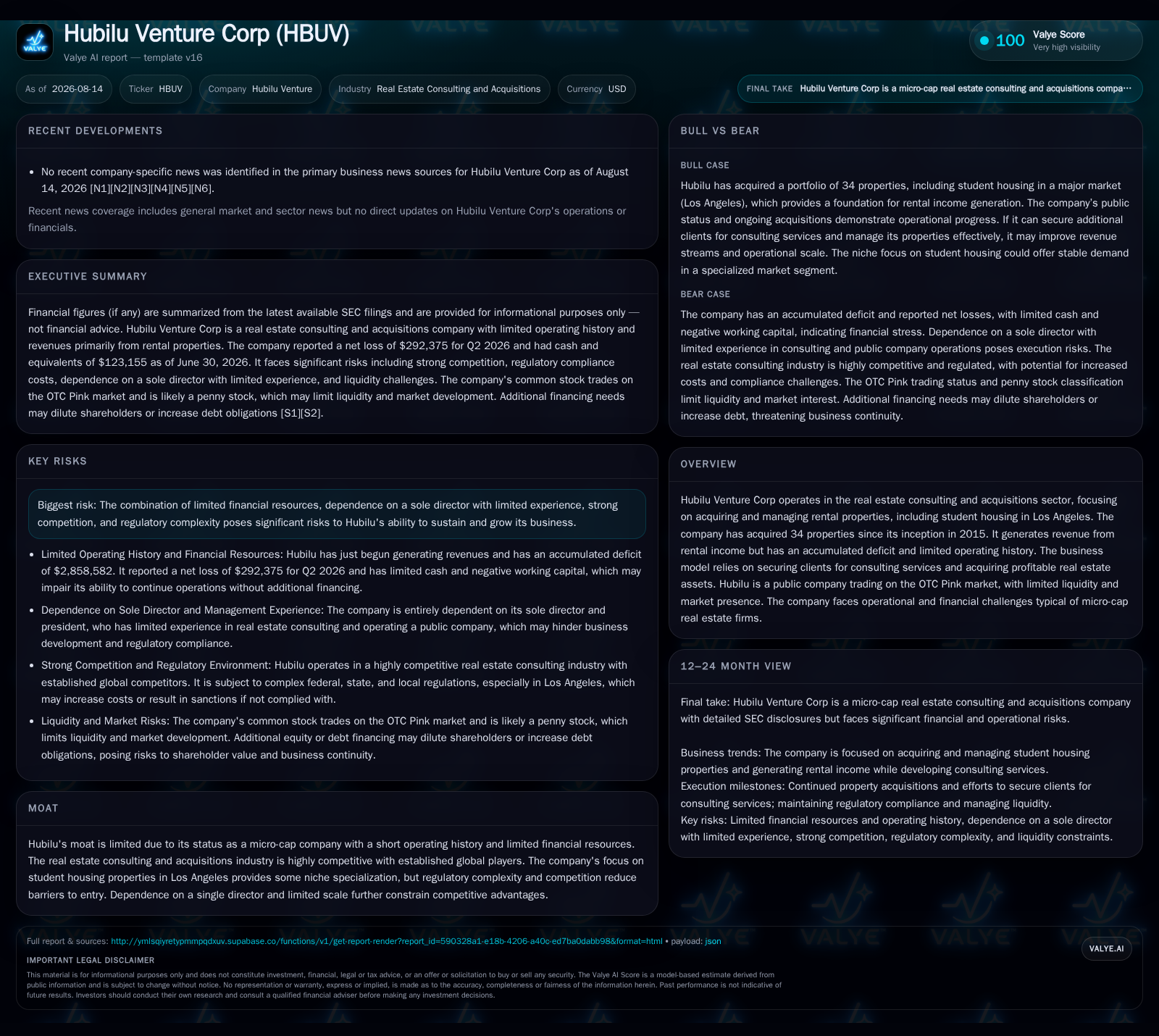
Hubilu Venture Corp operates primarily by acquiring and managing rental properties with a niche focus on student housing in Los Angeles, generating revenue predominantly from rental income. Despite accumulating 34 properties since inception, the company grapples with sustained operating losses, an accumulated deficit exceeding $2.8 million, and precariously low liquidity that constrains operational scale. Management's limited public company and consulting background further impairs growth potential amid fierce industry competition and regulatory complexity. Capital constraints and dependence on a sole director underscore elevated risks for sustaining profitability or scaling consulting revenues.
Recent Operating Update
Hubilu Venture Corp's latest quarterly filing dated August 14, 2026, confirms ongoing operational strains typical for a micro-cap real estate firm. The company's portfolio growth continues through incremental acquisitions of vacant properties within Los Angeles' student housing segment. Notably, in 2025 Hubilu purchased three vacant properties — at 417 W 52nd Place ($525K), 1460 Exposition Blvd ($520K), and 1434 W. 22nd Street ($640K) — all financed by first-position loans bearing near-10% interest rates and requiring balloon repayments within one year [S9][S10][S16]. These transactions illustrate aggressive capital deployment but also highlight refinancing risk given the short maturity structure amid constrained liquidity.
Financially, the firm reported a negative working capital position totaling approximately $1.48 million as of June 30, 2026, with current assets standing at roughly $140K against current liabilities exceeding $1.6M [F1]. The painfully low current ratio (0.09) underlines tight near-term financial flexibility exacerbated by net debt amounting to nearly $22.8 million after accounting for limited cash [F1]. This balance sheet profile restricts Hubilu’s ability to absorb shocks or capitalize quickly on acquisition opportunities without incurring additional dilutive equity or costly financing.
Business Model Analysis
Hubilu operates a dual business model comprising direct property ownership generating rental income and offering real estate consulting services. Revenue flows principally from tenant lease payments on owned assets; however, portfolio occupancy rates and tenant retention are critical operating variables currently materially impacting cash flows due to recent acquisitions starting out vacant [S1]. Consulting fees are anticipated from advising third-party clients on real estate projects but remain unproven revenue streams given management’s admitted limited experience in this domain [S1].
Revenue mechanics are closely linked to property acquisition volume (expansion pace), occupancy rates (tenant demand sustainability), lease terms (duration affecting stability), operating expense control (maintenance and management cost efficiency), and capital expenditure discipline (asset quality preservation). Margins derive from net operating income generated by rental yields minus direct operating costs. Consulting revenues would diversify income streams if successfully scaled but face client adoption challenges due to competitive dynamics and managerial capacity issues.
Contractually, Hubilu secures financing via high-interest loans tied directly to each property acquisition rather than a centralized capital structure. These loans carry monthly interest-only payments followed by balloon principal repayments within one year post-acquisition — heavily pressuring short-term cash flow planning [S9][S10][S16]
Industry Structure and Competitive Position
Within the real estate consulting and property management sector focused on student housing, competition ranges from large publicly traded REITs such as Equity Residential who bring scale economies and diversified geographic exposure, to specialized operators offering tailored student living environments with established tenant pipelines. Meanwhile, major advisory firms like CBRE or JLL dominate consulting service contracts due to broad institutional relationships.
Hubilu lacks scale relative to these peers: its portfolio comprises only dozens of properties mostly clustered geographically with no disclosed diversification across asset classes or regions [S1]. This concentration exposes it heavily to local market cycles specific to Los Angeles student demand and regulatory shifts. Its OTC Pink listing status entails limited trading liquidity constraining capital raise options compared to exchange-listed peers [S1][S15]. Furthermore, the absence of independent directors or extensive management teams reduces governance robustness versus larger competitors.
Regulatory oversight is intense in Los Angeles where multifaceted municipal rental regulations add layers of cost and compliance complexity not easily managed without expertise or dedicated resources [S1]. This dynamic favors established firms able to absorb compliance burdens or innovate around evolving rules — areas where Hubilu currently shows operational weaknesses.
Growth Drivers
Niche specialization in student housing can yield advantages tied to stable demographic trends around university populations and secular urbanization favoring rentals over homeownership among younger cohorts. Rising property values and escalating rents in Los Angeles can enhance asset appreciation potential and rental yields if occupancy is maintained.
Expansion opportunities exist through: (1) scaling the property portfolio via accretive acquisitions financed prudently; (2) leveraging consulting capabilities targeting institutional clients seeking market entry or portfolio optimization; (3) improving tenant occupancy through enhanced property management delivering higher retention rates; (4) adopting technology solutions improving operational efficiencies.
However, evidence points to slow ramp-up in consulting revenues due mainly to management’s inexperience in securing client contracts [S1], underscoring limits on near-term growth diversification beyond rental cash flow.
Risks / Watchpoints / Growth Constraints
Key risks envelop tightly linked financial constraints including very limited liquidity evidenced by working capital deficits and heavy reliance on expensive short-term debt requiring refinancing unless rapid operational improvements generate free cash flow [F1]. Failure to refinance or raise equity exposes the company to possible insolvency scenarios.
Operational scalability is hampered by an undiversified leadership team lacking depth typical of successful consultancies or REIT managements; dependence on a solitary director raises single-point-of-failure concerns [S1]. Regulatory complexity imposes costly compliance overheads disproportionately burdening small firms.
Competitive challenges are acute given dominance of well-capitalized peers boasting broader service offerings, stronger brand presence, deeper tenant networks, and more sophisticated asset management. Without breakthrough customer wins or margin improvement this gap will widen.
Investor base limitations owing to OTC Pink market tier reduce liquidity making share price discovery inefficient while potentially increasing bid-ask spreads discouraging institutional participation [S15]. Additionally, prospective dilution looms if future financing requires issuing shares at unfavorable valuations.
What to Watch Next
Near-term milestones include monitoring occupancy uptake rates for recently acquired vacant properties which will be pivotal for stabilizing rental income streams. Tracking any emerging consulting contracts won would signal progress diversifying revenue beyond asset ownership.
Capital management strategies remain critical: how Hubilu addresses looming balloon loan maturities by late 2026 — via refinance terms or new capital injections — will materially impact sustainability.
Regulatory developments especially any changes in local LA rental laws could alter operating cost structures; disclosures hint management must improve compliance systems given complexity cited [S1].
Operational execution steps such as hiring advisory personnel augmenting consulting sales capability would be cautiously positive signals that barriers posed by limited director experience are being addressed.
Financial Profile Discussion
At the end of Q2 2026, Hubilu held scant current assets (~$140K) against over $1.6 million in current liabilities placing its current ratio at just 0.09 — profoundly below comfort thresholds indicating acute short-term solvency stress [F1]. Cash on hand lags significantly behind total debt liabilities exceeding $22.8 million net after subtracting cash reserves [F1], reflecting leveraged acquisition finance structures largely composed of fixed-rate notes at circa 10% interest demanding balloon payoffs within months [S9][S10][S16].
Operating losses have been persistent with an accumulated deficit approaching $2.9 million as of end-2025 emphasizing persistent profitability challenges amid investment stage operational spend outpacing revenue growth [F1][S1]. While rental income forms most top-line revenue, growth has yet to yield positive net free cash flow coverage for debt servicing requirements.
The company's financial survival hinges on external capital availability either via equity issuance risking dilution or debt refinancings which may come at unfavorable terms given OTC Pink micro-cap status limiting access.
Management also bears elevated legal and reporting compliance costs innate to maintaining public company status often disproportionate for such micro-caps affecting net operating margins further [S1][S15].
Disclaimer: This analysis does not constitute investment advice or research views but aims to provide a detailed sector-specific perspective grounded in available regulatory filings and industry context relevant as of August 2026.
Disclaimer: This is research-only, informational analysis and not investment advice. It may include AI-generated interpretation and general industry context. Always verify important details using primary sources.

Comments