
Genprex Regains Nasdaq Compliance While Advancing Gene Therapy Pipeline Amid Capital Challenges
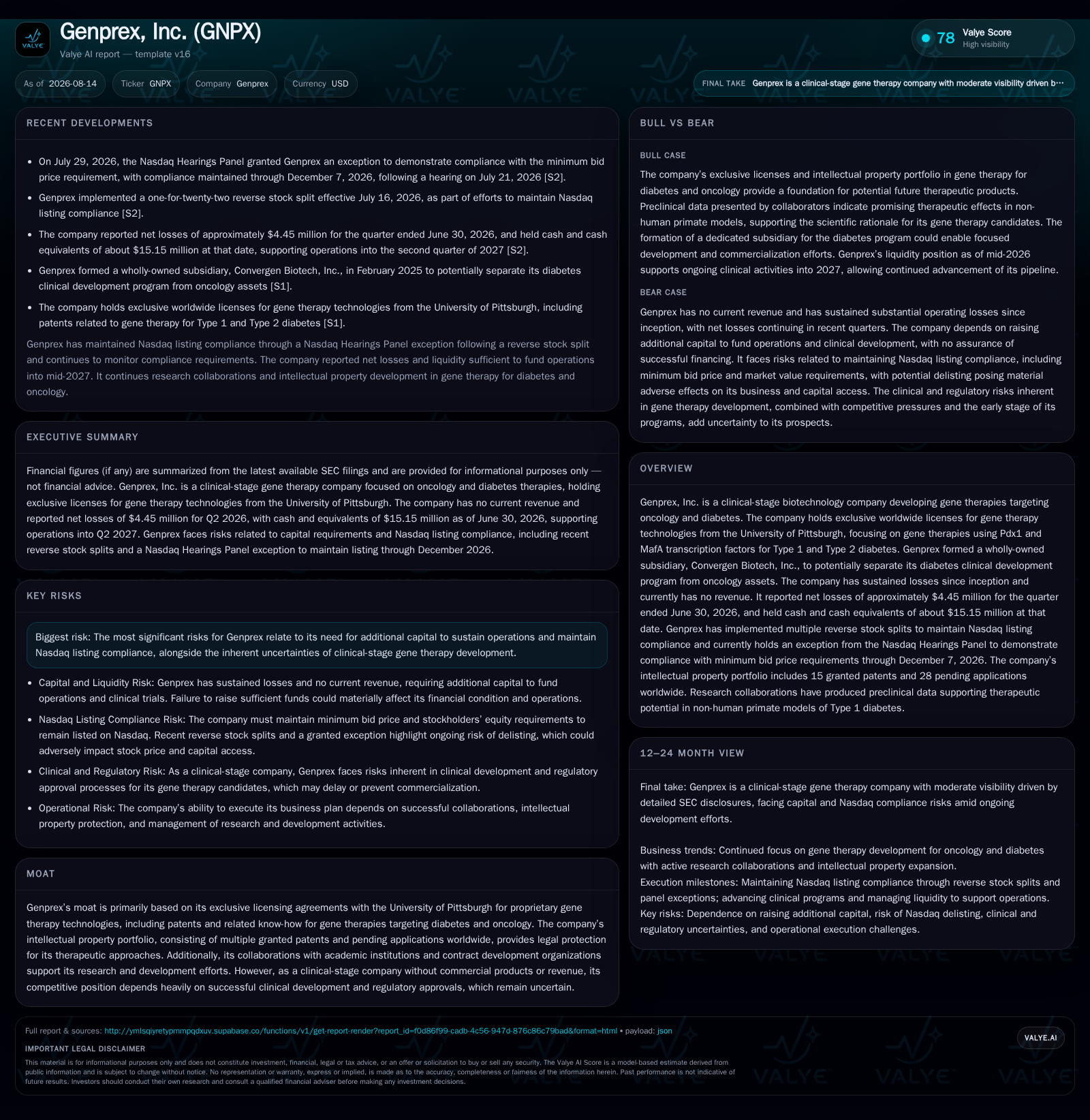
Genprex reported a net loss of $4.45 million in Q2 2026 with $15.15 million cash on hand, maintaining Nasdaq listing compliance via a temporary exception while progressing clinical-stage gene therapies targeting oncology and diabetes.
Genprex, a clinical-stage biotech focused on gene therapies for oncology and diabetes, recently secured a critical extension to maintain Nasdaq listing compliance after regaining the required $1 minimum bid price. The company reported ongoing net losses driven by R&D expenses, with no revenue and cash runway that remains pressured though sufficient near-term to support clinical development. Its exclusive licenses from the University of Pittsburgh underpin proprietary gene therapy programs, notably GPX-002 for diabetes, supported by promising preclinical data but yet to advance beyond early clinical stages. The company's growth trajectory hinges on successful trial progression, FDA regulatory milestones, and access to additional capital—risks shared broadly across comparable gene therapy developers.
Recent Operating Update
Genprex's latest quarterly filing for Q2 ended June 30, 2026 reveals a continuing pattern typical of clinical-stage biotechnology firms heavily invested in R&D but without current product revenue streams. The company posted a net loss of approximately $4.45 million during the quarter in large part due to expenses related to advancing its gene therapy pipeline through preclinical and clinical development stages [F1][S2]. Despite these operational losses, Genprex maintained liquidity with cash and cash equivalents totaling about $15.15 million at quarter-end, yielding a strong current ratio of nearly 6.8 due to relatively low current liabilities [F1]. This liquidity provides a limited but essential runway for ongoing research activities.
A material near-term positive was the resolution of Nasdaq listing concerns: after falling below the minimum bid price threshold of $1 per share earlier in 2026—which triggered a delisting threat—Genprex successfully petitioned the Nasdaq Hearings Panel for an exception to regain compliance as of August 4, 2026. The Panel has granted an extension through December 7, 2026 during which Genprex must sustain the minimum bid price daily while maintaining disclosure obligations [S3]. This regulatory reprieve is crucial since Nasdaq listing status strongly affects investor confidence and future capital raising capabilities.
Business Model Overview
Operating as a clinical-stage biotechnology company without commercial products or revenues forces Genprex into reliance on equity financing or partnerships to fund its operations. The company's value rests on proprietary intellectual property leveraged via exclusive worldwide licenses from the University of Pittsburgh focused on gene therapies employing Pdx1 and MafA transcription factors delivered by adeno-associated virus vectors directly into pancreatic ducts for diabetes treatment [S1]. These transcription factors act as master regulators aiming to restore insulin production capability.
Monetization will ultimately come through successful regulatory approval followed by commercialization or out-licensing deals that generate royalties or milestone payments. Until then, operating losses related primarily to R&D expenses dominate financial results. This cost-intensive business model shares characteristics with other early-stage gene therapy developers such as Bluebird Bio or REGENXBIO that also hold rare IP-based assets requiring extensive trials before market entry.
Furthermore, Genprex has formed Convergen Biotech Inc., a wholly owned subsidiary intended as a vehicle possibly to segregate its diabetes-focused assets from oncology-related programs—a strategic maneuver that could clarify its asset portfolio focus and potentially unlock more tailored partner interest or financing options [S1]. This separation may help investors better assess developmental progress across distinct therapeutic areas.
Industry Structure and Competitive Position
Within biotechnology’s innovation-centric ecosystem, companies like Genprex occupy an upstream position heavily focused on discovery science, technology licensing arrangements with academic institutions (namely University of Pittsburgh), and progressing candidates through costly clinical trials requiring close FDA interactions. Intellectual property forms the core moat protecting these sophisticated biological inventions—multiple granted patents alongside pending applications globally confer exclusivity for their gene therapy constructs targeting both Type 1 and Type 2 diabetes.
Competition arises not only from other gene therapy developers pursuing similar targets but also from incumbent pharmaceutical players developing biologics or alternative treatments for diabetes complications or cancers in oncology segments. Peer companies typically benchmark on metrics such as number of active clinical trials underway, phase progression speed, regulatory feedback cycles completed successfully, breadth of IP rights secured, collaboration deals executed with contract research organizations or larger pharma partners, and cash burn efficiency.
In this context, Genprex’s partnership with UP institutions offers scientific validation but faces industry-wide challenges around trial enrollment rates (particularly in complex diseases), manufacturing scale-up readiness needed for viral vector production—a known bottleneck—and uncertain reimbursement landscapes post-approval given high-cost gene therapies’ pricing debates.
Growth Drivers
Key growth catalysts will depend upon achieving important developmental milestones such as:
- Advancement of GPX-002 in clinical trials demonstrating efficacy signals sufficient to warrant progression to later phases;
- Successful completion of FDA meetings providing positive regulatory guidance reducing uncertainty in approval timelines;
- Expansion of licensing agreements or new collaborations enhancing both development funding and technical capabilities;
- Strengthening patent portfolio coverage ensuring competitive exclusivity over next decade;
- Advances in adeno-associated virus vector engineering improving delivery efficiency and lowering safety concerns;
- Positive preclinical data translations encouraging investor confidence and potential partnering interest.
These elements collectively enhance Genprex’s ability to attract necessary capital injections critical given ongoing net losses.
Risks and Watchpoints
The most significant risks confronting Genprex revolve around:
- Ongoing need for substantial additional funding; failure to secure acceptable financing terms could force delays or operational curtailments;
- Clinical results falling short of expectations causing pipeline devaluation;
- Regulatory setbacks including requests for extensive additional trials prolonging cost burdens;
- Manufacturing challenges scaling viral vector production at commercial scale;
- Potential intellectual property disputes or inability to enforce licensing rights threatening exclusivity;
- Market acceptance uncertainties due to competitor innovations or payer reluctance amid expensive gene therapies;
- Stock price volatility exacerbated by Nasdaq listing pressures—failure to maintain bid price above $1 after December 7 could lead to delisting adversely impacting capital access.
Monitoring how these risks evolve will be vital for assessing future operational viability.
What to Watch Next
Investors and analysts should track several key indicators over the coming months:
- Updates on patient enrollment progress in any ongoing Phase 1/2 studies for GPX-002 or oncology programs validating trial feasibility metrics;
- Announcements arising from FDA communication reflecting regulatory sentiment about clinical program designs;
- Fundraising activities including public equity offerings or strategic partnerships that extend cash runway beyond late 2026;
- Intellectual property developments such as newly granted patents reinforcing competitive position;
- Market performance trends maintaining compliance with Nasdaq trading standards post-exception period ending December 7.
Such markers will provide insights into execution momentum necessary to transition from pre-revenue research into viable commercial enterprise.
Financial Profile Discussion
The absence of any reported revenues underscores the company's stage in its lifecycle where value creation remains dependent principally on keeping candidate pipelines advancing through costly preclinical studies and regulatory trial phases [S1][S2]. Financing risk remains prominent given ongoing expenditures required ahead of commercialization opportunities—a dynamic shared broadly across peer gene therapy biotech companies.
In summary, Genprex maintains valuable exclusive intellectual property licenses underpinning novel gene therapies aimed at clinically challenging indications like diabetes. The company faces typical biotech hurdles: sustained negative earnings while building toward pivotal clinical milestones requiring additional capital infusions amid volatile stock market conditions linked closely to Nasdaq listing criteria compliance. Progress measured by regulatory interactions, trial phase advancement, cash management efficiency, and eventual patient impact evidence will dictate its path forward within a competitive but scientifically promising sector.
Disclaimer: This analysis is based solely on publicly filed SEC documents dated up to August 14, 2026 ([S1], [S2], [S3]) supplemented by companyfacts financial data ([F1]) without any investment advice or forward-looking projections.
Disclaimer: This is research-only, informational analysis and not investment advice. It may include AI-generated interpretation and general industry context. Always verify important details using primary sources.

Comments