
BHAV Acquisition’s Capital Position and Timeline Highlight SPAC Viability Challenges
BHAV Acquisition Corp’s latest quarterly filing underscores its sound liquidity profile amid critical timing pressures typical of early-stage SPACs poised for business combination decisions.
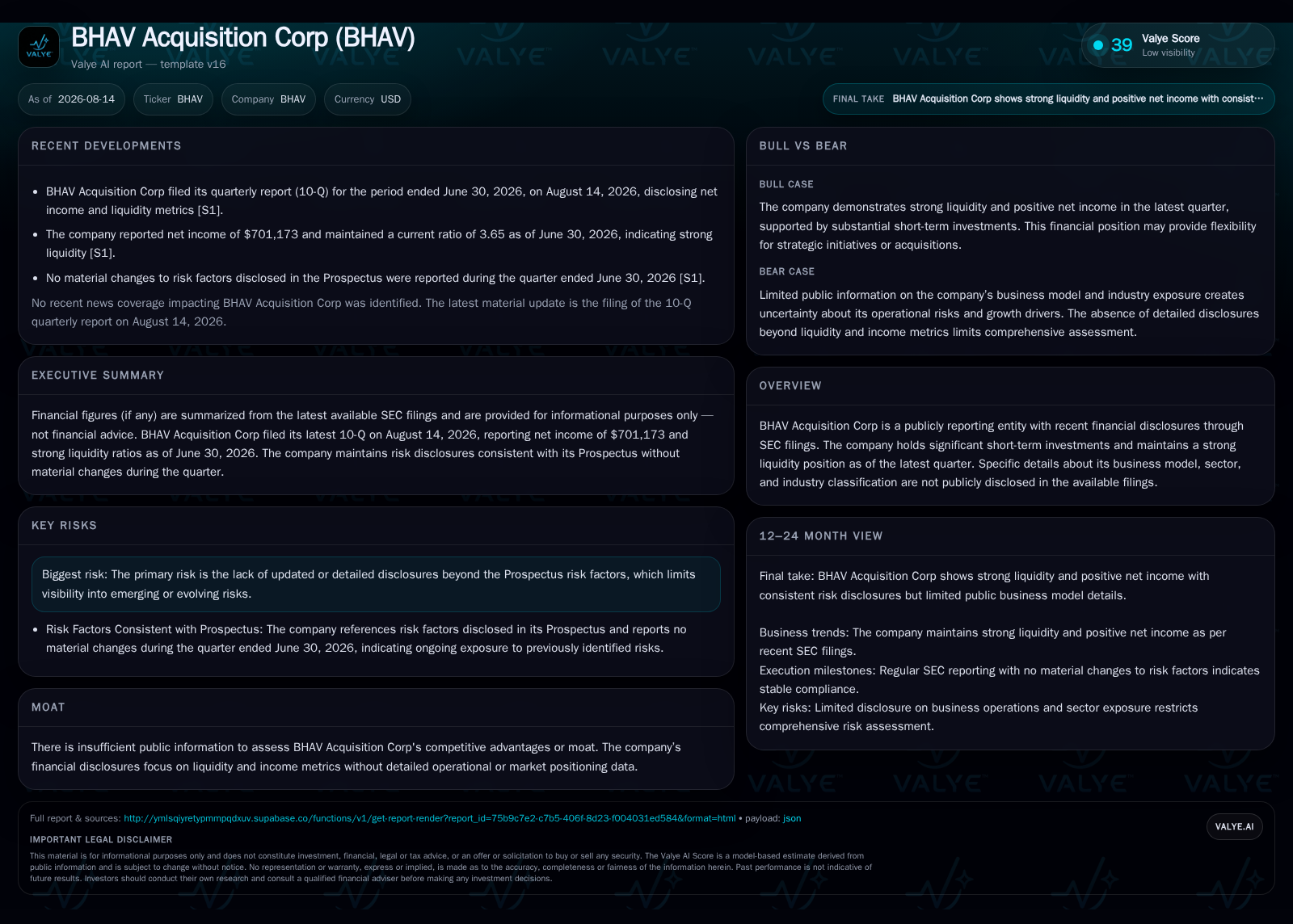
BHAV Acquisition Corp maintains strong liquidity with a current ratio of 3.65 supported by approximately $880,000 in current assets versus $241,000 in liabilities as of June 30, 2026 [F1]. The company completed its IPO in March 2026 raising $100 million through units comprised of Class A ordinary shares and fractional rights, with an additional $2 million from private placements to sponsors and at-risk investors [S8][S13]. As a Special Purpose Acquisition Company, BHAV's primary focus remains on identifying a target for business combination within the charter-mandated timeframe, with redemption rights posing potential constraints on available acquisition capital [S2][S8]. The absence of detailed operational disclosures limits visibility into emerging risks or deal progress, making trust account management and sponsor incentives key areas to monitor going forward.
Quarterly Liquidity Update Signals Cash Buffer Adequacy Ahead of Business Combination Deadline
BHAV Acquisition Corp’s latest quarterly report filed August 14, 2026, reveals a strong liquidity position with current assets standing at approximately $880,272 against current liabilities totaling $241,084, resulting in a current ratio of 3.65 as of June 30, 2026 [F1][S2]. This indicates that BHAV holds sufficient short-term resources relative to obligations, a critical metric given its SPAC nature wherein operating revenues are minimal or nonexistent prior to completing a business combination. The bulk of liquid assets resides in the trust account established with Continental Stock Transfer & Trust Company acting as trustee [S10], which safeguards IPO proceeds until deployment is authorized by shareholder votes or merger completion.
Given the typical SPAC cash burn profile characterized mainly by structuring costs and administrative expenses rather than operational outlays, this liquidity buffer is consistent with standard capital usage pacing pre-deal announcement [S8]. However, the timeframe set by BHAV’s amended charter imposes urgency on deploying these funds within the allowed window or facing mandatory liquidation—heightening the importance of managing both liquidity and redemptions effectively
SPAC Unit Structure and Capital Raised: Implications for Investor Rights and Deal Flexibility
BHAV conducted its initial public offering (IPO) in March 2026 pricing 10 million units at $10 each, raising gross proceeds of $100 million from public investors [S8][S12][S13]. Each unit comprises one Class A ordinary share coupled with one right entitling holders upon consummation of a business combination to purchase an additional one-fourth Class A share. This fractional rights component reflects common structuring intended to incentivize investor participation by providing upside exposure post-deal while maintaining near-par capital preservation pre-merger.
Additionally, BHAV raised roughly $2 million through private placement units sold simultaneously to the sponsor (BHAV Partners LLC) and at-risk third-party investors under identical terms [S17][S18]. These private units were sold without underwriting commissions and subject to transfer restrictions until post-business combination completion or expiration.
The rights agreement governs separation mechanics whereby holders may separately trade Class A shares and rights starting mid-April 2026, enhancing liquidity options for investors prior to deal closure [S4][S11]. Such mechanisms influence both market pricing dynamics for units/shares and shareholder redemption strategies impacting deal funding availability.
Redemption Rights and Shareholder Behavior: Constraints on Available Acquisition Capital
A hallmark feature shaping BHAV’s capital deployment prospects is public shareholder redemption rights allowing tendering for cash distributions from the trust account prior to merger approval votes. While no explicit redemption rate is disclosed yet given the early stage since IPO closing [S2], these rights inherently constrain the portion of raised proceeds ultimately locked for acquisition financing.
Broadly within SPAC markets, elevated redemption levels have proven impactful by reducing expected deal size or compelling sponsors to seek supplementary PIPE financing or negotiate valuation adjustments. BHAV’s unaltered risk disclosures affirm no material factor changes since its prospectus period but flag this dynamic as central given limited operational activity reported thus far [S15].
Tracking shareholder behavior around redemption elections will be essential to anticipate real-time effects on available cash balance. Industry peers often face fluctuating investor sentiment priced into unit/share trading spreads reflective of perceived transaction quality prospects.
Sponsor Dynamics: Alignment Mechanisms Versus Potential Dilution Risks
Prior to IPO close, BHAV issued approximately 3.18 million founder shares—Class B ordinary shares exchanged later into Class A shares at de-SPAC conversion—at nominal aggregate consideration near $25,000 creating founder equity stakes aligned with transaction success incentives [S17][S19]
Typical sponsor promote percentages associated with these founder shares range from about 20% post-merger equity upside diluted across public shareholders. While serving as motivation for sponsors’ proactive target identification and deal execution efforts, these structures also present dilution risks that require investor awareness when evaluating anticipated post-combination ownership dispersion.
The company’s governance framework includes indemnity agreements and letter arrangements balancing managerial oversight responsibilities with sponsor rights without indications of unusual conflicts detailed so far [S7][S10]. This reflects standard early-stage SPAC practice where operational economics pivot heavily on eventual deal terms rather than ongoing revenue generation.
Industry Context: How BHAV Compares to Peer SPACs on Capital Structure and Market Reception
At $100 million gross proceeds raised through IPO units plus modest private placements totaling about $2 million from affiliated parties, BHAV positions itself within mid-tier SPAC launches potentially suitable for middle-market acquisition targets [S8][S13]. Comparable entities such as Churchill Capital Corp series or Social Capital Hedosophia Holdings have demonstrated varying degrees of scale from sub-$100 million up to several hundred million dollars depending on targeted sectors and sponsor pedigree.
Sponsor promote percentages remain consistent industry-wide around founders receiving roughly 20% pre-dilution equity stakes. This norm balances alignment incentives against dilution exposures facing public shareholders.
Market acceptance continues evolving influenced by recent regulatory clarifications easing compliance burdens combined with sustained institutional appetite for PIPE investments facilitating robust funding behind announced de-SPAC deals—a critical element BHAV may leverage when structuring final combinations.
Drivers Supporting Demand for Alternative Listing Vehicles Amid Regulatory Evolution
SPAC activity benefits structurally from growing private company interest seeking expedited public listing avenues circumventing protracted traditional IPO regulatory scrutiny and complex roadshows. Facilitative environments including SEC staff guidance updates mitigate compliance uncertainties enabling more fluid de-SPAC transaction paths.
PIPE financing availability supplements cash resources beyond trust accounts bridging valuation gaps between sponsors’ negotiated purchase prices and public market valuations post-announcement. The cumulative effect sustains robust capital market interest reinforcing SPAC viability despite segment volatility periods.
Strong sponsor networks coupled with innovative deal structuring approaches expand potential target universes bolstering platform relevance alongside rising capital allocation shifts favoring alternative asset classes.
Risks Beyond the Prospectus: Visibility Challenges from Limited Disclosures
Although BHAV discloses no material changes in risk factors since its initial prospectus filing period ending early 2026 [S15], opacity regarding actual business combination progress remains an inherent risk for early-stage SPAC investors. Lack of new operational or pipeline disclosures complicates investment decision-making precision absent announcements clarifying target evaluation status or negotiation milestones.
This informational asymmetry elevates monitoring importance over forthcoming filings detailing potential amendments to charter provisions related to timing extensions or redemption policy modifications which materially affect deal viability metrics.
No delay extensions or announced targets have been publicly disclosed yet.
Upcoming shareholder voting sessions represent pivotal junctures where acceptance or rejection scenarios directly influence consummation probabilities along with associated redemption elections defining cash availability.
PIPE financing arrangements commonly serve as contingency liquidity sources supplementing reduced proceeds resulting from high redemptions if encountered. Sponsor networks’ strength in attracting institutional PIPE participants materially dictates transaction structuring flexibility here.
Continuous assessment of calendar timelines alongside shareholder communication cadence offers vital inputs in anticipating transaction outcomes and planning investor engagement strategies accordingly.
Financial Profile Discussion: Liquidity Ratios and Operating Expense Trends in Context
BHAV Acquisition’s balance sheet snapshot at June-end 2026 highlights current assets totaling about $880K compared against current liabilities near $241K yielding a current ratio of approximately 3.65 reflective of solid short-term solvency positioning amidst negligible operating revenues typical among undeployed SPAC entities [F1]
Operating income reported negative at approximately -$251K is inline with expected administrative expenditure patterns encompassing audit fees, legal expenses relating primarily to regulatory compliance required pre-deal activities rather than commercial-scale operations [F1]. Net income shows an anomaly likely linked to non-cash accounting adjustments rather than core earnings drivers given absence of revenues reported pre-acquisition.
Maintaining sufficient cash reserves relative to liabilities ensures operational continuity through milestone achievement phases such as target diligence completion and proxy statement dissemination while guarding against forced wind-up scenarios triggered by missed deadlines.
This liquidity cushion also supports ongoing costs incurred during vote solicitations and regulatory review processes integral to successful de-SPAC execution strategies aligning sponsor initiatives with shareholder interests closely.
Disclaimer: This is research-only, informational analysis and not investment advice. It may include AI-generated interpretation and general industry context. Always verify important details using primary sources.

Comments