
Greenland Technologies Faces Margin Pressure and Growth Challenges Amid Customer Concentration and Supply Chain Risks
The company's latest quarterly filing highlights ongoing operational constraints and strategic shifts amid volatile raw material prices and geopolitical uncertainties.
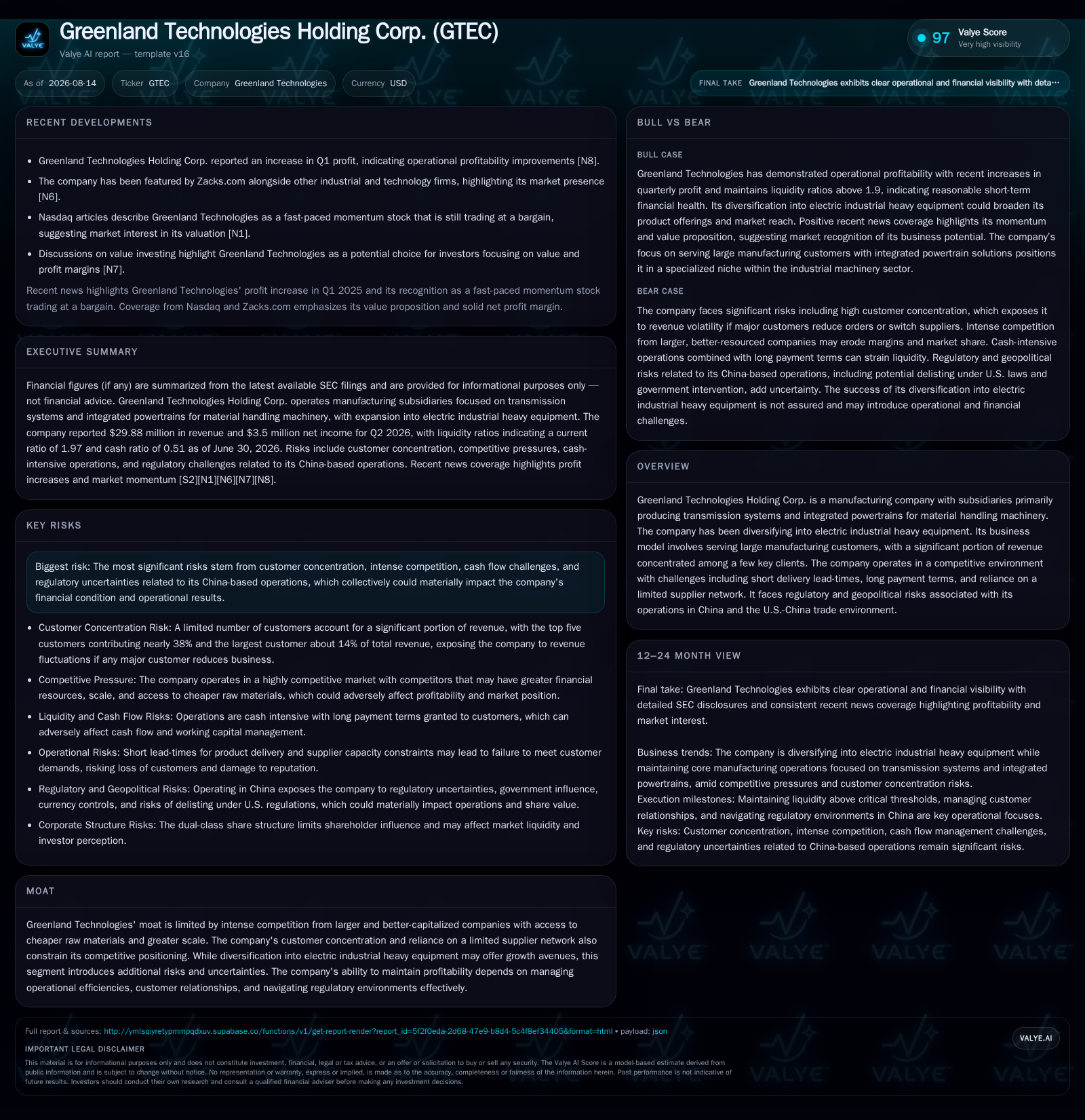
Greenland Technologies Holding Corp. reported operational challenges in its second quarter of 2026, including cash flow pressures due to long payment terms and short delivery lead times, underscoring the tight margin environment within industrial manufacturing. Customer concentration remains high, with over a third of revenue coming from the top five clients, particularly Hangcha Group. The company continues to expand into electric industrial heavy equipment, aiming to diversify but facing intensified competition and supply chain risks. Regulatory and geopolitical factors related to its China-based operations add complexity to its business outlook.
Recent Operating Update
Greenland Technologies Holding Corp.'s second quarter 2026 filing reveals continuing challenges characteristic of its industrial manufacturing niche. The business remains cash intensive, burdened by granting relatively long payment terms to customers while concurrently facing short lead times for product deliveries [S2]. These opposing pressures squeeze working capital and elevate liquidity risk. Failure to meet tight delivery schedules risks damaging both reputation and revenue streams given the importance of just-in-time protocols in serving large manufacturing clients [S2].
Customer concentration remains a critical constraint: the company’s five largest customers accounted for approximately 37.95% of revenues during the first half of 2026, a slight decrease from prior periods but still underscoring dependence on a few major accounts [S4]. Notably, Hangcha Group alone constituted nearly 14% of total revenue during this period, reinforcing that any weakening in this relationship or volume reduction could materially impact Greenland's financial health [S4]. This concentration imparts significant pricing negotiation leverage to customers, potentially compressing margins.
On the growth front, Greenland continues its strategic shift into electric industrial heavy equipment production—a diversification endeavor aimed at capturing emerging demand linked to broader electrification trends in material handling machinery [S2]. However, while this expansion offers a prospective avenue for revenue growth, it simultaneously introduces additional execution risks during intensifying competition from larger manufacturers with stronger capital bases and better access to low-cost raw materials [S2], [S12].
Business Model Analysis
Greenland operates primarily as a manufacturer of transmission systems and integrated powertrains tailored for material handling machinery, selling mainly to large industrial OEMs. Revenues are concentrated among a handful of substantial customers that issue bulk purchase orders under negotiated contracts [S1], [S4]. Revenue thereby depends heavily on production volumes aligned with order backlog maturity, negotiated pricing reflecting raw material costs—predominantly steel—and adherence to stringent delivery timelines.
The company’s monetization hinges on technology-driven components embedded in forklifts and similar heavy equipment. Pricing power is restricted by competitive pressures from more established peers offering comparable products at lower costs due to scale advantages or preferential supplier arrangements [S12]. Additionally, granting extended payment terms diminishes cash conversion velocity despite production cycles demanding fast fulfillment.
Product mix dynamics play a growing role; the nascent electric equipment line commands different margin profiles relative to traditional mechanical transmissions. Success here depends not only on engineering capabilities but also on managing new supply chains for batteries and electronic components—areas marked by heightened raw material cost volatility and regulatory scrutiny [S2], [S12].
Industry Structure and Competitive Position
The industrial manufacturing sector Greenland inhabits is dominated by well-capitalized competitors with integrated supply chains capable of absorbing input cost shocks better than smaller firms. The firm's limited supplier diversity exacerbates exposure to raw material price fluctuations—particularly steel—coupled with potential disruptions arising from geopolitical tensions impacting China-US trade relations [S2], [S9].
Customer concentration patterns are typical across the peer group but represent an ongoing vulnerability due to potential volume swings or pricing retrenchment imposed by large buyers wielding negotiating leverage [S4], [S13]. Larger competitors tend to benefit from closer relationships with suppliers enabling steadier raw material access at lower prices.
Emerging opportunities in electrification have attracted several incumbents investing heavily in advanced powertrain technologies, further challenging Greenland's efforts to establish itself in this segment without commensurate scale or R&D investment [S12]. Operational excellence—including reducing delivery lead times—is a key competitive differentiator; failure here risks customer attrition.
Growth Drivers
Several structural tailwinds underpin Greenland’s strategic initiatives:
- Rising demand for electric industrial heavy equipment driven by environmental regulations and sustainability goals fuels product diversification efforts.
- Expansion in logistics and warehousing sectors worldwide increases demand for advanced material handling solutions where Greenland’s transmission systems find application.
- Technological advances in powertrain integration offer scope for margin improvement if new products achieve market acceptance.
- Infrastructure investments promoting automation stimulate demand for sophisticated heavy equipment.
- Increasing supplier diversification efforts may reduce input cost volatility over time.
- Government incentives targeting clean energy machinery could enhance competitiveness for electric equipment lines.
- Geographic expansion leveraging global industrial growth—especially in emerging markets—offers volume upside if regulatory barriers are navigated effectively.
Risks and Watchpoints
Key risks constraining growth include:
- Persistent customer concentration risk limiting bargaining power and exposing revenue streams to fluctuations with few large clients.
- Intense competition from established entities capable of pricing below Greenland's cost structure due to scale or vertical integration.
- Raw material input price volatility—notably steel—that can quickly erode operating margins if not fully passed through pricing adjustments.
- Limited supplier network concentration creates procurement vulnerability amid supply disruptions or quality issues.
- Regulatory complexity and geopolitical tensions related primarily to China-based manufacturing operations may cause interruptions, tariffs impact profit margins or complicate product certifications [S9], [S16].
- Cash flow pressures magnified by generous customer payment terms compounded by capital intensity lead to working capital strains if receivable collections falter.
- Execution risks tied to meeting short delivery lead-times which could degrade customer satisfaction leading to order loss.
- Technology adoption risk inherent in electric heavy equipment ventures where market acceptance is unproven against incumbent players.
- Legal proceedings including shareholder derivative litigation could distract management or result in monetary damages impacting financial condition [S24].
What To Watch Next
Market observers should monitor several forthcoming developments:
- Order backlog trends indicating shifts in customer purchase timing or volume preferences will signal near-term revenue visibility.
- Changes in top customer revenue contributions that reflect either diversification progress or deepening dependence on key clients.
- Progress reports on electric industrial heavy equipment commercialization including early sales metrics or technology milestones.
- Supplier network changes addressing raw material sourcing diversity as a measure of operational resilience enhancement.
- Regulatory updates especially pertaining to China offshore listing permissions that might influence future capital raising or cross-border operations sustainability [S20], [S28].
- Quarterly cash flow performance highlighting receivables collection efficiency given long payment terms and inventory turnover improvements relating to working capital management.
- Legal developments regarding ongoing litigation which might affect management focus or impose financial penalties.
Financial Profile Discussion
As of June 30, 2026, Greenland demonstrated a current ratio of approximately 1.97 (current assets: $125.8 million versus current liabilities: $63.7 million), indicating adequate short-term liquidity capacity for near-term obligations [F1]. Cash and equivalents stood near $9 million, offering some buffer against day-to-day operational funding demands [F1]. Although no updated debt figure since 2019 is available, prior total debt was modest relative to assets ($3.5 million) suggesting conservative leverage usage historically [F1].
The firm's financial health is intricately linked with navigating geopolitical-related regulatory measures emerging from recent Chinese oversight rules concerning overseas listings which could impose compliance cost burdens or limit future capital market access if not adequately managed [S20], [S26].
This analysis synthesizes publicly available regulatory filings as of August 14, 2026. It aims solely at providing an informed review without making investment research views or forecasts. readers may want to monitor all risks disclosed by Greenland Technologies Holding Corp. when evaluating the company's prospects.
Disclaimer: This is research-only, informational analysis and not investment advice. It may include AI-generated interpretation and general industry context. Always verify important details using primary sources.

Comments