
Wintergreen Acquisition's SPAC Path Hinges on KIKA Merger and Asia-Focused Deal Execution
Wintergreen Acquisition Corp. is positioned to complete its de-SPAC merger with an Asia-based AdTech company, leveraging its trust account capital and management expertise.
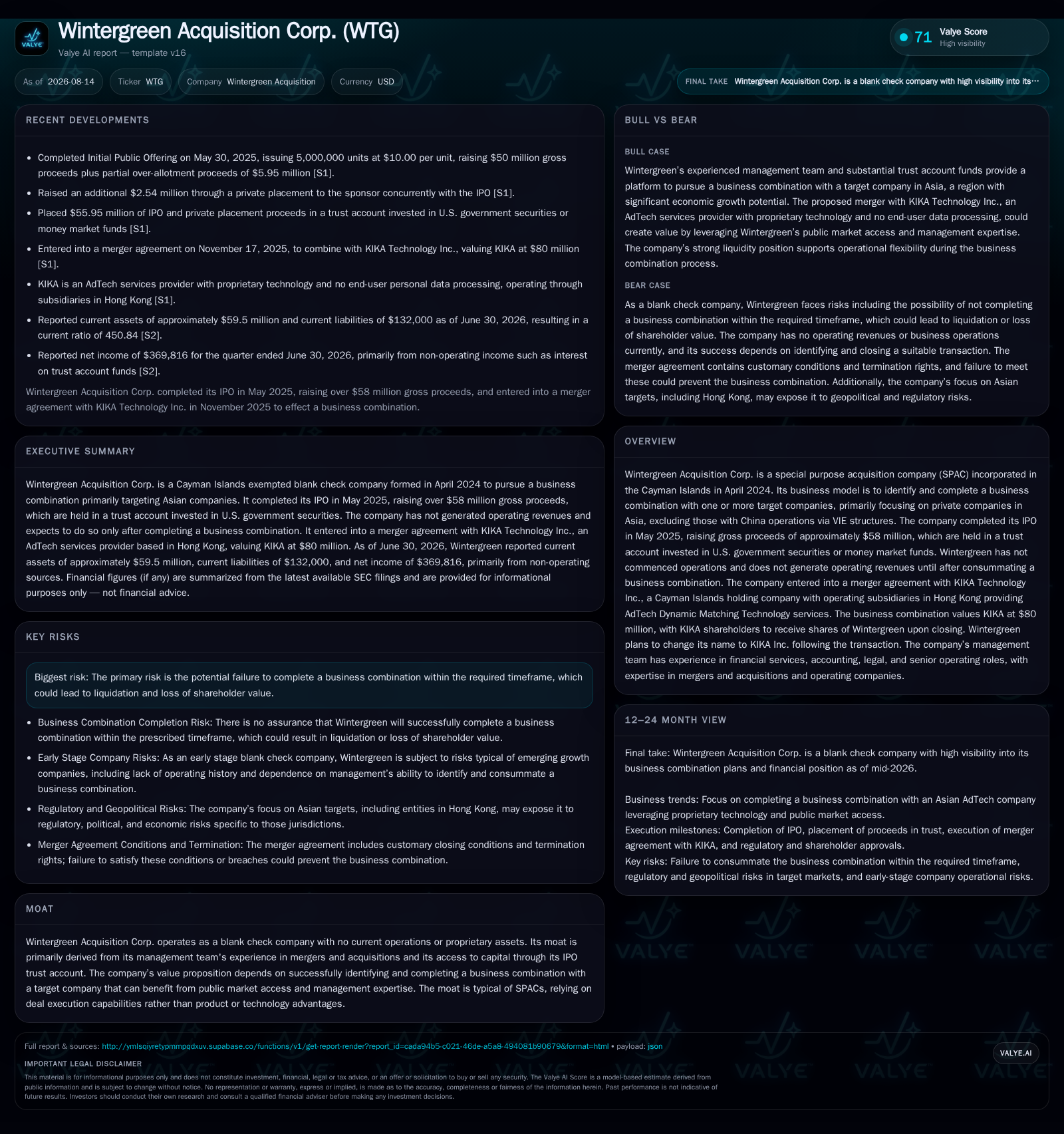
Wintergreen Acquisition Corp., a Cayman Islands-incorporated blank check company, raised approximately $58 million in a May 2025 IPO to finance a business combination focused on Asian private companies outside China’s VIE structures. The company signed a definitive merger agreement with KIKA Technology, an AdTech firm operating primarily in Hong Kong, valuing the target at $80 million and aiming to leverage public market access through de-SPAC. Wintergreen has yet to generate operating revenue, typical of SPACs pre-merger, but holds substantial cash in a trust account and retains shareholder approval milestones before closing. Risks center on execution within mandated timelines, redemption dynamics, and geopolitical uncertainties involving cross-border transactions.
Recent Operating Update: De-SPAC Progress Anchored on KIKA Merger
Wintergreen Acquisition Corp. remains in the critical transitional phase between SPAC formation and consummation of its inaugural business combination. The latest quarterly filing dated August 14, 2026, reflects no material changes in risk factors or operations but confirms continued organizational status with no revenue generation or operations prior to deal closure [S2]. This stability is typical for SPACs pending de-SPAC completion.
The most consequential development remains the November 2025 Merger Agreement with KIKA Technology Inc., a Cayman Islands holding company with key operations through Hong Kong subsidiaries specializing in AdTech dynamic matching technology services [S1][S23]. This deal values KIKA at $80 million and involves issuing approximately 7.98 million Wintergreen shares as consideration at roughly $10 per share equivalent, aligned with public shareholder redemption rights [S1][S23].
All closing conditions—including SEC clearance of proxy materials and requisite shareholder approvals—remain outstanding as of mid-2026 with management emphasizing their confidence but acknowledging inherent timing risks [S1][S2]. Wintergreen’s public shareholders retain redemption rights that could impact net proceeds deployed into the operating company post-merger, reflecting typical SPAC transaction mechanics.
Business Model: Pure De-SPAC Capital Vehicle Pre-Merger
Wintergreen operates as a classic blank check company incorporated under Cayman Islands jurisdiction exclusively to raise capital through IPO units priced at $10 each, hold those proceeds in a segregated trust account, and identify a qualifying target company for merger or acquisition–effectively taking that private entity public via a financial shell [S1][S24].
Cash inflows derive solely from the initial public offering completed May 30, 2025, which raised gross proceeds of $55.95 million including partial exercise of an over-allotment option, plus a concurrent sponsor private placement yielding $2.54 million [S1][F1]. After underwriting fees (~$1.3 million) and offering expenses, approximately $56 million remains held primarily in U.S. government securities within the trust account to preserve capital integrity until deployed at business combination closing [F1][S13].
Operating expenses prior to deal completion are limited to organizational costs funded by working capital loans from sponsors or management but remain nominal relative to capital held [S1][F1]. Post-closing revenue recognition depends entirely on KIKA’s operational results under public ownership. This model places significant emphasis on management’s capacity to execute deals within prescribed timelines and secure shareholder support.
Industry Structure and Competitive Position: SPAC Focused on Asia Ex-China
Wintergreen joins a cohort of special purpose acquisition companies targeting private firms primarily across Asia while expressly excluding opportunities employing China-based Variable Interest Entities (VIEs) due to regulatory complications and investment risk profiles associated with those structures [S1][S10]. This geographic focus seeks to capitalize on demonstrated economic expansion marked by private-sector growth, middle-class consumption increases, technological innovation, and policy reform across several Asian markets outside mainland China proper.
In this embryonic stage without commercial operations or direct product offerings, Wintergreen's competitive moat is indistinguishable from typical SPACs: access to IPO capital via trust accounts combined with management teams proficient in M&A transactions tailored for cross-border complexities and public market listing strategies. Its ability to differentiate depends strongly on identifying high-quality targets like KIKA—a specialized AdTech firm with proprietary algorithmic matching technology operating mostly in Hong Kong—and facilitating favorable shareholder vote outcomes.
Peers include other Asia-focused SPACs with comparable capital raises (~$50–$100 million), similar regional restriction strategies avoiding China VIE entanglements, robust M&A-experienced sponsors, and active pipelines in technology sectors such as digital advertising platforms or SaaS providers.
Growth Drivers: Demand for Alternative Public Market Access and Regional Digital Expansion
The principal growth catalytic factor lies in sustained demand by private companies seeking accelerated public-market exposure via de-SPAC transactions as alternatives to traditional IPO processes—the latter being lengthier and often more costly.
Asia’s structural economic trajectory underpins Wintergreen’s strategic rationale: growing middle-class segments drive advertising budgets online; adoption of digital marketing technologies accelerates; regional governments enact reforms encouraging foreign investment—excluding regulated mainland China VIE setups; thus creating fertile ground for deal origination particularly in sectors like AdTech where agility and proprietary algorithms yield competitive advantage [S15].
Additionally, Wintergreen’s experienced management team has deep connections facilitating sourcing multiple potential targets besides KIKA while monitoring market conditions affecting investor appetite for PIPE investments essential post-merger financing support.
Risks and Constraints: Deal Execution Timelines, Redemption Dynamics, Regulatory Hurdles
Chief risks persist around global macroeconomic uncertainty influencing market volatility that affects investor sentiment toward SPAC units leading to potentially higher redemption rates reducing available cash at closing—a vulnerability exacerbated by emerging market geopolitical tensions [S10].[Footnote: No material changes reported Q3’26]
Regulatory frameworks governing cross-border mergers require extensive compliance efforts; specifically heightened scrutiny on transactions involving entities operating partially within Asian jurisdictions adds complexity that can delay timeline adherence or increase transactional costs [S10].
Failure to consummate the business combination by May 30, 2027 triggers mandatory liquidation per governing documents—posing risk case for capital commitment-holding investors if management cannot identify agreeable targets timely or negotiate terms favorably [S9]
Sponsor dilution effects from founder shares (20%) combined with underwriting fee expenses (2.6% gross IPO proceeds) constrain net capital deployment efficiency; deferred underwriting commissions issued partly in shares add complexity regarding dilution mechanics post-deal closure [S1][S20].
Lastly, successful integration post-merger remains unproven; realizing projected revenue growth via scaling KIKA’s AdTech services within a public company framework necessitates operational discipline beyond pure financial engineering executed thus far by Wintergreen managers [Valye excerpt moat & risk].
What To Watch Next: Approvals Milestone Pathway & Shareholder Sentiment Markers
Key inflection points hinge on SEC declaring effectiveness of proxy statements required for shareholder votes expected imminently following August 2026 filings completion cycle [S2][S9]. Investor reception reflected through redemption election percentages will critically shape net funds retained for capitalization of KIKA going forward.
Subsequent SEC filings should disclose levels of public shareholder redemptions and updates on any amendments or waivers related to closing conditions compliance including minimum net tangible asset retention thresholds [$5 million minimum] post-closing requirements per merger agreement specifications [S9][S23]
Market conditions impacting overall equity issuance valuation will influence negotiation adjustments embedded within final share exchange calculations underpinning pro forma capitalization levels familiarizing new investors with governance post-deal completion under "KIKA Inc." name change plans [S9].
Management commentary around pipeline expansion beyond KIKA could indicate strategic pivoting or readiness for follow-on acquisitions addressing scalability goals linked explicitly to free cash flow generation potential highlighted earlier as central performance benchmarks [S15]
Financial Profile Discussion
As of June 30, 2026, Wintergreen maintains approximately $59.5 million in current assets predominantly consisting of marketable securities held within its trust account designed solely to safeguard investor funds ahead of business combination execution [F1]. Current liabilities remain negligible at $132 thousand resulting in an extraordinarily high current ratio approximating 451—a reflection not of operational efficiency but liquidity security consistent with SPAC industry norms prior to de-SPAC event execution
No operational income or loss has been generated beyond minor interest income recognized from trust investments; operating expenses have remained modest given absence of commercial activities pre-combination (operating loss approx. -$404k as per year-end data) [F1][S1]
Offering costs accounted for ~$1.3 million inclusive of cash commissions payable immediately plus deferred shares reserved post-business combination closing impair net capital deployment but conform closely with industry-standard underwriting fee rates around 2–3% total gross proceeds weighted toward deferred remuneration structures that align incentivization to merger success metrics rather than upfront fees alone [S20]
Leverage is nonexistent as no debt facilities have been drawn against balance sheet resources since inception reflecting pristine financial health required to maintain investor confidence throughout prolonged acquisition search phases common among early-stage blank check entities.
Overall financial posture underscores capability to endure pre-merger phases without external financing pressures while preserving ability to fund identified targets fully subject to dilution outcomes from redemption elections which remain the most volatile cash deployment determinant ahead of closing.
Disclaimer: This analysis is intended solely for informational purposes without providing investment advice or research views regarding Wintergreen Acquisition Corp. or any related securities.
Disclaimer: This is research-only, informational analysis and not investment advice. It may include AI-generated interpretation and general industry context. Always verify important details using primary sources.

Comments