
Lightwave Logic Advances Electro-Optic Polymer Commercialization Amid Lengthy Design Win Cycles
The company’s proprietary Perkinamine® polymer materials target integration into silicon photonics with a ramp dependent on customer qualification and foundry readiness.
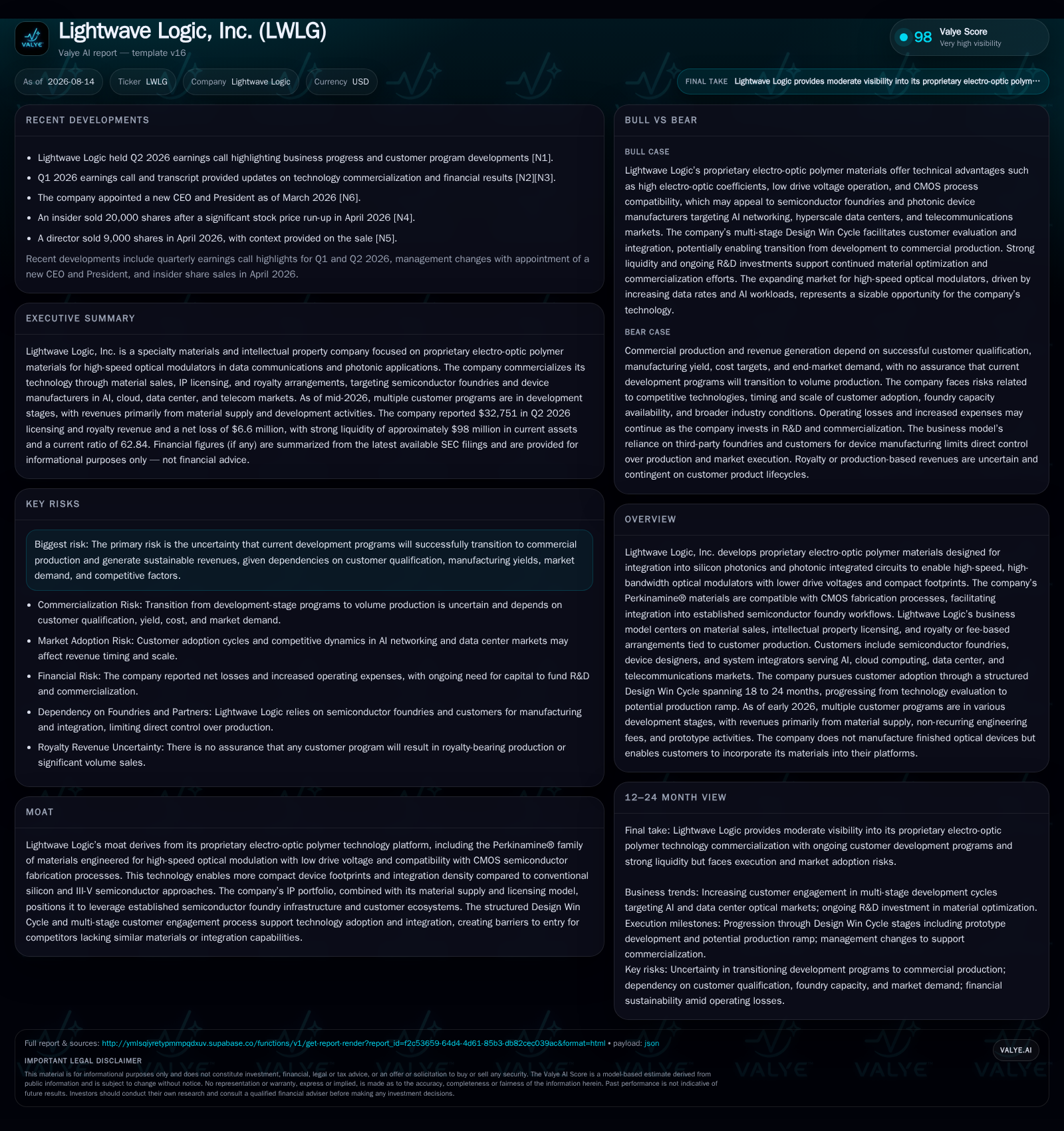
Lightwave Logic, Inc. continues to pursue commercialization of its electro-optic polymer materials designed for silicon photonics applications, leveraged through material sales and IP licensing within semiconductor foundry ecosystems. The company reported higher operating expenses in its latest quarter, reflecting expanded R&D and administrative investments aligned with accelerated development efforts. Revenue remains limited, tied mostly to early-stage licensing and supply agreements, with meaningful volume ramp expected only as customer programs progress through an extended 18-24 month design win cycle. Sustained operating losses and cash burn highlight the dependence on successful customer qualifications and scaling production readiness amid evolving industry competition and capital needs.
Recent Operating Update
In its latest quarterly report filed August 14, 2026 [S2], Lightwave Logic reiterates progress in advancing multiple customer programs through its defined commercialization process but signals that significant revenue from large-scale production is not expected until at least 2027. Revenues so far derive primarily from material supply for prototyping activities and license/royalty fees. The company emphasizes the critical role of customer product qualification stages and manufacturing yield achievements before scaling commercial volumes.
The quarter also saw continued substantial increases in research and development (R&D) expenses — driven by higher salaries, stock-based compensation expenses, lab supplies, prototype device development including wafer fabrications — along with a marked rise in general and administrative (G&A) costs linked to staffing growth, legal fees, director compensation, recruiting efforts, and compliance requirements. Cash on hand was $47.2 million as of June 30, 2026 [F1], bolstered by recent capital raises including at-the-market (ATM) equity issuances and stock option/warrant exercises [S2]. The company reports no debt outstanding and a strong working capital position supported by a current ratio of approximately 62.8 [F1].
Business Model
Lightwave Logic focuses exclusively on the upstream specialty materials segment of the silicon photonics value chain. Its core offering is a proprietary family of electro-optic (EO) polymer materials branded Perkinamine®, designed for integration into silicon photonic integrated circuits (PICs). These polymers enable high-speed optical modulators characterized by lower drive voltages and shorter interaction lengths than many traditional III-V semiconductor or pure silicon approaches [S1][S2]. The lower voltage requirement can simplify driver electronics and reduce system power consumption—an important consideration for dense data center interconnect applications.
Unlike device manufacturers or module assemblers such as Inphi (Marvell) or Lumentum analogs which produce finished optical components or transceivers, Lightwave Logic generates revenue via material sales to semiconductor foundries during development and eventual volume manufacturing phases. Additionally, intellectual property licensing forms a key monetization channel—upfront license fees or milestone payments may be earned based on technology integration scope while ongoing royalties could accrue as customers scale production using proprietary polymers [S1][S2]. This IP-led model grants the company exposure to semiconductor ecosystem growth without requiring heavy capital investment in wafer fabrication facilities.
Customer segments comprise silicon photonics foundries, device designers aiming to enhance PIC performance through polymer integration, optical module manufacturers embedding advanced modulators into transceivers, and system integrators focused on AI workloads or cloud-scale data centers where bandwidth demands proliferate [S2]. This broad market approach reflects recognition of expanding demand for next-generation optical interconnects with improved power efficiency and footprint reduction.
Industry Structure & Competitive Position
Within the emerging electro-optic polymer materials industry serving silicon photonics platforms—a niche within industrial hardware specializing in specialty materials—Lightwave Logic occupies an upstream supplier role supplying both essential materials and IP. This upstream focus contrasts with downstream actors producing complete PIC devices or modules.
Competition arises from alternative material technologies including conventional silicon-based modulators relying on plasma dispersion effects or III-V compound semiconductors like indium phosphide approaches extensively used in telecom optics. These incumbent technologies benefit from mature manufacturing but often trade off power efficiency or integration density compared to electro-optic polymers which theoretically offer superior modulation efficiency and smaller footprints due to strong electro-optic coefficients of organic chromophore molecules embedded in polymers.
Lightwave Logic’s moat is built upon its proprietary Perkinamine® chemistry optimized for CMOS-compatible processing—a critical factor enabling integration into established semiconductor foundry workflows without disruptive process changes [S1]. This reduces barriers for adoption relative to less compatible material systems requiring specialized fabrication facilities or novel process flows.
Additionally, the company’s extensive intellectual property portfolio—covering polymer compositions, device architectures such as silicon-organic hybrid slot modulators, integration techniques—is a structural asset underpinning royalty-based revenue potential if customers achieve volume deployment [S1]. However, given the long sales/design-win cycles typical in semiconductor photonics (~18–24 months), visibility into commercial scaling remains limited until later-stage customer qualifications are confirmed.
Growth Drivers
Demand tailwinds stem largely from the booming data center sector driven by AI workload expansion requiring massive increases in interconnect bandwidth paired with tighter power budgets. Silicon photonics adoption accelerates within cloud computing infrastructure as operators seek low-power optical links scalable across tens of thousands of network lanes per hyperscale facility.
Further impetus arises from telecommunications evolution toward 5G/6G networks necessitating compact optical components with enhanced performance metrics suitable for dense deployment environments. The trend toward increasing integration density within PIC platforms favors smaller modulator sizes achievable via effective electro-optic polymers.
Additional growth stems from customers transitioning away from legacy III-V devices toward solutions promising reduced system complexity plus potential cost advantages via compatibility with standard CMOS fab processes [S1][S2]. Strategic partnerships with leading semiconductor foundries are also essential growth enablers by embedding electro-optic polymer PDKs into commercial process flows facilitating customer design wins.
Risks & Constraints
The primary risks relate to the inherent uncertainty around whether current customer development programs successfully qualify products incorporating Lightwave's polymers for mass production. Foundry capacity availability aligned with these programs is also a gating factor given competing demands on process lines.
Manufacturing yield improvements represent another critical operational milestone impacting reliable material supply at commercial scale. Poor yields can undermine cost targets essential for wider industry adoption.
Another risk involves technology competition from silicon-only or incumbent III-V semiconductor modulators that benefit from entrenched ecosystem support; continuous innovation investments are required to maintain differentiation.
Financially, continued operating losses reflect high fixed costs incurred during R&D intensification and commercialization phases prior to scalable revenue generation [S1][S2]. Capital intensity required for facility expansions or foundry collaborations imposes constraints despite Lightwave's model focusing on leveraging existing foundry infrastructure rather than building dedicated fabs itself
Finally, long design win cycles typical of semiconductor photonics introduce revenue visibility challenges; multi-year program durations mean that short-term operating results may fluctuate without presaging ultimate success.
What to Watch Next
Key upcoming milestones include progression of current customer programs through defined Design Win Cycle stages—from initial technology evaluation past product design finalization into prototyping phases advancing toward production ramp-up [S13][S25]. Monitoring announcements regarding new commercial agreements or expansions of existing licenses will signal increasing adoption momentum.
Operational KPIs such as manufacturing yield rates reported by partners or customers' qualification success rates will provide clues about scaling potential.
Financially, future quarters should be watched for evidence of accelerating material sales revenue beyond prototyping/NRE levels along with any uptake in royalty income indicating deployed volumes rising within end markets. Trends in R&D spending versus results may also help gauge commercialization pacing.
Emerging competitive developments among alternative materials providers could impact longer-term positioning; shifts in customer process standards or foundry PDK inclusions will be telling signals about integration success.
Financial Profile Discussion
As of June 30, 2026, Lightwave Logic reported cash and equivalents totaling $47.2 million [F1]. Current assets stand at nearly $98 million against minimal current liabilities around $1.56 million yielding an exceptionally high current ratio (~62.8), underscoring ample near-term liquidity [F1]. The company has no outstanding debt obligations [S2], limiting financial risk related to leverage.
Capital raising through public offerings including the Titan arrangement ($32+ million net proceeds raised late 2025/early 2026) plus steady ATM sales via Roth Capital contributed significantly to strengthening financial resources throughout the last year [S7][S10]. The company expects this liquidity will sustain operations into late 2027 assuming planned revenue growth trajectories unfold without major setbacks [S2][S8].
Despite strong cash runway presently supporting R&D scale-up phases crucial prior to broad commercial sales ramping expected post-2027 horizon [S12], continuing losses underscore dependency on timely conversion of customer engagements into commercial volume production necessary to reach operational break-even eventually.
This analysis presents a synthesis of publicly filed financial disclosures combined with industry context around electro-optic polymer materials commercialization within silicon photonics ecosystems relevant as of mid-2026. It highlights Lightwave Logic’s strategic positioning upstream in the value chain leveraging proprietary IP under a licensing/material supply business model geared towards fast-evolving high-bandwidth connectivity markets such as AI datacenters while emphasizing execution risks inherent in long development cycles typical of this sector.
Disclaimer: This is research-only, informational analysis and not investment advice. It may include AI-generated interpretation and general industry context. Always verify important details using primary sources.

Comments