
PMV Pharmaceuticals Pushes Rezatapopt Toward Pivotal Approval Amid Funding Challenges
PMV advances its mutant p53-targeting therapy through pivotal Phase 2 trials while managing growing cash burn and sustainability risks.
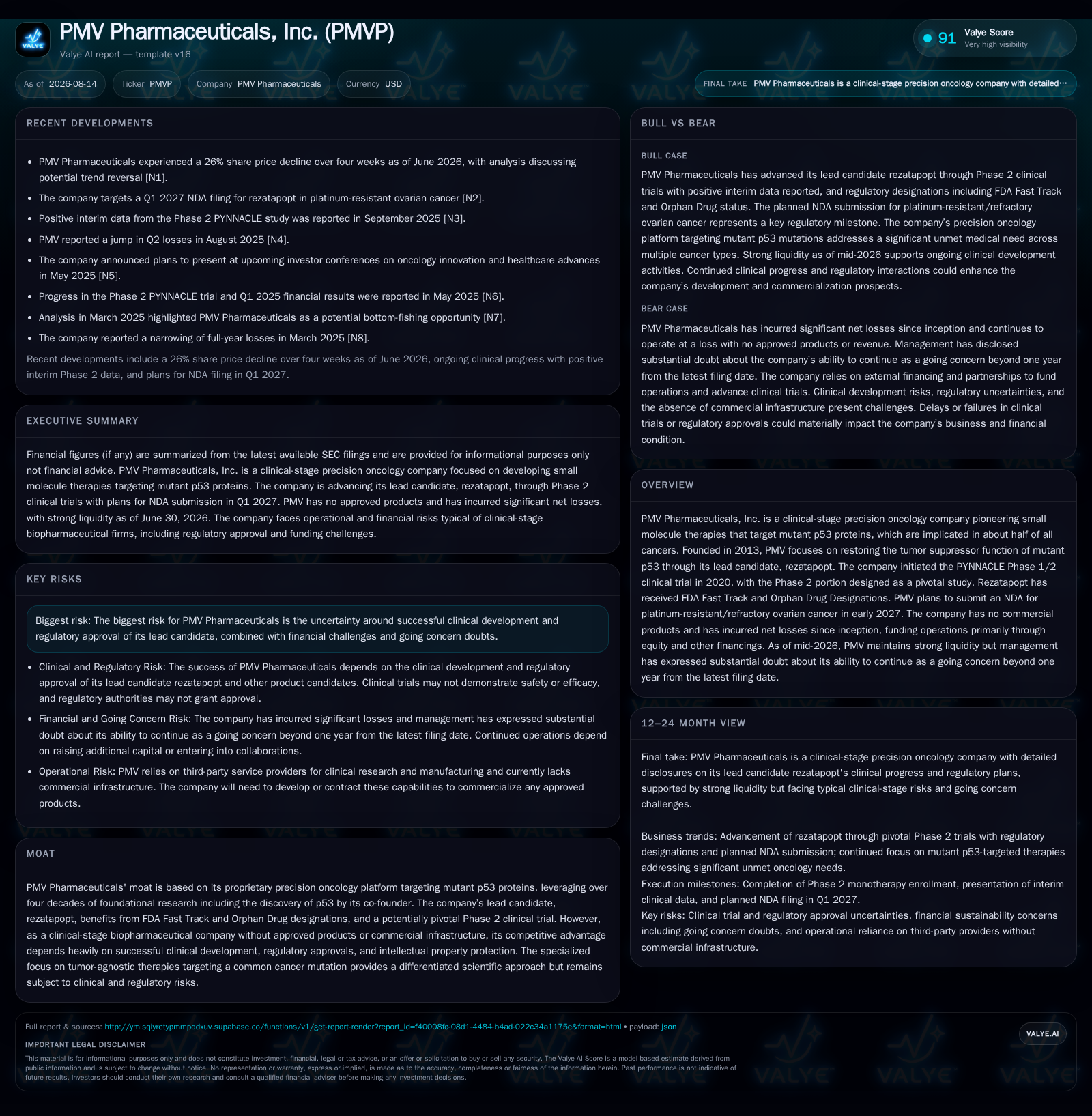
PMV Pharmaceuticals is progressing the Phase 2 registrational PYNNACLE trial for rezatapopt, a tumor-agnostic small molecule targeting mutant p53, with FDA Fast Track and Orphan Drug designations supporting an accelerated pathway. The company plans an NDA submission for platinum-resistant ovarian cancer in early 2027, marking a critical inflection point. However, its equity-financed model faces increasing pressure as net losses persist and cash reserves decline, prompting management's expressed concerns about ongoing operational viability absent new financing. Clinical progress juxtaposed with liquidity constraints frames the near-term investment landscape for this specialized precision oncology developer.
Latest Quarter Highlights: Clinical Validation Meets Liquidity Warning
PMV Pharmaceuticals’ latest quarterly filing dated August 14, 2026, reaffirms critical clinical progress alongside tightening financial headwinds [S2][S3][F1]. The PYNNACLE Phase 2 monotherapy portion continues enrolling patients with TP53 Y220C-mutant tumors, aiming for an NDA filing in Q1 2027 to treat platinum-resistant/refractory ovarian cancer [S2][S3]. This timing aligns with FDA guidance following a successful End of Phase 1 meeting in mid-2023 that established dosing and trial design parameters [S1][S2]. However, these forward clinical ambitions contrast sharply with disclosed liquidity pressures: cash and equivalents dwindled to approximately $12.5 million by June 30, 2026 [F1], down from prior periods despite maintaining a healthy current ratio of roughly 7.7x driven by sizeable current assets exceeding liabilities [F1]. Management explicitly acknowledges going concern uncertainties post this window if no additional capitalization occurs [S2]. Such dual realities encapsulate the classic clinical-stage biopharma dichotomy — advancing toward a pivotal data inflection while wrestling with capital intensity and dilutive funding needs.
Decoding PMV’s Precision Oncology Platform Focused on Mutant p53 Rescue
PMV operates at the pioneering edge of precision oncology by targeting mutant forms of the tumor suppressor protein p53 — mutations detected in about half of all human cancers — through its proprietary small molecule platform [S1][S2]. Founded on the legacy research of co-founder Dr. Arnold Levine who discovered p53 in 1979, the company focuses on correcting misfolded mutant p53 proteins to restore their natural anti-cancer function, an approach divergent from biologic or gene therapy competitors [S1]. Its lead candidate rezatapopt exemplifies this strategy and is currently the sole asset moving through development toward potential approval via the single-arm Phase 2 PYNNACLE trial intended as a registrational study [S1][S2]. This product concentration imparts both scientific moat benefit through specialized IP around Y220C mutation rescue and substantial execution risk tied to a narrow pipeline focus. The absence of approved products means PMV depends entirely on developmental success and regulatory milestones to validate future commercial viability.
Competitive Edge: Regulatory Designations Bolster Rezatapopt’s Development Pathway
The FDA awarded rezatapopt Fast Track designation shortly after Phase 1 initiation in October 2020, reflecting recognition of its potential to address an unmet medical need in mutant p53-associated solid tumors [S1][S2]. More recently in March 2026, Orphan Drug Designation was granted specifically for TP53 Y220C positive ovarian cancer cases — a narrower indication emphasizing unmet therapeutic needs in this patient subset [S1][S2]. Such regulatory statuses typically confer benefits including priority review eligibility, rolling submissions for NDAs, and extended market exclusivity post-approval — factors that can materially shorten development timelines and enhance market appeal relative to typical biotech drug candidates. Peer clinical-stage oncology firms often leverage similar designations to advance drug candidates faster and secure premium valuation premiums during investment due diligence. Nevertheless, while these designations mitigate some regulatory risk and cost burdens associated with large randomized trials, true validation awaits pivotal Phase 2 efficacy data.
Growth Catalysts: What Drives Demand for Tumor-Agnostic Mutant p53 Therapies?
Addressing platinum-resistant/refractory ovarian cancer harboring TP53 Y220C mutations situates rezatapopt within a patient subgroup characterized by significant unmet needs due to limited treatment options following frontline failures — underscoring potentially strong demand dynamics upon approval [S1][S2]. Furthermore, PMV’s tumor-agnostic approach suggests future scalability beyond ovarian cancer into other indications driven by common p53 mutations if clinical proof points emerge. In oncology drug development paradigms, tumor-agnostic therapies that target shared molecular alterations regardless of tissue origin can tap larger addressable populations than traditional histology-based drugs. Yet commercialization feasibility hinges not only on positive clinical outcomes but also on strategic partnerships or licensing agreements to complement PMV’s lack of commercial infrastructure [S1][S2]. Mid-term growth could thus be catalyzed by deal-making with established pharmaceutical companies capable of marketing reach expansion beyond initial orphan status indications.
Financial Strain Behind Innovation: Burn Rate, Cash Reserves, and Sustainability Risks
PMV remains unprofitable with no revenue from product sales; net losses totaled approximately $36.1 million for the first half of calendar year 2026 alone—consistent with prior growth-period operating trends typical in clinical-stage biopharma focused heavily on R&D activities [S2][F1]. Its burn rate accelerates pressure on liquidity given that cash and equivalents have diminished sharply to near $12.5 million at midyear from substantially higher balances seen previously [F1], despite holding current assets well above short-term liabilities resulting in a favorable current ratio (~7.7x) [F1]. However, reliance predominantly on equity financing introduces dilution risk for shareholders if capital raises occur under distressed conditions [S2]. The company retains no debt obligations evidenced by filings but openly flags substantial doubt regarding continued operational viability absent fresh financing before pivotal NDA submission milestones [S2]. Comparatively speaking within the clinical-stage oncology sector where peer firms frequently navigate several successive equity raises pre-commercialization (e.g., Bluebird Bio or Translate Bio), PMV's financial positioning demands close monitoring given looming cash runway constraints.
"Watch Points": Upcoming Milestones, NDA Plans, and Financing Triggers
In addition to ongoing patient enrollment progress within PYNNACLE's pivotal Phase 2 cohort—crucial for achieving statistical robustness—investors should monitor updates on interim efficacy readouts expected before or concurrent with NDA submission planned for early 2027 [S2][S3][S1]. Greater clarity surrounding FDA feedback post-submission will also serve as key regulatory barometers influencing timing toward potential accelerated approval pathways facilitated by Fast Track designation [S1][S2]. Financially, announcements related to capital raises or impactful collaboration/licensing partnerships represent immediate inflection points that could mitigate going concern risks highlighted recently by management while underpinning continued R&D investment execution capability [S2][S3]. Failure to secure such resources timely would heighten risk of program delays or scaling back essential development activities.
PMV Pharmaceuticals exemplifies the challenges inherent in pioneering precision oncology platforms oriented around difficult-to-target molecular mechanisms such as mutant p53 protein correction. Its lead product rezatapopt benefits from robust regulatory designations strengthening its path through registrational trials toward anticipated NDA submission targeting platinum-resistant ovarian cancer patients harboring the Y220C mutation—a notably underserved epidemiology segment. Nonetheless, clinical validation strides spotlighted through recent interim presentations coexist with significant financial strain emblematic of early-stage drug developers reliant solely on equity funding to carry operations amid high R&D spend demands. The impending months will decisively weigh whether PMV can marshal sufficient capital paired with pivotal trial data momentum to transition from uncertain development-stage venture toward emergent commercial opportunity within tumor-agnostic oncology therapeutics.
This analysis is based on publicly available filings as of August 14, 2026 ([S1], [S2], [S3]) and company-specific financial data ([F1]). It does not constitute investment advice or an endorsement of any securities.
Disclaimer: This is research-only, informational analysis and not investment advice. It may include AI-generated interpretation and general industry context. Always verify important details using primary sources.

Comments