
HawkEye 360's Government Contract Dynamics and Satellite Expansion Positioning
Q2 2026 filings highlight HawkEye 360's growing satellite constellation and contract awards amid sustained operating losses and variable government backlog.
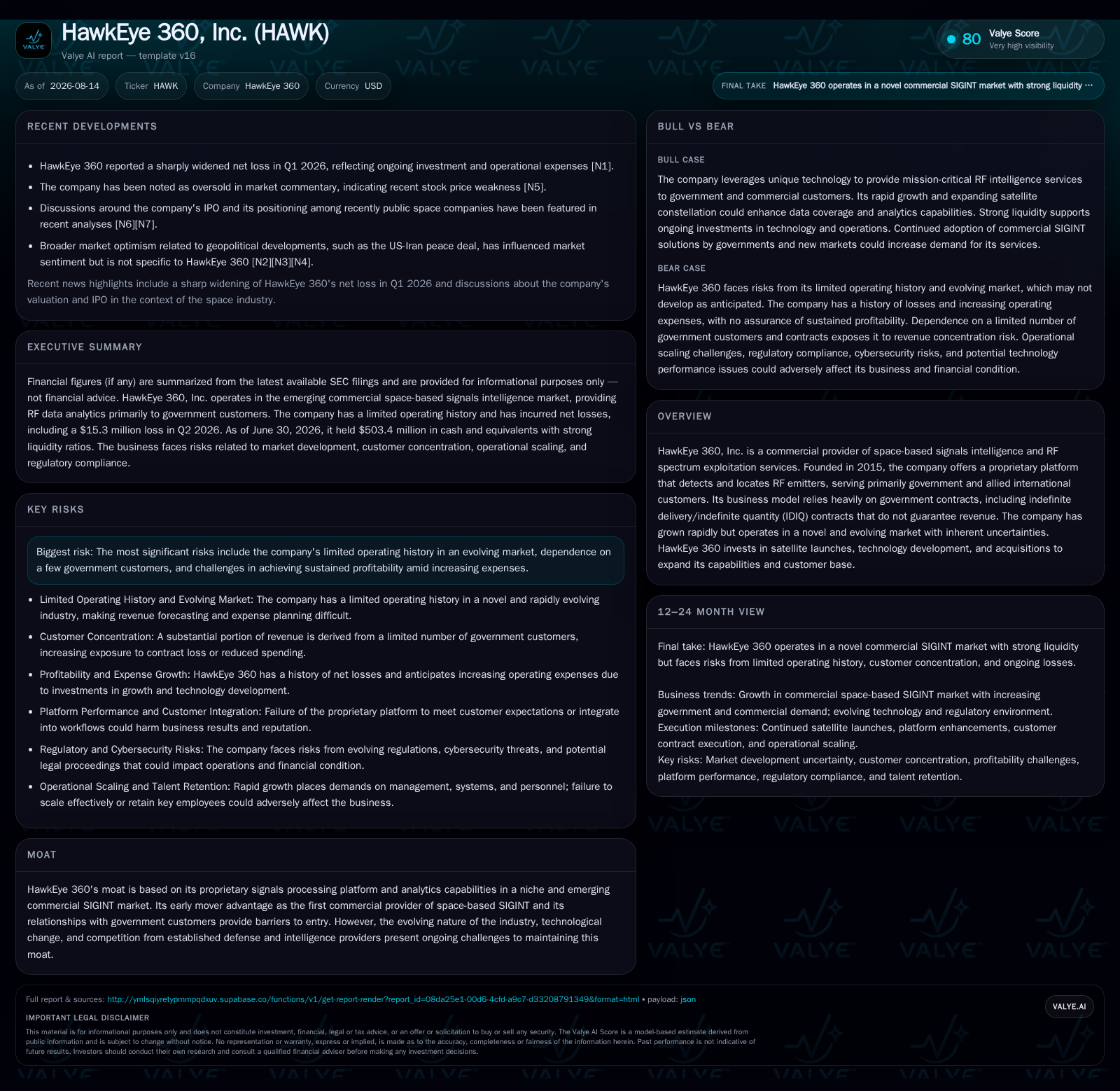
HawkEye 360 continues to expand its space-based signals intelligence capabilities through satellite deployments and new government contracts, underscoring the strategic imperative of persistent RF spectrum monitoring. However, reliance on indefinite delivery/indefinite quantity (IDIQ) contracts introduces revenue variability that complicates near-term forecasting. Despite operational growth in geolocation data coverage, profitability remains elusive due to high R&D and capital spending. The company’s strong cash position and manageable debt provide runway for continued investment, but execution risks persist around converting backlog into stable revenue streams and diversifying its concentrated government customer base.
Q2 Update: Satellite Deployments Accelerate While Profitability Pressure Persists
In the latest quarterly filing ending June 30, 2026, HawkEye 360 disclosed a meaningful increase in its deployed satellite constellation supporting its core radio frequency (RF) geolocation services [S2]. This expansion directly enhances the platform’s revisit rate and coverage density—key determinants in persistent monitoring quality within the commercial space-based signals intelligence (SIGINT) market. However, despite this operational progress underpinning the company's service capability growth, the report reveals continued negative operating income of approximately $11.5 million for Q2 [F1], pointing to persistent pressure from upfront capital expenditures related to satellite launches and sustained research & development (R&D) efforts.
The contradiction between capability scaling and profitability underscores endemic challenges in this capital-intensive sector where establishing a sizable constellation is prerequisite for competitive differentiation but requires substantial upfront cash outlays before stabilizing recurring revenue streams emerge [S3]. Platform uptime metrics were maintained at targeted levels while data delivery latency improvements remain a management focus area as per disclosures accompanying the quarter's earnings announcement
How HawkEye’s Contracting Framework Drives Near-Term Revenue Uncertainty
HawkEye 360's business derives predominantly from government contracting arrangements structured around indefinite delivery/indefinite quantity (IDIQ) contracts that award capacity without guaranteeing firm revenue volumes [S9][S10]. This places inherent variability on backlog-to-revenue conversion as the exercised portions of these contracts fluctuate with changes in government priorities and budget allocations. The IDIQ framework is common among government SIGINT contractors such as L3Harris Technologies but introduces a key modeling challenge: whether awarded contract values translate into steady recognized revenues is uncertain.
These contracts also carry termination-for-convenience clauses allowing customers to reduce or halt orders with notice, creating volatility risk absent longer-term fixed-price commitments typical in other defense segments. This risk extends into backlog valuation; while HawkEye tracks funded backlog including change orders in advanced bidding stages ([S24]), actual realization depends on dynamic procurement conditions.
Business Model Focus: Commercial Space-Based SIGINT Services Backed by Proprietary Analytics Platforms
HawkEye operates as an upstream provider of specialized space-based sensors that detect, locate, and classify RF emissions globally using its proprietary geolocation platform—a combination of its satellite constellation and sophisticated signal processing algorithms [S2]. Revenues are generated primarily through subscription or usage-based access fees paid by government agencies seeking persistent spectrum exploitation capabilities for defense intelligence purposes.
This model mandates substantial upfront investment cycles for satellite launches coupled with continuous R&D spend directed at advancing analytics differentiation and platform integration efficiency. Such investments drive a lag between capital deployment and margin expansion but establish barriers versus traditional defense suppliers relying mainly on Earth-based assets or less frequent coverage.
Customer relationships are primarily long-term government engagements often initiated via "test-and-evaluate" phases before scaling subscriptions breadthwise across use cases—a dynamic reflecting evolving trust-building steps characteristic in sensitive national security markets [S29].
Industry Outlook: Competitive Landmarks Among Government SIGINT Contractors and Commercial Satellite Peers
Positioned within a novel niche of commercial space-based SIGINT providers targeting governmental customers traditionally served by entrenched defense contractors like L3Harris Technologies or Raytheon Technologies, HawkEye benefits from early-mover advantages conferred by proprietary technology stacks and first-mover status in commercial RF geolocation services. While firms such as Spire Global share overlapping constellation management experience focused more broadly on weather or maritime data services rather than full-spectrum SIGINT analysis, HawkEye’s specialization supports defensible IP-driven moats centered on signal processing capabilities.
Allied international governments seeking alternative intelligence sources further expand addressable markets relative to purely domestic-focused competitors. Competitor differentiation hinges not merely on constellation size—which impacts revisit rates—but also on analytics depth enabling actionable intelligence automation within customer workflows.
Growth Catalysts Fueled by Persistent Monitoring Demand and Ally Expansion Efforts
The industry tailwinds powering HawkEye's opportunity set include heightened demand for persistent global RF situational awareness amid expanding geopolitical tensions driving defense intelligence budgets upwards across allied nations. Government initiatives increasingly embrace commercial outsourcing of SIGINT functions previously reserved for national entities due to cost efficiencies and rapid innovation potential.
Technological advances enabling smaller satellites with enhanced sensors lower entry barriers over time but simultaneously increase pressure to expand constellation footprints rapidly to maintain relevant coverage densities. Machine learning integration into signal exploitation workflows amplifies value creation potential by transforming raw signals into predictive behavioral insights.
Expanding penetration within allied international customer bases offers diversification avenues mitigating single-government dependence risks prevalent in HawkEye’s current portfolio.
Risk Factors Spotlight: Customer Concentration, IDIQ Contract Variability, and Capital Intensity Constraints
Principal risk exposures identified derive from HawkEye's pronounced dependence on limited U.S. government agencies constituting the bulk of revenue—a concentration raising sensitivity to budget fluctuations or strategic shifts impacting contract renewals or scale-ups [S9][S22]. IDIQ contracts impose further undercurrents of unpredictability given their inherent non-guaranteed nature combined with termination-for-convenience provisions constituting tangible downside scenarios if priority shifts occur.
Capital intensity remains another critical constraint; protracted build-out periods for satellites amplify cash burn rates necessitating continuous equity or debt funding support lest operational momentum stall—an aspect accentuated by recent operating losses exceeding $11 million during the quarter [F1][S2]
Regulatory environment complexity concerning export controls governing international customer engagements alongside compliance demands surrounding anti-corruption laws add further operational risk layers [S10]. Competitive pressures arise not only from established defense firms but also emerging technology companies innovating within signal detection arenas potentially compressing margins over time.
Key Milestones & Metrics to Monitor for Execution Progress Ahead
Stakeholders should track several near-term performance indicators signifying successful execution pathways including: - Announcements of contract renewals or incremental awards elucidating backlog conversion health; - Launch cadence maintaining or accelerating constellation deployment affording higher global revisit rates; - Platform reliability advancements decreasing data delivery latency thereby enhancing user experience; - Publications disclosing R&D outcomes evidencing progression toward improved analytic algorithms empowering greater signal exploitation precision; - Customer diversification metrics revealing broadened international ally engagements reducing concentration risk exposures [S2][S24]. These variables collectively validate whether investments transition smoothly into scalable revenue generation unlocking margin capture opportunities critical for long-term sustainability
Financial Profile Discussion: Liquidity Cushion Supports R&D-Heavy Expansion Despite Ongoing Losses
As of Q2 2026 close, HawkEye maintains a robust liquidity profile supported by approximately $503 million in cash equivalents against total debt near $48.6 million yielding an exceptionally healthy current ratio above 9.8x—affording a comfortable buffer to fuel aggressive R&D pipelines alongside costly satellite constellation expansions without immediate liquidity stress concerns [F1][S4][S6]
Nevertheless, operating income remained negative at approximately -$11.5 million accompanied by net losses reflecting ongoing investments ahead of stabilization phases typical for companies pioneering commercial space-based SIGINT platforms bearing lengthy asset deployment cycles prior to scaling subscription monetization efficiencies [F1]
It does not constitute investment advice or research views.*
Disclaimer: This is research-only, informational analysis and not investment advice. It may include AI-generated interpretation and general industry context. Always verify important details using primary sources.

Comments