
AEI Income & Growth Fund XXII's Stable Distributions Anchored by Rental Income and Strategic Unit Repurchases
AEI Income & Growth Fund XXII maintains steady distributions supported by consistent rental income and a cautious unit repurchase approach amid competitive market pressures.
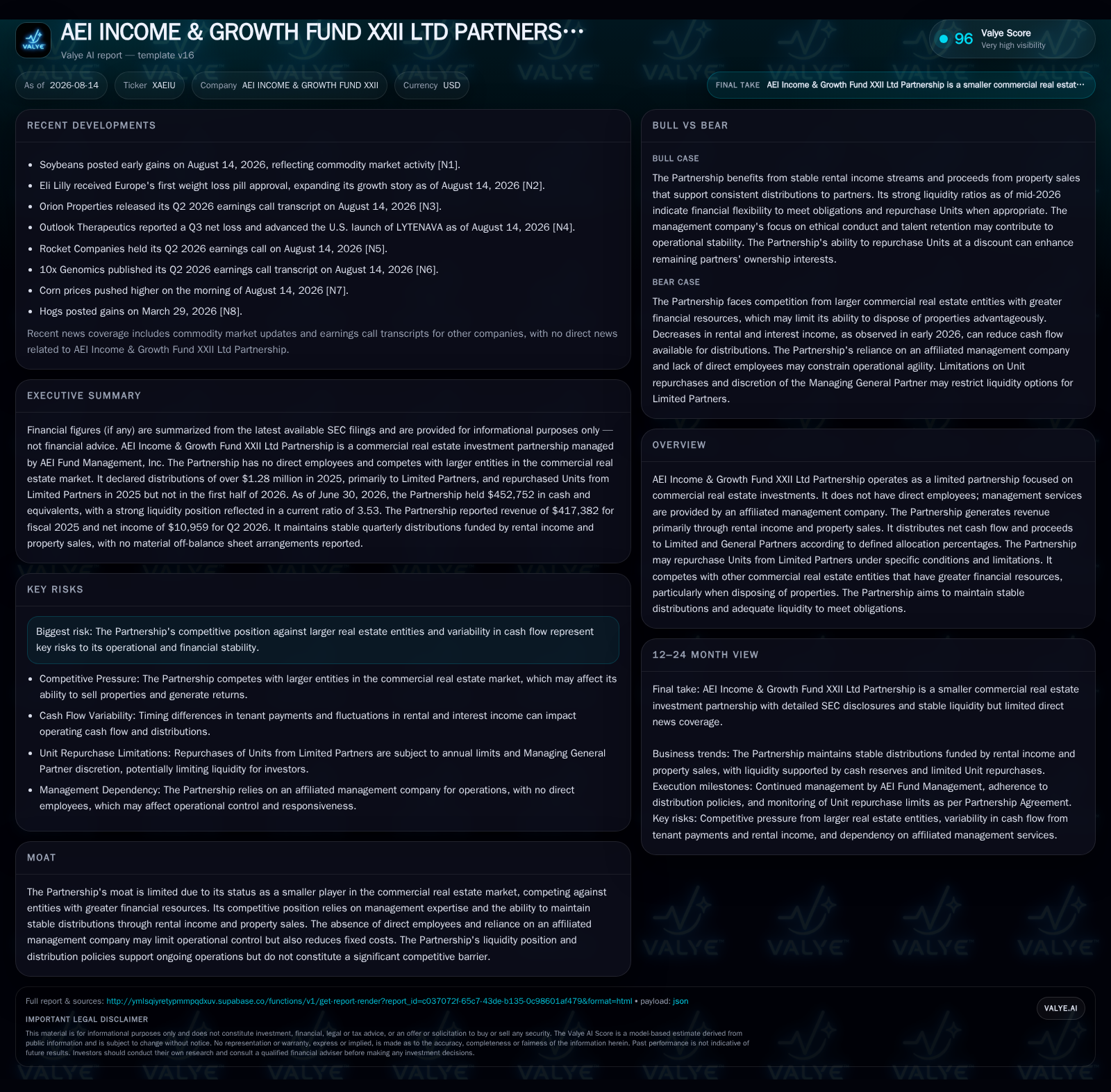
In its latest 10-Q filing dated August 14, 2026, AEI Income & Growth Fund XXII reported no unit repurchases during H1 2026, reflecting a conservative capital allocation stance compared to prior year buybacks. The partnership continues to rely primarily on rental income supplemented by property sales proceeds to fund stable distributions to Limited and General Partners. Operating without direct employees, AEI depends on an affiliated management company for asset management, allowing cost containment but limiting operational control. Competitive pressures from larger commercial real estate investors challenge the partnership’s pricing power during property sales, while liquidity metrics indicate adequate capacity to meet obligations. Going forward, monitoring distribution consistency and potential changes in unit repurchase activity will be critical.
Recent Quarterly Operating Update: Stability in Distribution Funding Amid Minimal Unit Repurchases
The most recent quarterly disclosure dated August 14, 2026 highlights that AEI Income & Growth Fund XXII did not repurchase any units from Limited Partners during the first six months of the year [S2][S8]. This marks a marked contrast from 2025 when the partnership completed repurchases totaling approximately 720 units for roughly $381,000 [S1]. Such inactivity in unit buybacks suggests a deliberate capital preservation posture given current operating conditions. Despite this restraint, the partnership confirms that continuing rent payments combined with proceeds generated from prior property sales remain adequate to support ongoing distributions and general obligations over both short- and long-term horizons [S2]. This update reinforces the fundamental stability underpinning distributions despite episodic fluctuations in unit repurchase activity.
Partnership Economics: Structure of Distributions and Unit Repurchase Framework Impacting Ownership Dilution
AEI operates as a limited partnership where net cash flow is primarily allocated between Limited Partners (97%) and General Partners (3%) according to its Partnership Agreement [S1]. This distribution framework aligns with standard limited partnership yield profiles, maximizing returns to passive investors while compensating the managing entity modestly. The Partnership also has a defined unit repurchase program permitting acquisition of tendered Units at discounts but capped annually at no more than 5% of outstanding Units determined at year start [S1][S2]. Repurchases are contingent upon Managing General Partner discretion to avoid impairing capital or operational capability. While such repurchases reduce liquidity demands, they increase concentration among holders who retain Units post-buyback—a dynamic that can enhance per-unit yield if executed prudently. The absence of unit repurchases in H1 2026 indicates either limited tender offers or strategic choice aimed at preserving cash flow [S2].
Competitive Positioning Challenges Facing a Smaller Participant in Commercial Real Estate Investment Market
The Partnership candidly identifies itself as a minor player within the broader commercial real estate landscape facing competition from significantly larger entities with deeper financial resources when disposing of assets [S1][S22]. Such scale disparities can limit AEI's pricing power and complicate transaction timing during property sales since institutional buyers often dictate market conditions. Moreover, AEI sustains no direct employees; instead asset management responsibilities are delegated to an affiliated management company [S1]. While this reduces fixed operational overhead—critical for controlling costs in modestly scaled partnerships—it constrains direct control over day-to-day execution and rapid response agility. This structural tradeoff underlines the partnership’s reliance on external expertise but also accentuates vulnerability to competitive pressures that require nimble decision-making.
Growth Opportunities and Demand Drivers within AEI Fund’s Portfolio Strategy and Asset Management Approach
Growth levers for AEI fundamentally rest upon consistent rental income expansion driven by economic growth trends supporting leasing demand in its portfolio markets [S1]. Effective asset management practices by the affiliated manager aim to sustain favorable occupancy rates alongside lease renewal success to preserve net operating income stability. The Partnership also benefits from strategic capital recycling via selective property sales that realize gains while freeing capital for future investments or debt reduction efforts where applicable [S1]. However, given its scale and limited capital base relative to peers like large REITs or private equity funds focused on commercial real estate sectors (office buildings, retail centers), acquisitions or transactions occur more cautiously.
Risk Factors: Market Competition, Liquidity Constraints, and Dependence on Affiliated Management Operations
The primary operational risks confronting AEI stem from intense competition against larger players exerting influence over market pricing during property sales cycles [S1]. This constraint can depress achievable sale proceeds or elongate holding periods beyond preferred horizons. Liquidity risk is also prominent given constraints on annual unit repurchase volumes designed explicitly to prevent impairing capital resources [S1][S2]. With no unit repurchases completed so far in 2026, it is possible that liquidity preservation has become paramount amid market uncertainties or lower tender volume. Tenant credit quality variability and vacancy risk pose additional threats impacting rental income continuity—core to distribution sustainability. Furthermore, reliance on an affiliated management company entails operational dependence outside direct control of the partnership which may impact responsiveness or cost structures if personnel changes occur [S1].
Looking Ahead: Key Milestones, Distribution Outlook, and Operational Execution Signals to Monitor
Near-term indicators worth close observation include announced quarterly distribution levels compared against historical patterns as these serve as concrete proxies for ongoing cash flow health [S2]. Stability or growth would affirm portfolio revenue resilience while reductions could signal turnover challenges or capital strain. Additionally, any resumption or increase in unit repurchase activity would reveal shifts in balance sheet strategy by Managing General Partner—either reflecting improved liquidity confidence or investor demand for exits [S2]. Portfolio turnover events such as new acquisitions or dispositions involving material assets could materially alter cash flow profiles warranting attention. Lastly, lease renewal success rates and tenant quality developments remain key leading indicators influencing revenue visibility.
Financial Profile Discussion: Liquidity Health and Cash Flow Adequacy to Sustain Partnership Obligations
As of June 30, 2026, AEI holds approximately $452,752 in cash and equivalents while reporting current liabilities near $124,496 yielding a robust current ratio around 3.53x indicative of solid short-term payment capacity [F1]. Earlier filings affirm absence of material off-balance-sheet arrangements further underscoring transparent liquidity risk parameters [S2][S1]. The combination of recurring rental income streams supplemented selectively by property sale proceeds underpins adequate cash flow generation sufficient for both distribution commitments and operational expenses [S2][S1]. This financial profile suggests sound liquidity management albeit with scale limitations requiring ongoing vigilance.
AEI Income & Growth Fund XXII exemplifies a smaller-scale commercial real estate limited partnership focusing on efficiency through externalized asset management while maintaining stable distributions funded by core rental incomes combined with tactical property sales. Its disciplined approach toward unit repurchases reflects prudent capital stewardship recognizing competitive pressures from larger industry participants. Continued execution will hinge on leasing fundamentals resilience alongside measured capital allocation balancing investor returns against liquidity preservation amid an evolving market backdrop.
Disclaimer: This analysis is based solely on publicly reported filings without investment advice.
Disclaimer: This is research-only, informational analysis and not investment advice. It may include AI-generated interpretation and general industry context. Always verify important details using primary sources.

Comments