
ASPC II Acquisition Corp. Extends SPAC Timeline Amid China-Linked Sponsorship and OTC Trading Challenges
The blank check company navigates sponsor loans and geopolitical risks while searching for a Proptech or Fintech target.
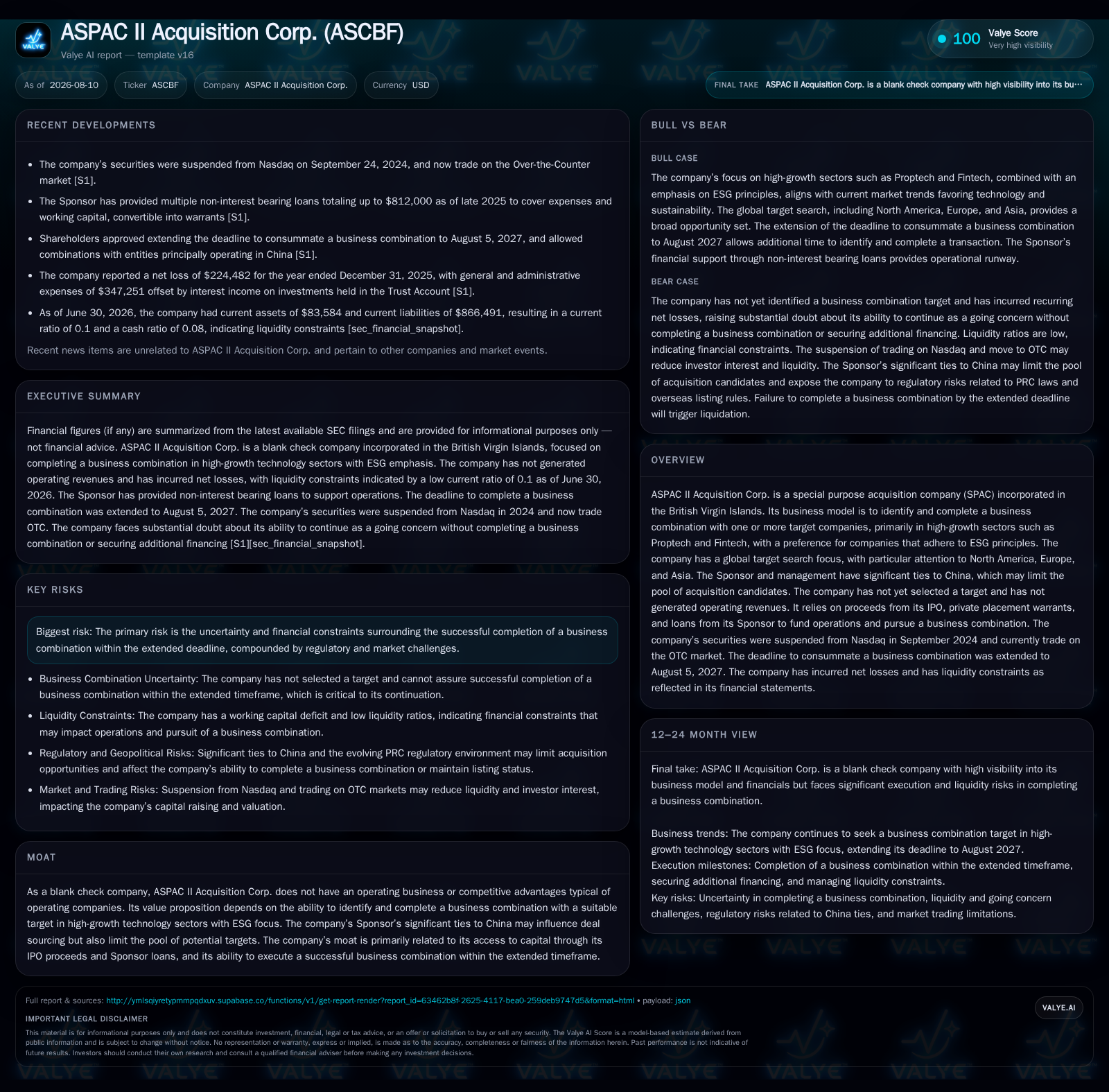
ASPAC II Acquisition Corp. remains a blank check vehicle focused on business combinations in high-growth sectors such as Proptech and Fintech, with an ESG bent. The company extended its de-SPAC deadline to August 2027, reflecting challenges in deal execution likely tied to its China-based sponsor’s influence and regulatory uncertainties. Despite liquidity support from sponsor loans, the company trades OTC following Nasdaq suspension in 2024, underscoring execution and market-access risks.
Recent Operating Update
ASPAC II Acquisition Corp.'s latest quarterly report dated August 10, 2026, reaffirms its status as a blank check company actively pursuing a business combination but without an identified target yet [S2]. Notably, the company operates under an extended timeline granted by shareholder vote in mid-2025 that pushes the deadline for completing a de-SPAC transaction out to August 5, 2027 — two years beyond the original expiry [S18]. This extension signals ongoing challenges in sourcing or executing deals within the tightly defined genre of ESG-focused technology companies in Proptech and Fintech globally but especially considering its China-oriented sponsorship background.
The suspension of NASDAQ trading on September 24, 2024, and consequent shift onto OTC markets reduces liquidity and market visibility for ASPAC II shares [S1]. This situation highlights execution skepticism from investors' perspective and reflects broader sectoral pressures faced by SPACs post-peak activity cycles
Despite no operational revenues—as expected for a SPAC—the company continues incurring expenses related to due diligence, administrative requirements, legal costs, and regulatory filings necessary during the search and negotiation phase of a business combination [S21]. Consequently, management relies heavily on financial support from sponsor loans disclosed since December 2024. These non-interest bearing advances have cumulatively reached roughly $812,000 by late 2025 through three promissory notes convertible to warrants at the sponsor’s option — providing a crucial cash buffer but raising dilution risk upon conversion [S1][S17][S26].
Business Model
As a special purpose acquisition company incorporated in the British Virgin Islands, ASPAC II functions solely as an acquisition vehicle designed to raise capital through its IPO and private placement warrant sales [S14][S15][S16]. The proceeds form a trust account invested conservatively in short-maturity U.S. treasuries that cannot be accessed except to fund an acquisition or redeem public shareholders if the merger fails to materialize within the prescribed timeframe. The company's revenue model is therefore nonexistent before combining with an operating entity; value accrues primarily based on successful deal execution followed by stock price appreciation of the post-merger entity
Monetization hinges on identifying an appealing 'New Economy Sector' target — predominantly companies in Proptech or Fintech industries that integrate ESG principles into their operations — following strategic guidance set forth at IPO. However, this focus narrows opportunity pipelines compared with broader-deal SPACs but aims to attract impact-conscious investors seeking exposure to emerging technologies aligned with global sustainability trends.
Sponsor involvement plays a critical role beyond capital provision; ASPAC II's management team is China-based with strong sponsor ties to China-affiliated entities. While this connection could facilitate access to Chinese technology firms aligned with ESG directives—especially in propelling firms across Asia—it conversely restricts potential partnerships with Western or non-China-centric firms wary of geopolitical entanglements or compliance uncertainty. Regulatory challenges loom large given evolving PRC laws governing overseas-listed entities that might affect either deal structure or ongoing compliance post-merger [S1][S8][S11].
Industry Structure and Competitive Position
Within the SPAC ecosystem—a capital-market intermediary that bridges private growth companies with public investors—ASPAC II comprises one of many blank check companies initiated during the recent SPAC wave targeting technology-enabled sectors. Peer groups include other thematic technology-focused SPACs such as Churchill Capital series or Social Capital Hedosophia Holdings that pioneered tech-sector acquisitions but often focus on different geographies or sub-industries.
ASPC II’s distinctiveness lies in its explicit ESG focus combined with pronounced ties to China via its sponsor and management team—a double-edged sword offering potential preferential insights into Chinese high-growth companies but also exposing it to scrutiny amid tightening rules on cross-border listings post-2023 CSRC guidelines [S11]. This dynamic may reduce broad investor appeal compared to peers with more diversified geographical footprints or those domiciled entirely outside sensitive jurisdictions.
The suspension of NASDAQ trading further impacts ASPAC II's competitive positioning versus listed SPAC peers who maintain exchange visibility. OTC quotation generally means lower trading volumes and higher bid-ask spreads—a challenge for shareholder liquidity prior to any announced merger unlocking fundamental value.
Growth Drivers
Key growth drivers rest squarely on successful identification and closing of a suitable target company within the extended timeline:
- Sector Tailwinds: Proptech and Fintech remain buoyant sectors with robust innovation flows supported by rising digitization demand globally; additionally, ESG investment frameworks continue gaining traction among large institutional investors seeking sustainable exposure.
- Sponsor Expertise: Ability of management tied closely to Chinese networks may open proprietary pipelines constrained for other Western-based SPACs exploring Asia-Pacific tech growth opportunities.
- Regulatory Adaptation: Navigation through China's evolving regulations around foreign listings could differentiate ASPAC II if managed effectively.
- Market Volatility: Given ongoing volatility in traditional IPO markets and regulatory tightening worldwide around public listings, alternative routes like SPACs endure as attractive albeit challenging paths for private firms seeking public capital.
Risks / Growth Constraints
Several risks significantly cloud ASPAC II's pathway:
- Execution Timeline: Despite extension until August 2027, failure to consummate a business combination triggers liquidation risks with capital returned less fees incurred.
- Limited Target Pool: Stringent sector/ESG filters plus geographic considerations may unduly constrain viable acquisition candidates.
- Chinese Regulatory Uncertainty: Changing PRC laws governing overseas offerings introduce ambiguity around approval timelines or listing eligibility post-merger.
- Liquidity Constraints: Low current ratio (~0.1) due primarily to significant current liabilities signals tight near-term cash flow dynamics pending new equity infusion upon deal close [F1][S2].
- Dilution Potential: Sponsor loan conversion into warrants increases share count dilution risks impacting shareholder returns.
- Market Sentiment: General skepticism toward SPACs post-bubble affects share prices adversely before definitive transaction announcements.
- Geopolitical Factors: Heightened U.S.-China tensions risk adverse regulation or investor flight concerning China-affiliated sponsors/targets.
What to Watch Next
Critical milestones include:
- Announcement of any definitive merger agreement or target identification providing clarity on deal terms and sector alignment;
- Regulatory approvals from relevant U.S., BVI, or PRC authorities particularly concerning listing permissions or disclosures;
- Redemptions trends among existing retail/public shareholders signaling confidence or apprehension toward proposed transactions;
- Utilization rate of outstanding sponsor loans converting into equity/warrants which will highlight capital structure adjustments;
- Market reactions on OTC trading volume spikes potentially reflecting merger speculation;
- Any management commentary updates regarding search progress or strategic shifts adapting from previous limitations.
Financial Profile Discussion
As of June 30, 2026, ASPAC II reported current assets at approximately $83,584 against current liabilities near $866,491 — implying a stretched liquidity position with a current ratio near 0.1 signifying material working capital pressure pre-business combination [F1][S2]. This framework is typical for pre-combination SPACs whose operational cash flows are minimal while incurring expenses related mainly to due diligence and corporate upkeep.
Cash balances available for operations outside the trust are limited (historically only nominal sums reported), thereby necessitating continued dependence on sponsor financing lines that total over $800k as non-interest bearing promissory notes convertible into warrants at sponsor discretion [S1][S17][S26]. Such loans provide essential runway but pose dilution concerns once converted.
Net losses reported reflect standard pre-revenue status inherent among all blank-check companies engaged solely in acquisition pursuits rather than independent operating profit generation [F1]. Going concern disclosures highlight recurring loss conditions offset by sponsor support noting execution uncertainty without future adjustments planned absent successful combination completion [S21][S22].
Conclusion
ASPAC II Acquisition Corp.'s journey typifies many challenges confronting modern SPACs focused on complex cross-border tech sectors entwined with evolving ESG mandates. While poised to fill gaps between private firms in Proptech / Fintech realms and public market access with an ESG overlay, its heavy reliance on China-linked sponsorship introduces both differentiated sourcing opportunities and heightened geopolitical/regulatory hurdles that restrict transaction scope and investor appeal in foreign markets.
The extension of its merger deadline acknowledges practical delays but also elevates urgency for successful strategic execution within two years.
Disclaimer: This analysis is provided for informational purposes only and does not constitute an investment research view or advice.
Disclaimer: This is research-only, informational analysis and not investment advice. It may include AI-generated interpretation and general industry context. Always verify important details using primary sources.

Comments