
Accelerant Holdings Advances Specialty Insurance Marketplaces With Data-Driven Risk Exchange
The latest quarter and merger announcement underscore Accelerant's strategic focus on platform technology and member quality amid moderating growth.
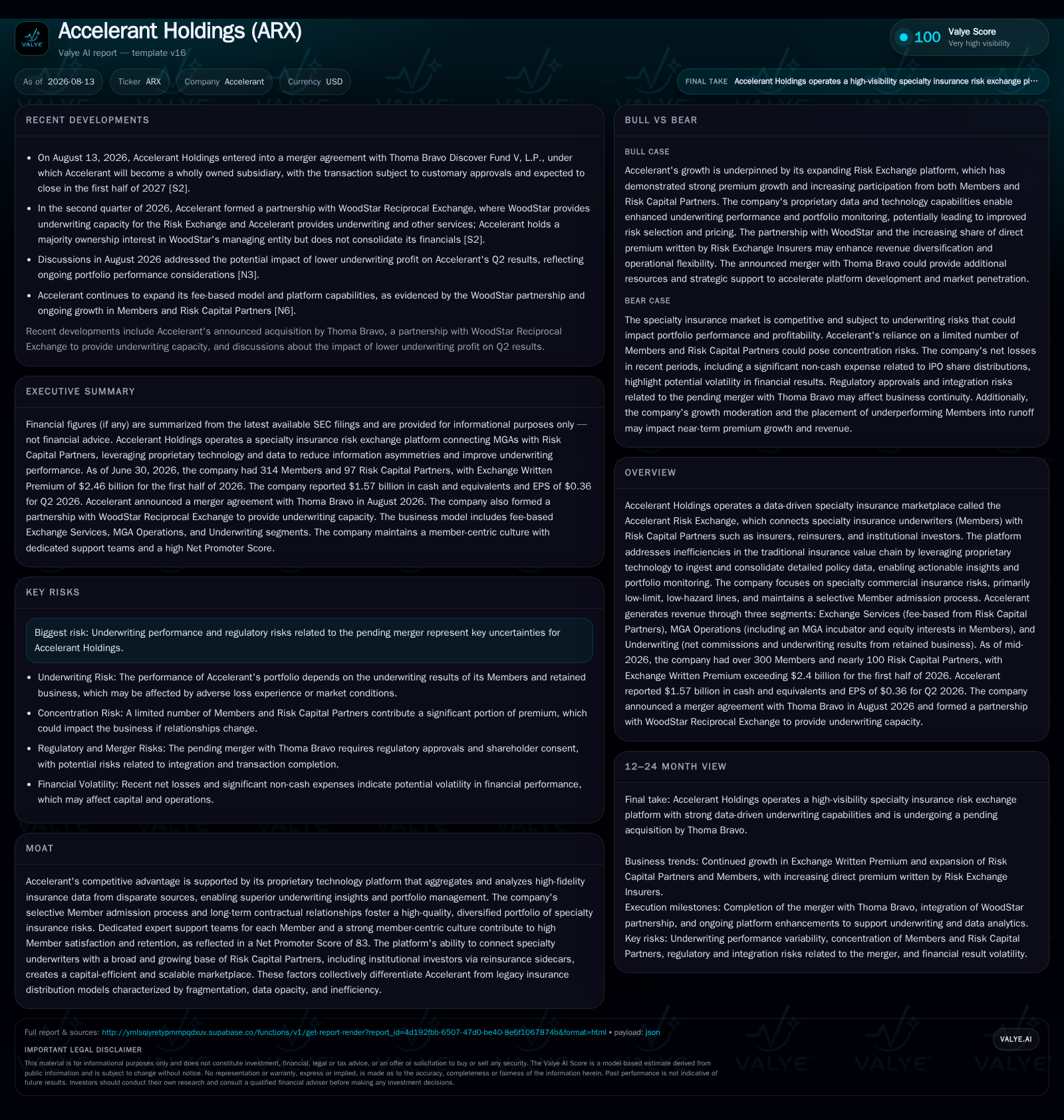
Accelerant Holdings reported steady expansion in its specialty insurance marketplace as of Q2 2026, growing its Member underwriters to 314 and Risk Capital Partners to 97 while exchange written premium rose at a moderated pace. The company highlighted enhanced investments in its proprietary data-driven risk exchange platform, underscoring its role in delivering underwriting insights and portfolio monitoring that differentiate it from legacy models. A transformative merger agreement with Thoma Bravo was announced, signaling potential acceleration in technology investment and market positioning. Key risks remain related to underwriting volatility and regulatory scrutiny around the merger.
Scaling High-Quality Memberships and Risk Capital Amid Growth Moderation
Data-Powered Underwriting Insights Driving Competitive Differentiation
At the heart of Accelerant’s value proposition is its proprietary Accelerant Risk Exchange platform, which aggregates complex policy-level data spanning thousands of attributes into analyzable datasets. By ingesting disparate data sources from Members’ policies and external inputs, the platform delivers actionable underwriting insights that improve pricing accuracy and loss reduction [S1]. These capabilities are further enhanced by ongoing technology investments disclosed in the latest filings aiming to deepen analytics sophistication and participant user experience [S2]. This data-driven approach addresses traditional insurance inefficiencies such as information gaps and excessive intermediation costs. It fosters high underwriting discipline among Members through portfolio monitoring tools, which theoretically lower loss ratios relative to legacy brokers or MGAs relying on less granular data. A reported Net Promoter Score (NPS) of 83 among platform participants underscores strong Member satisfaction tied to these offerings, encouraging retention [S1]. These elements reinforce a durable competitive moat anchored in technology-led transparency.
Capital Partners’ Role in Platform Liquidity and Premium Expansion
Risk Capital Partners form the demand side of Accelerant’s Risk Exchange by supplying underwriting capacity secured via multi-year collateralized quota share reinsurance arrangements. Notably, Flywheel Re—a Cayman Islands special purpose reinsurer backed by institutional investors—recently upsized its treaty commitment through March 2028, exemplifying increasing institutional investor involvement providing stable risk capital [S1]. This arrangement benefits Accelerant by fostering capital efficiency; premium written can be large-scale without proportional capital requirements on the company’s balance sheet. The recurring fee-based revenue model tied to these partner commitments underpins predictable earnings streams distinct from underwriting volatility. Moreover, such multi-year contracts enhance platform liquidity and reduce execution risk for Members writing policies through the Exchange.
Strategic Implications of the Thoma Bravo Merger Announcement
On August 13, 2026, Accelerant announced an agreement to be acquired by Thoma Bravo Discover Fund V, L.P., a prominent private equity firm specializing in software-enabled businesses [S3], [S2]. This transaction will convert all outstanding shares into cash at a fixed price and cancel underwater stock options without consideration. The move likely reflects an intention to accelerate platform development away from public market pressures. Private ownership typically supports more aggressive investment horizons needed for scaling complex SaaS-like marketplaces such as specialty insurance platforms. However, the merger introduces regulatory uncertainty risks common with financial services consolidations given the sector’s compliance complexities [S2]. The infusion of private equity capital could markedly enhance Accelerant’s ability to invest further in technology enhancements critical for sustaining competitive advantage.
Growth Catalysts: Platform Innovation and Fee Revenue Expansion
Management highlights intentions to escalate technology spending beyond prior levels, seeking to add features that enrich data analytics depth and overall user engagement within both Member underwriters and Risk Capital Partners [S2], [S1]. Such innovation is expected to increase fee revenue recurring rates by broadening services relied upon by participants. Expanding MGA onboarding remains another lever; higher Member diversity can facilitate broader product offerings capturing additional underserved specialty niches. This aligns with broader industry trends moving away from legacy brokers toward digital exchanges enabling better risk segmentation and transparent pricing. Furthermore, growing institutional investor interest in insurance-linked asset classes supports continued expansion of risk capital partnerships.
Risks from Underwriting Performance Variability and Regulatory Environment
Despite technological safeguards, inherent underwriting risk remains a principal challenge for Accelerant’s partially retained business lines. Loss ratio volatility can adversely impact net income given segments retaining up to mid-teens percent of premium risk [S2], [S1]. The selective Member admission process mitigates this by enforcing disciplined underwriting standards supported by analytics; however, deviations or adverse experience could materially affect profitability. Regulatory risks linked especially to the pending merger compound uncertainties as increased scrutiny could delay closing or impose operational constraints [S2], [S8]. Operational scaling burdens including maintaining data integrity across expanding Membership also pose execution risks impacting pricing accuracy.
Key Upcoming Milestones: Merger Progress, Technology Enhancements, and Member Metrics
Market participants should closely monitor regulatory approvals related to the Thoma Bravo acquisition expected over coming quarters along with shareholder vote outcomes [S3]. Additionally, deployment timelines for planned Enhancements to the Accelerant Risk Exchange platform will serve as critical signals validating management’s ability to deliver promised technology-driven differentiation [N14]. Tracking quarterly Membership trends—such as net additions or attrition among high-quality MGAs—and changes in fee revenue recurring rates will further illuminate execution momentum or emerging challenges [S2]. Positive markers here could confirm accelerating maturation consistent with long-term value creation priorities.
Financial Profile Discussion: Robust Liquidity Supports Strategic Agenda
As of June 30, 2026, Accelerant reported approximately $1.57 billion in cash and cash equivalents against total debt near $120 million, positioning it with a strong net cash balance exceeding $1.45 billion [F1], [S2]. This liquidity reservoir provides ample runway for ongoing technology investments critical post-merger integration while maintaining regulatory capital buffers required for insurance operations. Overall, this conservative leverage posture complements Accelerant’s evolving dual-revenue model driven by fee-based services combined with selective underwriting retention.
This analysis synthesizes publicly disclosed operational updates primarily from Accelerant Holdings’ August 2026 quarterly filing and related SEC disclosures interpreted within broader specialty insurance marketplace dynamics. It refrains from speculative conclusions beyond supported evidence while emphasizing how proprietary technology integration distinguishes Accelerant in connecting specialty MGA underwriters with diversified institutional risk capital partners amid industry shifts toward digitization.
Disclaimer: This write-up is for informational purposes only and does not constitute investment advice or research view.
Disclaimer: This is research-only, informational analysis and not investment advice. It may include AI-generated interpretation and general industry context. Always verify important details using primary sources.

Comments