
Pyxis Oncology Advances ADC Clinical Data While Balancing Near-Term Cash Constraints
Latest quarter highlights early clinical promise for MICVO alongside a finite cash runway typical of clinical-stage oncology biotechs.
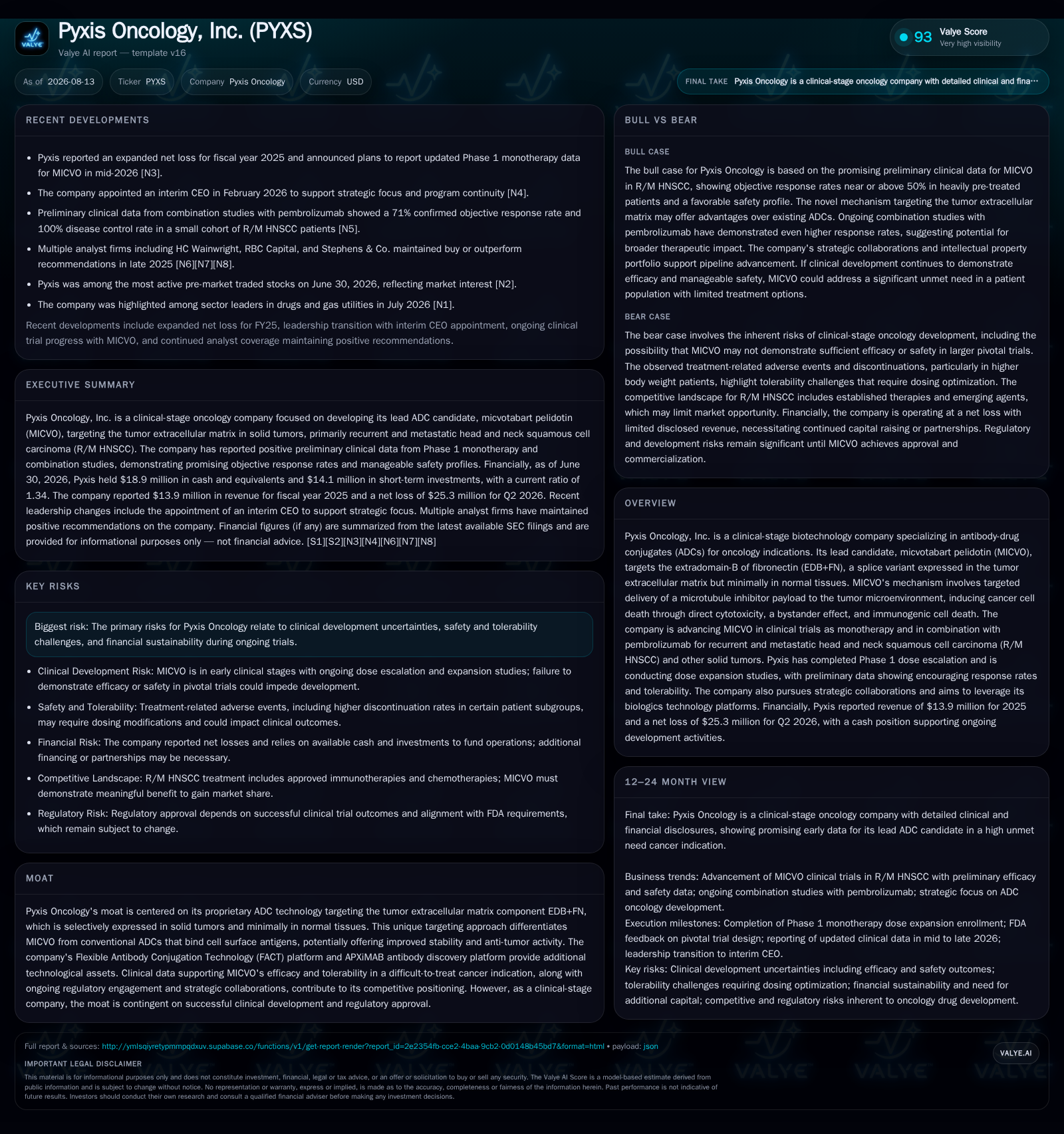
Pyxis Oncology reported continued progress in developing its lead antibody-drug conjugate, micvotabart pelidotin (MICVO), targeting the tumor extracellular matrix in solid tumors including head and neck squamous cell carcinoma. Early-phase data show encouraging objective response rates driven by a novel extracellular matrix targeting mechanism, differentiating Pyxis’s platform from traditional ADCs that bind cell surface antigens. The company remains pre-commercial with no product revenue, relying on R&D investment funded by limited cash reserves. Manufacturing remains outsourced to contract development organizations, and while regulatory engagement continues, key clinical milestones will be critical to validate the platform’s potential. Financially, Pyxis ended Q2 2026 with a modest cash balance and a current ratio of 1.34, underscoring capital needs amid ongoing trials. Risks center on clinical and regulatory uncertainties inherent to first-in-class oncology programs.
Recent Operating Update
In its latest Form 10-Q filing dated August 13, 2026, Pyxis Oncology reiterated active clinical development of its lead antibody-drug conjugate (ADC) candidate micvotabart pelidotin (MICVO), with focus on solid tumor indications such as recurrent/metastatic head and neck squamous cell carcinoma (R/M HNSCC) [S2]. This quarterly update underscores ongoing dose expansion studies following completion of Phase 1 dose escalation—data from which previously demonstrated promising efficacy signals among heavily pretreated patients. Management's disclosure confirms patient enrollment is progressing according to plan without triggered safety holds or new adverse events of concern. The company also issued a contemporaneous press release emphasizing these points alongside its Q2 financial results [S3][N1].
This near-term update anchors Pyxis’s position as a clinical-stage biotech advancing a differentiated ADC platform with early signals meriting continued investigation.
Business Model and Product Differentiation
Pyxis Oncology operates as a clinical-stage biotechnology developer specializing in antibody-drug conjugates directed at oncology indications. Fundamental to its business model is proprietary targeting of the tumor extracellular matrix (ECM) component extradomain-B fibronectin (EDB+FN), an isoform abundantly expressed within tumor stroma but minimally present in normal adult tissues [S1]. This strategy contrasts with conventional ADCs which target antigens on cancer cell surfaces.
The lead product candidate, MICVO (formerly PYX-201), consists of a fully human IgG1 monoclonal antibody conjugated site-specifically to a microtubule inhibitor payload (auristatin Aur0101) via a cleavable linker. In the acidic tumor microenvironment rich with extracellular proteases, the linker is cleaved releasing the cytotoxic payload extracellularly. The payload then enters nearby cancer cells resulting in direct cytotoxicity—the primary mode of action (MOA). Secondary mechanisms include a bystander effect where payload released from dying cells kills adjacent cancer cells irrespective of target antigen expression and immunogenic cell death that may activate anti-tumor immune responses [S1].
This triple-pronged MOA potentially offers enhanced efficacy particularly in heterogeneous tumors while potentially mitigating off-target toxicity compared to ADCs reliant solely on cell surface antigen internalization. Monetization currently focuses on milestone-driven capital infusion supporting R&D; commercial revenue is prospective upon regulatory success.
Sales and marketing capabilities are undeveloped given clinical stage status; plans envisage building internal expertise post-approval complemented possibly by strategic partnerships for broader geography or specialized promotional efforts [S7]
Industry Context and Competitive Positioning
Within the competitive landscape of clinical-stage oncology biotechs focused on ADC technology—exemplified by companies such as Seagen or ImmunoGen—Pyxis’s unique EDB+FN ECM targeting represents an innovative niche aiming to overcome limitations like antigen heterogeneity and resistance seen with classical ADCs targeting cancer cell surface markers. This novelty could translate into improved response durability or broader applicability across solid tumors.
However, substantial risk remains given the early stage: efficacy signals must be validated in larger cohorts; safety profiles refined; and manufacturing scale-up demonstrated under cGMP conditions typically handled by external CDMOs due to high infrastructure costs [S1]. Reliance on third-party manufacturers is standard but introduces supply chain dependencies.
An added industry dynamic is competition from alternative therapeutic modalities such as bispecific antibodies, cell therapies (CAR-T/TCR-T), radiopharmaceuticals, or targeted small molecules that might deliver superior efficacy/safety or faster regulatory approval timelines for overlapping indications [S4]
Pyxis’s approach intertwines intellectual property generated primarily via exclusive licenses from academic institutions like the University of Chicago and strategic acquisitions such as Apexigen to bolster its technology base [S13][S27].
Growth Drivers
Key drivers underpinning Pyxis Oncology’s growth narrative center on continuing positive clinical data demonstrations that confirm MICVO's differentiated MOA translates into meaningful patient outcomes such as objective response rate (ORR), progression-free survival (PFS), or overall survival (OS) improvements in difficult-to-treat solid tumors. Preliminary data indicating an approximate 50% ORR in heavily pretreated R/M HNSCC patients validates target engagement and functional activity at selected dosing regimens [S1].
Expansion into combination therapies with checkpoint inhibitors like pembrolizumab represents additional growth vectors leveraging possible synergistic immune activation pathways. Success here warrants broader indication use beyond initial monotherapy trials.
Execution milestones include enrolling additional dose expansion cohorts, managing dose-limiting toxicities carefully to maintain tolerability thresholds, securing pivotal study design agreements with regulators such as FDA or EMA, and cultivating commercialization partnerships or capabilities post-approval [S2][N1]
Capital availability from non-dilutive sources such as recent $11 million royalty sale proceeds on Enzeshu® royalties provides operational flexibility funding key development stages through late 2026 [S6]
Risks and Growth Constraints
Clinical trial execution risks dominate: failure to meet primary endpoints or emergence of unacceptable safety/tolerability profiles could halt development or necessitate significant program restructuring. Given the novel ECM target engagement approach, unanticipated pharmacodynamics or adverse immune reactions remain possible.
Financial sustainability beyond current cash reserves poses challenges amid prolonged trial timelines and negative operating income typical for stage; inability to secure follow-on funding promptly risks delays in trial progress or forced asset sales/licensing under less favorable terms [F1][S2]
Regulatory uncertainties encompass protracted review times or demands for additional data which could extend timelines materially relative to peer approvals.
Market penetration post-approval depends on demonstrating superiority or clear differentiation versus existing ADCs or alternative therapies with established physician adoption patterns—a nontrivial hurdle given competition intensity.
Supply chain reliance on CDMOs introduces manufacturing risk related to scalability constraints or quality control variabilities during transition to commercial-scale production if approved [S1]
Cybersecurity safeguards noted in filings reflect heightened attention but remain an area requiring vigilant risk management given sensitive proprietary data exposure implications [S10].
What to Watch Next
Upcoming key catalysts include:
- Readouts from ongoing dose expansion cohorts evaluating MICVO monotherapy efficacy and safety metrics,
- Combination therapy trial data integration assessing synergy potential with pembrolizumab,
- Regulatory interactions including feedback on pivotal trial designs,
- Updates on partnership strategies for commercialization scope extension,
- Financial disclosures clarifying cash runway projections beyond late 2026 once new financing actions occur,
- Any safety signal reports influencing dosage adjustments or enrollment pace. Monitoring these developments alongside industry shifts toward next-gen ADC innovations will provide clarity on Pyxis Oncology’s pathway toward potential market entry.
Financial Profile Discussion
As of June 30, 2026, Pyxis held approximately $18.9 million in cash and equivalents against current liabilities near $27.5 million yielding a current ratio of roughly 1.34—indicative of tight short-term liquidity typical for pre-revenue clinical-stage biotechs reliant heavily on external funding sources [F1]. Operating losses continue reflecting substantial R&D investments underpinning clinical program advancement; reported negative net income was $79.6 million at year-end 2025 [F1].
The company strengthened near-term liquidity through strategic royalty monetization transactions generating $11 million non-dilutive proceeds intended to fund operations through critical data milestone releases by Q4 2026 [S6]. However, absent commercial revenues pending regulatory approval, Pyxis faces ongoing capital raise imperatives requiring adept financial management balancing dilution risks against sustaining development momentum.
Given sector norms where burn rates often outpace incoming funds in early years until successful registration triggers licensing payments or product sales commence, monitoring quarterly liquidity trends alongside milestone achievements remains essential for assessing financing sufficiency.
This analysis is based solely on publicly available SEC filings dated through August 13, 2026 ([S1], [S2], [S3]) supplemented by contemporaneous news reports ([N1], [N2]) and company's disclosed financial snapshot ([F1]). It aims to provide detailed operational insights without investment research views.
Disclaimer: This is research-only, informational analysis and not investment advice. It may include AI-generated interpretation and general industry context. Always verify important details using primary sources.

Comments