
Azitra Advances Clinical Programs with AI-Driven Microbial Therapeutics Amid Emerging Tariff Risks
Azitra’s recent quarterly filing highlights progress in its orphan dermatology pipeline alongside emerging cost pressures linked to evolving U.S. trade policies affecting clinical operations.
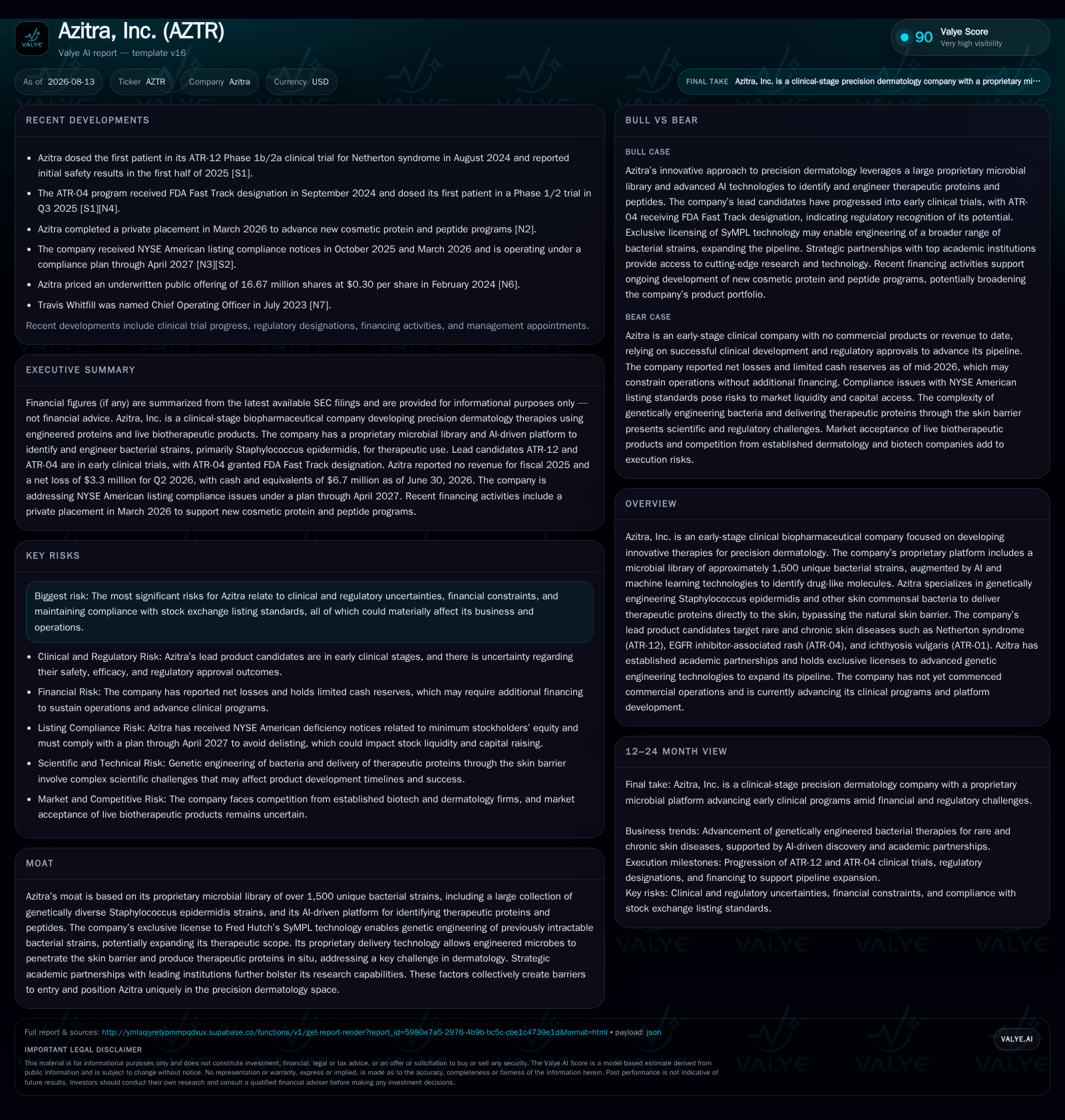
Azitra, Inc. has initiated a Phase 1b clinical trial for ATR-12, its genetically engineered S. epidermidis candidate targeting the rare skin condition Netherton syndrome, marking a key clinical milestone supported by prior FDA clearance [S2][S3]. The company leverages a proprietary microbial strain library enhanced by artificial intelligence and holds exclusive licensing of a genetic engineering platform to expand its pipeline [S1]. However, new U.S. tariffs on foreign manufacturing and service providers introduce operational cost uncertainties that may impact research and development expenses [S2]. Azitra remains pre-revenue but maintains a solid liquidity position with $6.7 million in cash and a current ratio near 4.9 as of June 30, 2026, supporting ongoing development activities [F1][S2]. Key upcoming milestones include clinical trial readouts and regulatory interactions critical for advancing its novel live biotherapeutic products.
Recent Quarterly Update Highlights Clinical Progress and Supply Chain Challenges
Azitra's August 12, 2026 quarterly filing reveals the initiation of a Phase 1b clinical trial for ATR-12, its lead genetically engineered Staphylococcus epidermidis candidate designed to treat Netherton syndrome—a rare orphan dermatologic disease with limited treatment options [S2][S3]. This advancement follows FDA clearance post-investigational new drug (IND) submission, reflecting meaningful regulatory progress critical for validating the company's live biotherapeutic approach.
Simultaneously, the filing draws attention to an emerging challenge: since April 2025, new U.S. import tariffs have been imposed on foreign third-party manufacturers and service providers integral to Azitra's clinical operations [S2]. Although the company currently does not source from China—the most affected market—these tariffs introduce unpredictability around manufacturing costs and service expenses that underpin research activities. Potential tariff expansions to services could further inflate R&D expenditures, complicating budget forecasts in an already resource-intensive development phase.
As Azitra remains pre-revenue without commercial product sales, managing these operational cost pressures is pivotal for sustaining its development momentum.
Proprietary Microbial Library and AI-Enhanced Discovery Drive Differentiation
Central to Azitra’s innovation is its extensive microbial strain library containing about 1,500 unique bacterial isolates representing over 60 species identified for therapeutic engineering [S1]. This breadth surpasses typical microbiome collections by coupling scale with an artificial intelligence (AI) and machine learning (ML) discovery platform that predicts drug-like molecules within strains. Such technology streamlines candidate identification by prioritizing microbes capable of delivering durable therapeutic effects topically.
This AI-driven screening enhances Azitra's ability to efficiently navigate the complex biological space of live biotherapeutic products (LBPs), setting it apart from peers focused on single protein biologics or small molecules. The platform potentially accelerates early-stage pipeline maturation by mitigating bottlenecks inherent in selecting viable live microbial drug candidates.
Strategic Licensing Expands Genetic Engineering Capabilities
Azitra’s exclusive license to Fred Hutchinson Cancer Center’s SyMPL genetic engineering platform is a strategic asset enabling modification of bacterial species previously resistant to standard recombinant DNA techniques [S1]. This platform circumvents bacterial defense mechanisms against foreign DNA insertion, allowing broader exploration beyond Staphylococcus epidermidis.
Such exclusivity creates competitive barriers by restricting access to this enabling technology and strengthens Azitra’s intellectual property position—a crucial factor in synthetic biology-driven therapeutic development where proprietary gene-editing tools underpin product differentiation.
Competitive Positioning Within Emerging Microbial Therapeutics Biotech
Within the clinical-stage biotech sector focusing on dermatology and microbial therapeutics, Azitra occupies a niche integrating AI-powered discovery with live biotherapeutic engineering. While companies like Recursion Pharmaceuticals also employ AI/ML broadly across drug discovery pipelines, their focus diverges from Azitra’s precision dermatology application of engineered microbes. Similarly, firms such as Intellia Therapeutics innovate at the gene-editing level but target systemic diseases rather than topical microbiome modulation.
Azitra's approach emphasizes overcoming skin barrier challenges by delivering engineered bacteria that produce therapeutic proteins locally—an underexplored modality relative to conventional biologics or small molecules.
Growth Drivers: Orphan Disease Focus and Manufacturing Scale-Up
Targeting orphan diseases like Netherton syndrome aligns Azitra with favorable regulatory incentives including orphan drug designations that provide benefits such as market exclusivity extensions and reduced fees [S1]. The Pediatric Rare Disease Designation for ATR-12 underscores this strategy addressing unmet medical needs in rare dermatological conditions.
Market adoption potential hinges on increased awareness of rare skin diseases coupled with successful clinical validation. Nevertheless, scaling manufacturing processes for live biotherapeutic organisms under stringent GMP conditions remains complex; ensuring consistent biological activity and safety during scale-up is critical ahead of commercialization.
Key Risks: Clinical Outcomes, Regulatory Uncertainty, IP Challenges, Tariff Exposure
As an early-stage clinical biopharmaceutical company, Azitra faces significant risks related to trial success rates and regulatory approval timelines that are inherently uncertain [S1]. Regulatory agencies may require additional data or impose delays based on evolving safety or manufacturing considerations.
Intellectual property protection is another area of vulnerability given rapid advances in gene editing technologies that could erode exclusivity if competitors develop alternative platforms.
The newly disclosed tariff-related cost inflation introduces macroeconomic uncertainty impacting R&D budgeting amid ongoing geopolitical trade tensions [S2]. Sustaining financial resources through capital markets is essential given expected net losses before any commercial revenues materialize.
Upcoming Milestones: Clinical Readouts and Capital Strategy
Near-term catalysts include anticipated data from the Phase 1b ATR-12 trial which will inform safety profiles and preliminary efficacy signals necessary for planning pivotal studies [S2][S3]. Progress across other pipeline candidates leveraging SyMPL technology will also indicate platform scalability.
Capital raising initiatives remain critical to extend operational runway amidst rising costs influenced by tariff exposure.
Financial Profile Discussion: Solid Liquidity Supports Development Efforts
As of June 30, 2026, Azitra reported $6.7 million in cash and equivalents with current assets substantially exceeding liabilities resulting in a current ratio of approximately 4.86—signaling strong short-term liquidity relative to obligations [F1][S2]. In absence of revenue generation so far and historical net losses exceeding $10 million annually [F1], ongoing operations rely heavily on equity financing complemented intermittently by grants or collaborations.
This liquidity position supports continued R&D investment into late 2026 provided no unexpected cost escalations arise or additional funding is secured amid economic uncertainties stemming from trade policy shifts.
This analysis synthesizes Azitra's latest public filings up to August 2026 within the context of biotechnology sector dynamics without projecting investment outcomes.
Disclaimer: This is research-only, informational analysis and not investment advice. It may include AI-generated interpretation and general industry context. Always verify important details using primary sources.

Comments