
Virgin Galactic's Flight Cadence and Next-Gen Spaceship Development Shape Growth Trajectory
Q2 2026 filings reveal Virgin Galactic's progress scaling operations and developing next-generation vehicles underscores its growth prospects and risks.
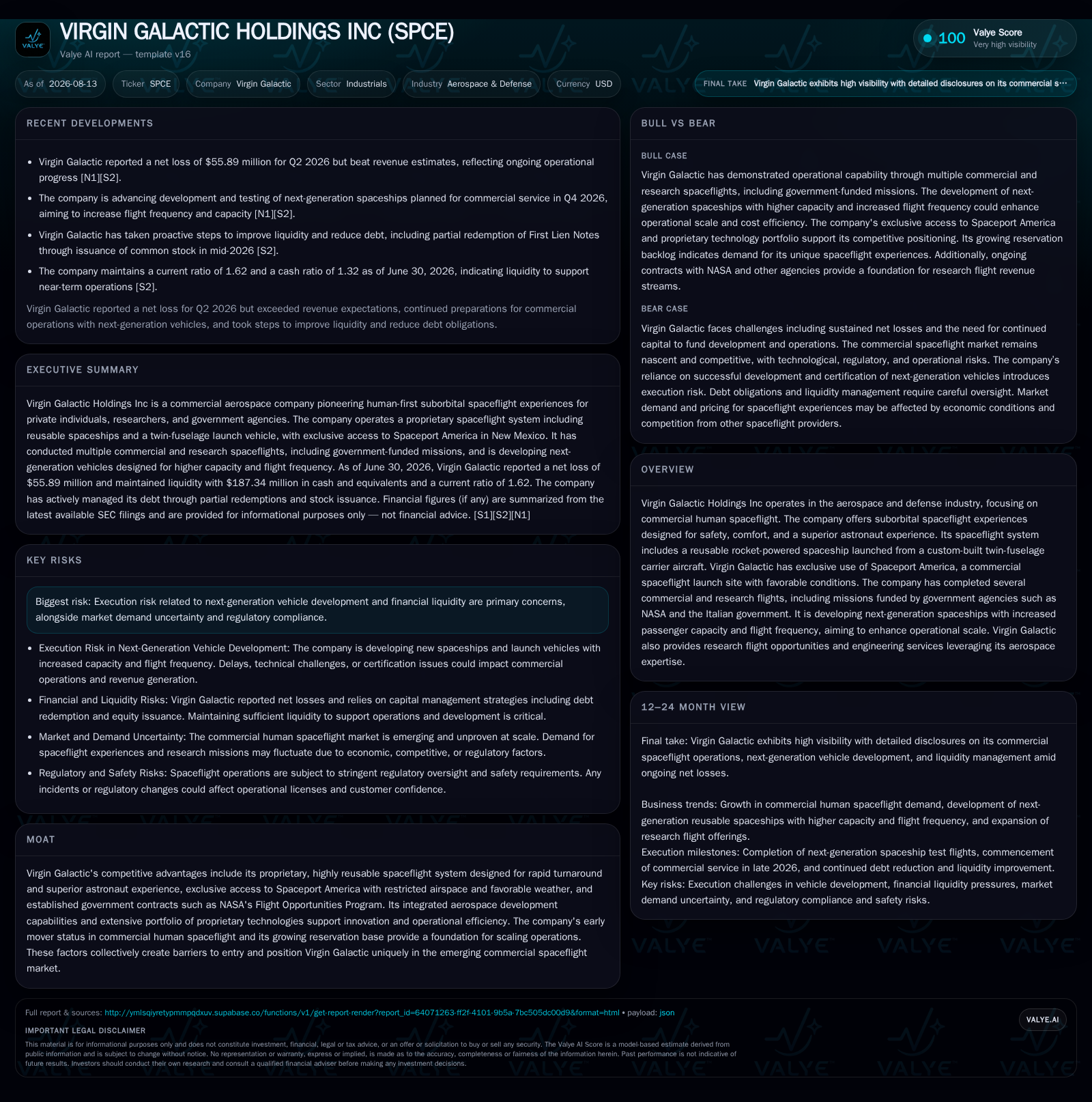
Virgin Galactic reported operational milestones in Q2 2026 reflecting incremental gains in commercial flight activity amid ongoing development of next-generation spacecraft designed to expand passenger capacity and improve flight cadence. Its proprietary reusable spaceflight system, combined with exclusive access to Spaceport America, supports a unique market position in commercial human spaceflight. The company’s substantial reservation backlog signals demand potential, but execution risks around vehicle development, regulatory compliance, and liquidity remain significant. Government research contracts diversify revenue, complementing space tourism efforts. Upcoming vehicle tests and conversion of reservations into flights will be key execution indicators going forward.
Q2 Operating Milestones Refine Commercial Flight Momentum
Virgin Galactic’s Q2 2026 report highlights measured progress in its commercial flight cadence. While specific flight count disclosures are limited, the company confirmed conducting multiple suborbital flights as part of testing and commercial demonstration activities within the quarter [S2]. This demonstrates incremental utilization of its reusable spaceflight system—a vectored strategy critical to scaling operations. The absence of reported safety incidents during this period suggests ongoing adherence to operational safety protocols that underpin customer confidence, an essential feature given the nascent commercial nature of human space travel.
Flight cadence is a pivotal operating KPI in commercial human spaceflight because it directly correlates with revenue generation capacity. For Virgin Galactic, increasing the number of launches per year per vehicle indicates improvement in turnaround efficiency and operational maturity. This metric will be instructive against peers such as Blue Origin—who similarly emphasize reusable launch vehicles—but Virgin Galactic’s focus on suborbital voyages for private astronauts differentiates the monetization axis away from satellite payloads or orbital transport.
Capitalizing on Reusable Spacecraft Design: Pathway to Flight Cadence Optimization
The cornerstone of Virgin Galactic’s operational scaling is its proprietary reusable spacecraft system composed of rocket-powered spaceships launched from a twin-fuselage carrier aircraft. This architecture contrasts with vertically-launched rockets common among competitors, offering potential benefits in reusability, turnaround time, and astronaut experience quality [S1]. The design facilitates runway takeoffs and landings which reduce infrastructure dependency compared to conventional pads.
Such reusability is critical as each flight’s cost amortization depends on rapid refurbishment cycles. Compared to Blue Origin’s partially reusable New Shepard or SpaceX’s focus on orbital rocket recovery, Virgin Galactic targets a niche emphasizing astronaut experience over cargo mass. Its ability to compress operational turnaround time below peer benchmarks would imply potential margin advantages if flight frequency can increase without proportionate cost inflation.
Reservation Backlog Trends Signal Demand Sustainability with Customer Acquisition Nuances
A vital growth indicator remains the approximately 675-person reservation backlog noted end-2025 [S1]. This backlog represents prospective buyers who have either paid deposits or reserved seats for future suborbital flights. Such bookings provide forward revenue visibility especially as flights convert backlog customers into paying astronauts.
However, converting reservations into actual flights at scale entails marketing sophistication and delivery reliability. Historically limited sales volumes coupled with the novelty of space tourism introduce uncertainty around customer acquisition costs and repeat booking dynamics. Marketing expenses are rising as Virgin Galactic expands outreach efforts aiming for broader customer demographics beyond early adopters.
The backlog also serves as a barometer for brand strength given increasing competition among commercial spacelines attempting to monetize human space access. Successful reduction in sales cycle times through targeted campaigns would corroborate long-term demand structural growth rather than cyclical hype.
Competitive Moat Anchored by Exclusive Spaceport Access and Government Research Engagements
Virgin Galactic possesses an important competitive advantage via its exclusive rights to operate from Spaceport America in New Mexico—a purpose-built facility optimized for suborbital launches [S1]. The site offers relatively predictable desert weather conditions conducive to reliable scheduling alongside restricted airspace minimizing interference from general aviation traffic. Such logistical advantages simplify regulatory compliance hurdles and reduce weather-induced delays common elsewhere.
Additionally, government contracts such as NASA's Flight Opportunities Program provide dual benefits: stable revenue streams supporting R&D investments and validation through scientific payload missions integrated into existing flight manifests. These engagements diversify Virgin Galactic’s revenue beyond consumer space tourism while building high-profile partnerships that bolster institutional credibility—a distinct asset against aerospace manufacturing giants like Boeing or Lockheed Martin focusing on governmental aerospace contracts.
Scaling Risks from Next-Generation Vehicle Development Introduce Execution Unease
At the core of Virgin Galactic’s growth ambitions lies the development of next-generation spaceships featuring expanded passenger cabins promising greater capacity per flight alongside advanced propulsion tailored for increased sortie rates [S1], [S22]. While this progression is crucial for operational scale-up and margin improvements through beneficial load factors, it introduces significant execution risk.
Technical challenges inherent in aerospace design could precipitate costly delays or design modifications impacting launch cadence timelines. Coupled with stringent safety regulations governing human-rated spacecraft—enforced by bodies like the FAA Office of Commercial Space Transportation—the path to certification remains complex. Any slippages may impair anticipated ramp-ups in commercial operations that underpin revenue forecasts.
The company also faces risk inherent in heightened R&D expenditures potentially outpacing revenue growth in the near term given current losses exceeding $278 million annually through 2025 [F1]. Sustained liquidity adequacy is paramount during this transition phase.
Growth Drivers: Expanding Passenger Capacity, Flight Frequency & Broadening Market Reach
Looking forward, Virgin Galactic aims to leverage its next-generation spaceships’ increased seating capacity alongside operational efficiencies gained through improved turnaround technologies to multiply annual flight counts per vehicle [S1], [N1]. Enhanced passenger volume enhances average revenue per flight substantially given fixed flight operational costs are relatively stable irrespective of cabin occupancy.
Additionally, broader demographic engagement fueled by expanded marketing initiatives seeks to tap into a growing global appetite for experiential luxury travel—space tourism’s fastest-growing segment. Institutional clients requiring research payload access through government programs provide complementary upside beyond consumer ticket sales.
Together these factors outline a multi-pronged demand expansion vector that targets sustainable top-line scale while progressively improving unit economics via better leverage on fixed costs.
Monitoring Catalysts: Upcoming Vehicle Tests, Reservation Conversions & Regulatory Landscape
Crucial near-term milestones include successful completion of next-generation spaceship test flights validated under rigorous FAA standards that would catalyze full commercial deployment [S2], [S3]. Additionally, quarterly tracking of reservation conversions into flown passengers will serve as a direct metric reflecting market acceptance and delivery capability.
Regulatory approvals related to vehicle certifications or enhanced operating licenses at Spaceport America could materially affect achievable flight frequencies or introduce constraints if delayed.
Stakeholders should prioritize updates on these fronts as clear signals clarifying whether Virgin Galactic’s operating model transitions from developmental to fully commercial scale efficiently or faces bottlenecks raising cost structure concerns.
Financial Context: Cash Position, Debt Management & R&D Investment Support Execution
Virgin Galactic ended Q2 2026 with cash and equivalents around $187 million against total debt near $192 million—yielding a net-debt position close to neutral with a healthy current ratio near 1.62 indicating adequate short-term liquidity buffers [F1]
The company has aggressively managed debt maturity profiles by partially redeeming high-interest First Lien Notes via equity issuance earlier in June 2026 reducing interest burdens ahead of expected revenue ramp-ups tied to commercial flight operations commencing late 2026 [S6], [S19].
Nevertheless, ongoing heavy R&D spending associated with next-gen spacecraft development remains a critical cash outflow driver necessitating vigilant capital management amid continued operating losses exceeding $278 million annually through year-end 2025 levels while still evidencing limited organic profit generation capacity [F1]
Financial discipline balancing investment for growth against preserving runway amid evolving demand dynamics represents an essential watchpoint for sustainability.
This analysis synthesizes publicly filed data up to Q2 2026 alongside comprehensive industry context without conjectural forecasts or investment research views. It emphasizes evidence-backed insights into Virgin Galactic’s operational scale trajectory within the emerging commercial human spaceflight sector where technological innovation must be balanced against regulatory rigor and market adoption challenges.
Disclaimer: This is research-only, informational analysis and not investment advice. It may include AI-generated interpretation and general industry context. Always verify important details using primary sources.

Comments