
Crown Reserve Acquisition Corp. I Advances Business Combination Strategy with Carvix Agreement
The SPAC leverages its substantial trust account and experienced management to pursue a business combination with Carvix within an extended timeline, while navigating typical execution and market risks.
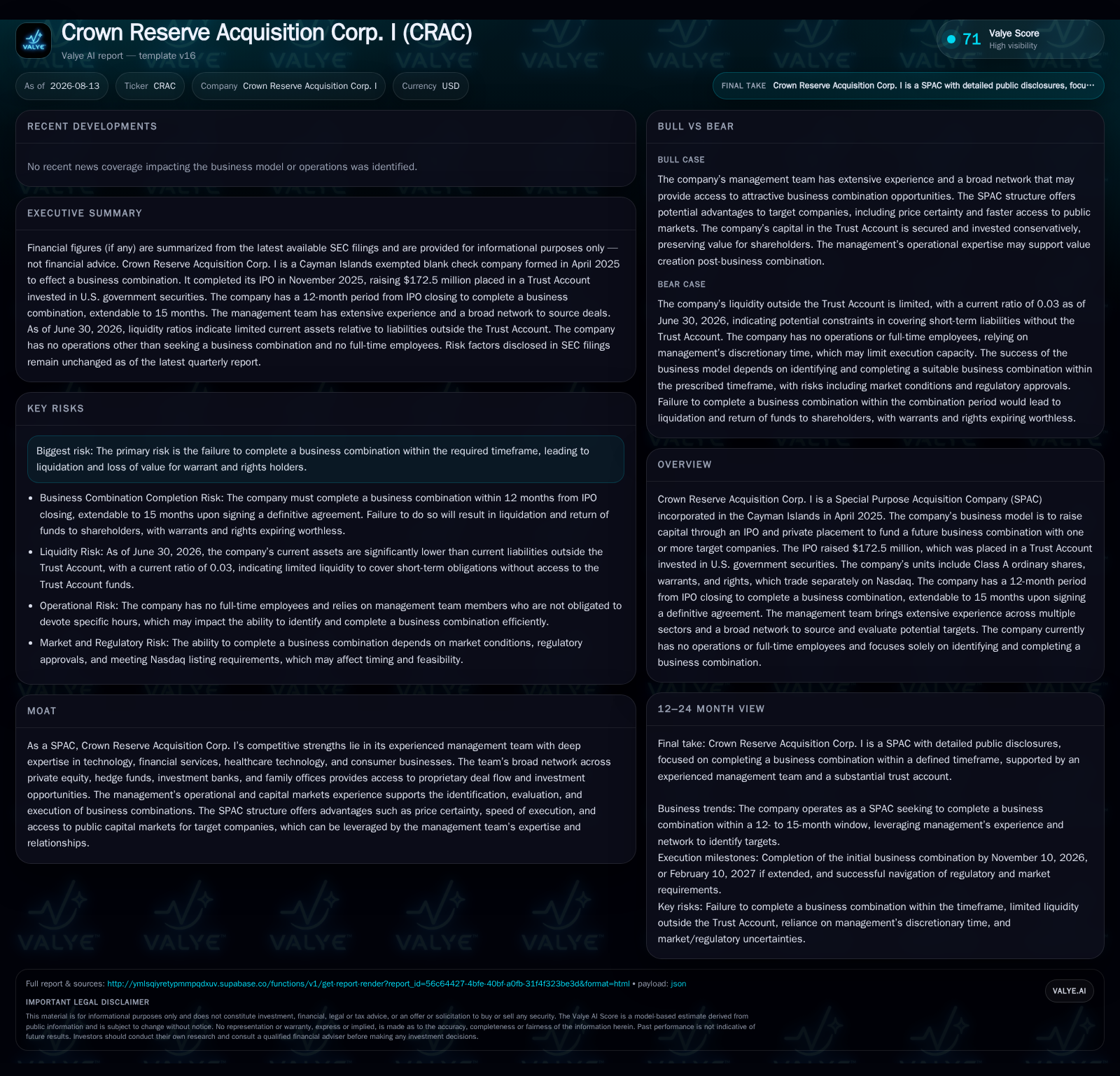
Crown Reserve Acquisition Corp. I reported steady progress toward completing its initial business combination under a definitive agreement with Carvix, extending the merger deadline to February 2027. The Cayman Islands-based SPAC raised $172.5 million in its IPO, held in a trust invested in U.S. government securities, with additional sponsor-aligned private placements. The management team's cross-sector expertise supports proprietary deal sourcing amid competitive SPAC markets. Key risks include timely deal closure, shareholder redemption dynamics, and dilution impact from warrants and founder shares. Financially, the company maintains minimal operating expenses and a low current ratio consistent with SPAC structures where cash is segregated in trust accounts [S1], [S2], [S9], [S17], [F1].
Recent Operating Update
Crown Reserve Acquisition Corp. I (CRAC) filed its most recent quarterly report on August 12, 2026, affirming no material changes to previously disclosed risk factors while progressing toward consummating its initial business combination with Carvix, Inc. The binding Business Combination Agreement signed on March 30, 2026 extends the deadline for closing the transaction from the standard 12 months post-IPO (November 10, 2026) to 15 months (February 10, 2027), providing additional runway to finalize terms and secure necessary approvals [S2], [S9], [S21]. Any further extensions would require shareholder consent.
Operating activity remains consistent with typical SPAC profiles at this stage: no revenues or full-time staff exist prior to merging with a target company. Operating losses are minimal and primarily reflect administrative and legal expenses necessary for regulatory compliance and corporate governance maintenance before deal closure [F1].
Business Model Overview
Incorporated as a Cayman Islands exempted company in April 2025, Crown Reserve Acquisition Corp [S1]. I functions exclusively as a blank check company that raises capital through an IPO and private placements to facilitate one or more future business combinations without engaging in commercial operations until such transactions occur
As of June 30, 2026, current assets outside the trust account totaled roughly $114 thousand against current liabilities near $3.47 million, resulting in an unusually low current ratio around 0.03—a structural feature reflecting that the bulk of cash proceeds ($172.5 million IPO plus $3 million private placement) are held separately in a trust account invested solely in U.S. government securities to preserve capital certainty for public shareholders pending acquisition closure [F1], [S1].
Capital was raised via units priced at $10 each during the November 2025 IPO generating gross proceeds of $172.5 million alongside private placement units sold primarily to sponsors at $8 per unit raising an additional $3 million. Each unit includes one Class A ordinary share, one-half redeemable warrant exercisable at $11.50 per share subject to market conditions following deal closing, plus rights convertible into fractional shares upon consummation of the business combination [S1]. These components have traded separately on Nasdaq since December 2025 under distinct tickers.
Founder shares totaling about 4.31 million Class B ordinary shares are held by the sponsor providing alignment incentives given their favorable economics but forfeitable status if no transaction completes within mandated timeframes [S1]. Private placement warrants held by insiders are non-redeemable until after merger completion further aligning sponsor interests with successful deal execution
Industry Structure and Competitive Position
Crown Reserve operates as a financial intermediary facilitating private companies’ access to public equity markets through de-SPAC transactions rather than traditional IPOs—a pathway valued for speed, cost control, and pricing certainty relative to conventional offerings vulnerable to market volatility or delays. This places Crown Reserve among peer SPAC sponsors competing for attractive targets within limited time horizons.
Its Cayman Islands incorporation offers certain jurisdictional flexibilities compared with U.S.-incorporated peers while adhering to Nasdaq listing standards.
The management team's multi-sector expertise spanning technology, healthcare technology, financial services, and consumer businesses enhances proprietary access to quality acquisition candidates through extensive networks that include private equity firms, hedge funds, family offices, investment banks, and corporate executives—critical advantage amid intense competition for compelling deal flow within constrained windows for transaction completion [S17].
Unlike diversified investment vehicles pursuing multiple deals simultaneously, CRAC targets a single initial business combination common among SPACs which concentrates execution risk but aligns investor interests around one transformative event.
Growth Drivers
Key growth drivers hinge on leveraging management’s sector experience and relationships to identify targets demonstrating strong value creation potential post-merger while navigating diligence complexities efficiently within compressed timelines.
The executed definitive agreement with Carvix marks progression beyond preliminary evaluation into binding commitment territory—a pivotal milestone signaling imminent capital deployment amid favorable market receptivity for well-supported SPAC transactions.
PIPE financing remains a critical enabler by supplementing merger capital with institutional investment validating deal economics and supporting post-merger operational scaling; however no PIPE commitments have been disclosed as of latest filings [S2]. Regulatory provisions applicable to emerging growth companies under JOBS Act exemptions support reporting flexibility aiding agility.
Risks and Watchpoints
The foremost risk is failure to close a business combination before mandatory liquidation deadlines resulting in return of IPO proceeds less fees and total loss of value for warrants and rights holders whose instruments expire worthless absent merger completion [S1], [S2].
Shareholder redemptions pose material risk by diminishing available cash for acquisition funding unless offset by PIPE financing or sponsor capital infusion.
Public shareholder voting may not be required depending on governing rules; combined with sponsor commitments to vote founder shares favorably irrespective of public dissent this dynamic could generate minority shareholder disenfranchisement concerns potentially affecting litigation risk or market perceptions post-announcement.
Dilution from warrant exercises—including public half-warrants priced at $11.50 issued during IPO and non-redeemable private placement warrants—must be factored into post-merger capital structure considerations influencing long-term shareholder value [S18].
Liquidity metrics will remain atypically low until merger completion given segregation of trust holdings excluded from current assets against accrued liabilities related primarily to administrative costs; investors must interpret balance sheet figures within this structural context [F1]
What to Watch Next
Investors should monitor:
- Completion status or potential extension requests relative to February 10, 2027 deadline.
- Proxy materials including audited financial statements from Carvix essential for informed shareholder voting.
- PIPE financing announcements providing incremental transaction liquidity.
- Shareholder redemption rates indicating public sentiment toward valuation.
- Market movements impacting warrant fair values ahead of merger closing.
- Regulatory developments affecting disclosure requirements tied to emerging growth company status.
These indicators will clarify Crown Reserve’s ability to capitalize on management strengths amidst competitive SPAC market pressures.
Financial Profile Discussion
As of June 30, 2026, Crown Reserve reported nominal working capital assets excluding trust funds ($114 thousand) versus accrued liabilities near $3.47 million reflecting ongoing administrative expenses aligned with corporate governance obligations pre-merger; thus yielding a low current ratio (~0.03) consistent with SPACs holding segregated cash unavailable for general claims outside limited permitted uses prior closing (e.g., taxes or wind-up costs) [F1]
Net income recorded positive marginally at December 31, 2025 mainly due to non-operating gains rather than sustainable earnings given absence of commercial operations during initial post-IPO period; operating losses remain minimal reflecting tight cost control customary among blank-check companies awaiting deployment phase [F1]
Sponsor investments through private placement units totaling approximately $3 million alongside founder shares ensure meaningful skin-in-the-game aligning management incentives toward timely value-accretive business combination execution without excessive dilution outside contractual terms established at IPO closing [S1], [S25].
-- Disclaimer: This analysis is based solely on available SEC filings and does not constitute investment advice regarding Crown Reserve Acquisition Corp. I securities or related transactions.
Disclaimer: This is research-only, informational analysis and not investment advice. It may include AI-generated interpretation and general industry context. Always verify important details using primary sources.

Comments