
Journey Medical Accelerates FDA-Approved Dermatology Portfolio Growth With Key Commercial and Licensing Milestones
Q2 2026 results underscore Journey Medical’s advancing commercialization strategy and licensing revenue streams amid patent protections, with financials reflecting balanced leverage and ongoing investment.
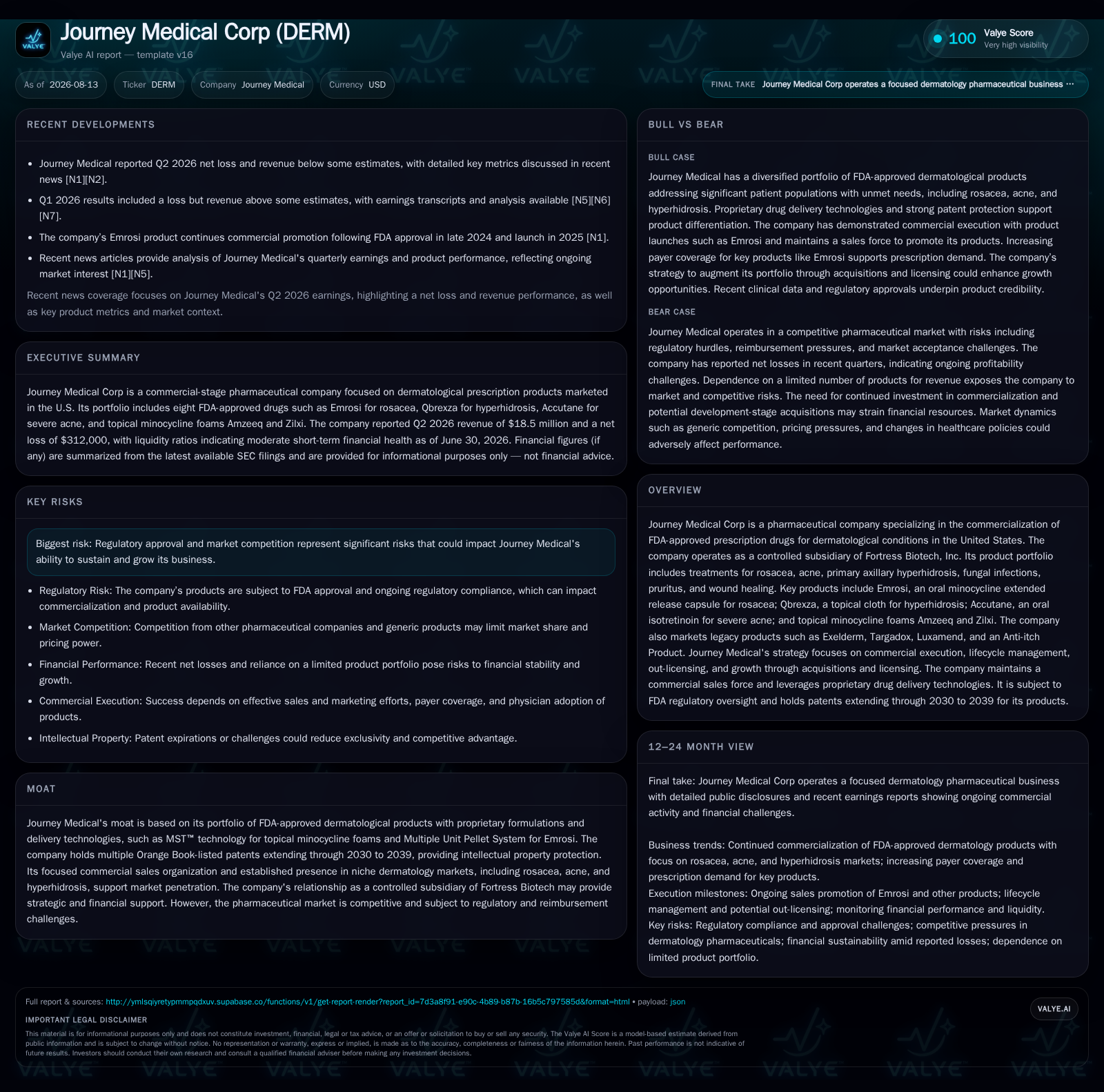
Journey Medical's 2026 second quarter filing reveals growing momentum in commercial sales execution across its FDA-approved dermatology product portfolio, particularly for flagship assets like Emrosi and Accutane. Licensing agreements continue to deliver milestone-driven payments and royalties, strengthening revenue stability while patent protections extend through 2039. The company navigates competitive pressures from generics with targeted lifecycle management and formulation innovation. Financially, manageable net debt and a solid current ratio support ongoing investment in growth initiatives.
Q2 Operating Developments: Licensing Milestones and Sales Execution Signal Momentum Shift
The company’s interest expense of approximately $0.8 million per quarter alongside amortization of debt discount levels reflects a stable cost structure related to the $25 million credit facility originally drawn in late 2023 and extended mid-2024 [S2]. This balance-sheet prudence supports sustained investment into commercial capabilities with manageable financial servicing burdens.
(Re)Defining Dermatology Market Niches: Journey Medical’s Commercial Model in Focus
Journey Medical operates as a specialist pharmaceutical commercializer focusing exclusively on FDA-approved prescription drugs for dermatological conditions within the United States [S1]. Their product suite addresses niche conditions including rosacea (Emrosi), severe acne (Accutane), hyperhidrosis (Qbrexza), among others. This targeted approach leverages regulatory barriers to entry since each product possesses distinct FDA approvals generally covering unique indications or formulations.
Importantly, Journey deploys an established dedicated U.S.-based sales force calibrated to reach dermatologists and specialists managing these chronic skin diseases—a tactic essential in specialty pharma where prescriber education, relationship-building, and reimbursement navigation are critical adoption factors [S1]. Proprietary formulation technologies such as MST™ used for topical minocycline foams enhance product differentiation versus generics or off-label substitutes by improving patient compliance and tolerability.
Proprietary Formulations and IP Protection Funnel Revenue Sustainability
Intellectual property protection anchors Journey Medical’s moat. The company holds multiple Orange Book-listed patents protecting flagship drugs like Emrosi through dates ranging from 2030 up to 2039 [S1]. Such extended exclusivity is crucial in sheltering revenues from generic substitution—a prevalent erosion risk once patents lapse in this industry.
These patents protect not only the active ingredient but also the innovative delivery systems distinguishing their products in terms of efficacy or administration convenience. Given the minocycline-based therapies’ crowded space with generic competitors outside proprietary formulations (e.g., oral antibiotics versus topical foams), this IP protection materially supports pricing power and margin sustainability [S1]
Competitive Environment: Navigating Generic Pressure and Peer Benchmarks
Journey Medical faces competitive headwinds typical of its peer group comprising specialty dermatology pharmaceutical companies like Cara Therapeutics or Dermira, both known for proprietary formulations targeting niche skin conditions via innovative delivery platforms. While such firms focus heavily on R&D pipeline strength to fuel growth, Journey emphasizes commercialization of licensed FDA-approved products combined with licensing arrangements to diversify revenue sources.
Additionally, larger dermatology divisions within conglomerates such as AbbVie or Johnson & Johnson offer scale advantages but tend to compete more broadly across multiple therapeutic areas. For Journey, competition primarily arises from generics applying downward pricing pressure once patents expire or from payer reimbursement challenges limiting formulary inclusion or patient access.
Growth Catalysts: New Indications, Acquisition Strategy, and Lifecycle Management
Future revenue expansion hinges on several strategic levers detailed in filings [S1][S2]: first, ongoing lifecycle management initiatives to extend indications or develop enhanced formulations—this repositions current products commercially beyond initial launch windows. Second, acquisitions or in-licensing deals remain a cornerstone growth tactic whereby Journey selectively adds complementary assets to flesh out its dermatology portfolio.
Partnership models involving milestone payments further incentivize bringing additional FDA approvals to fruition efficiently while defraying upfront R&D risks. Such a pipeline approach allows Journey to maintain nimble capital deployment aligned with clinical success signals without heavy internal research infrastructure—a common characteristic in mid-sized specialty pharmaceutical firms.
Risks That Could Temper Expansion: Regulatory Hurdles and Market Saturation
Despite execution strengths, substantial risks persist. Regulatory approval delays or failure to obtain expected clearances under pathways such as Section 505(b)(2) could materially increase time-to-market costs or cancel new product launches [S1]. The company also depends heavily on a relatively concentrated portfolio; any disruption caused by adverse safety findings or loss of exclusivity would disproportionately impact financial performance.
Market saturation is another factor as dermatology treatments often target chronic yet well-served indications where patient population growth is moderate. Pricing pressures from payers and generics tighten margins further; navigating this complex reimbursement environment requires careful stakeholder engagement.
Key Near-Term Milestones to Monitor on Sales Volume, Licensing Events, & Pipeline
Analysts should track prescription volume trajectories for cornerstone products like Emrosi and Accutane as direct indicators of market penetration efficacy [S2]. Progression towards contingent milestone achievements embedded in licensing contracts notably at $17 million total potential payments under the Accutane Agreement offers measurable financial inflection points.
Patent expiration calendars through the late 2030s provide a framework for assessing durability but necessitate proactive lifecycle tactics ahead of expiry dates to avoid steep revenue cliffs. Additionally, any announced new FDA submissions or label expansions will inform growth projections.
Financial Health Snapshot: Debt Refinancing Ability Amid Growth Investments
As of June 30, 2026, Journey holds $25 million drawn on its credit facility balanced against cash reserves of approximately $25.6 million generating a near-neutral net debt position around $0.6 million [F1][S2]. Current assets stand at $72.8 million versus current liabilities of $45.8 million resulting in a healthy current ratio of about 1.59 indicating ample short-term liquidity buffer [F1].
Cash interest expense remains steady near $0.8 million per quarter which aligns with the firm’s conservative debt profile facilitating growth investments without undue refinancing pressure [S2]. This financial posture equips Journey to fund ongoing commercial scaling activities including sales force expansion or lifecycle management R&D supporting sustained revenue expansion.
This analysis synthesizes Journey Medical Corporation’s Q2 2026 filing-driven data within broader pharmaceutical dermatology industry dynamics emphasizing commercialization execution supported by licensing revenues amid patent protections alongside manageable leverage metrics underpinning strategic flexibility.
Disclaimer: This report is for informational purposes only reflecting analysis based strictly on publicly available SEC filings dated through August 12, 2026, and industry contextual knowledge without investment research views or forward-looking projections beyond stated evidence.
Disclaimer: This is research-only, informational analysis and not investment advice. It may include AI-generated interpretation and general industry context. Always verify important details using primary sources.

Comments