
Regional Health Properties’ Shift to Integrated Operations Enhances Turnaround Potential Amid Challenging Liquidity
RHEP’s transition from landlord to vertically integrated healthcare owner-operator in the Southeast reshapes its value creation and operational risks.
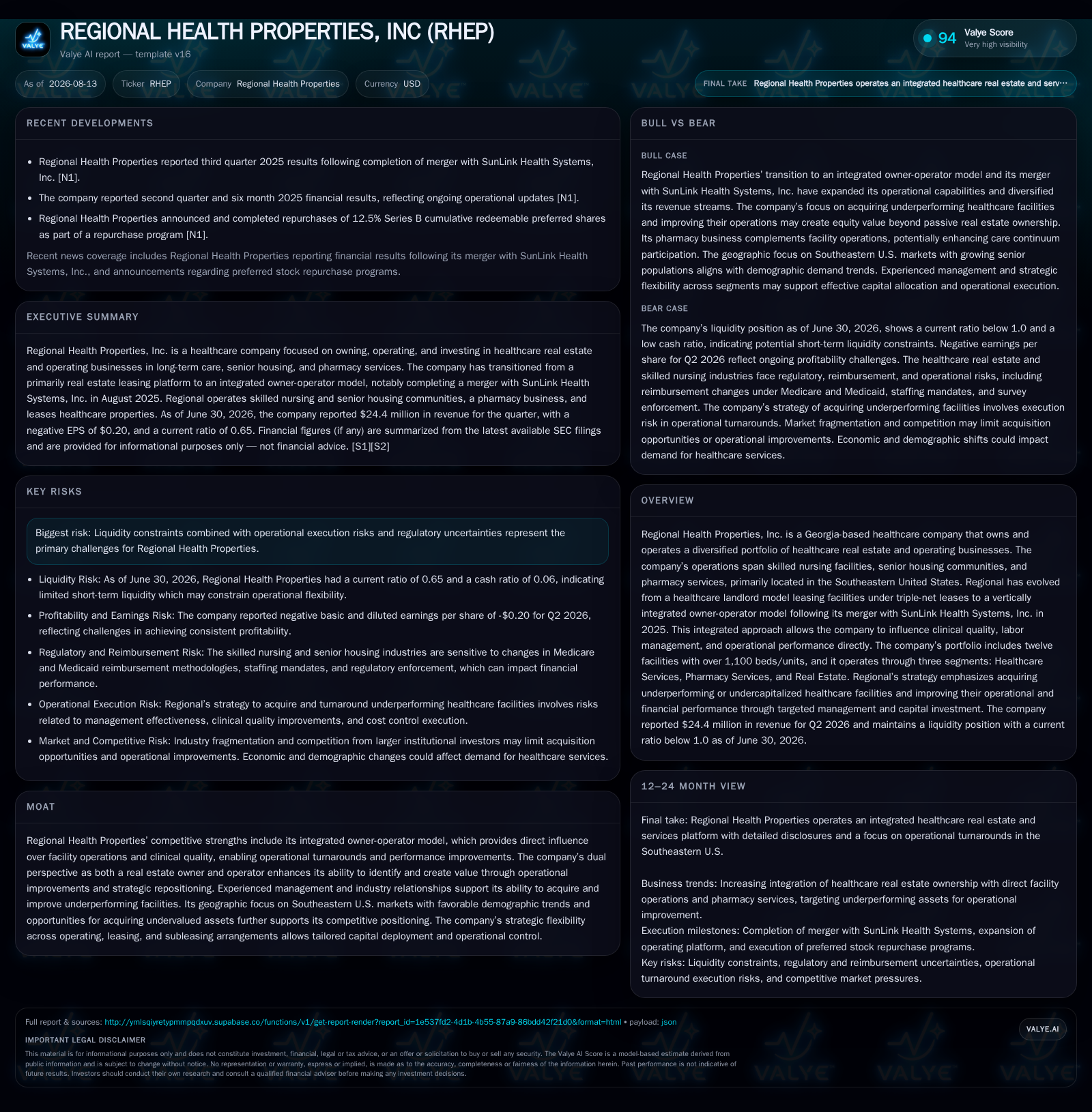
Regional Health Properties, Inc. has accelerated its strategic shift from a traditional healthcare real estate landlord model toward an integrated owner-operator platform following its merger with SunLink Health Systems in 2025. This evolution enhances its ability to drive operational improvements, clinical quality, and asset repositioning across a portfolio of skilled nursing facilities, senior housing communities, and pharmacy services primarily in the Southeastern U.S. However, the transition exposes Regional to more direct operating complexities, labor market pressures, reimbursement uncertainties, and liquidity constraints amid ongoing industry regulatory changes. The company’s smaller scale and focused geographic footprint position it to pursue underperforming assets with hands-on oversight, but financial flexibility and execution risk will be crucial watchpoints.
Recent Operating Update
In its latest quarterly filing dated August 12, 2026, Regional Health Properties underscores ongoing efforts to finalize integration of the SunLink acquisition completed in August 2025 [S2]. This transaction catalyzed a strategic transformation from mainly a landlord leasing healthcare real estate assets under triple-net leases toward an integrated owner-operator model managing both facility operations and complementary pharmacy services [S1][S17]. The Q2 filing reiterates exposure to challenges inherent in operating skilled nursing facilities (SNFs) directly: labor recruitment during chronic shortages, licensing compliance burdens, rehabilitation of underperforming assets requiring working capital infusion, and reimbursement volatility tied to government programs [S2].
This hybrid business approach increasingly blends real estate investment with active healthcare service delivery — allowing Regional to influence clinical outcomes and operational efficiency rather than relying solely on passive rent collection. Yet this also brings operational risks absent under prior lease arrangements such as managing labor costs that represent a significant share of facility expenses and navigating evolving regulatory oversight for both SNFs and pharmacy operations [S6][S19].
Business Model Analysis
Regional’s revenue derives from three interrelated segments: Healthcare Services (operation revenues from SNFs and senior housing), Pharmacy Services (including retail dispensing, institutional pharmacy contracts, durable medical equipment sales), and Real Estate (rental income primarily via triple-net leases or subleases) [S17][S18]. Historically focused on healthcare REIT-style leasing arrangements, the company now emphasizes acquiring distressed or operationally challenged healthcare facilities at valuations that anticipate operational turnarounds via improved census management, payor mix optimization favoring higher Medicare reimbursements over Medicaid or private pay decline, enhanced clinical quality metrics that support value-based purchasing incentives, and tighter labor deployment strategies [S24][S27].
The August 2026 disclosure confirms ownership/operation of twelve facilities encompassing over 1,100 beds/units largely spread across six Southeastern states marked by favorable demographic tailwinds such as growing elderly populations coupled with increasing prevalence of chronic conditions requiring long-term/post-acute care support [S1][S18]. This geographic concentration enables Regional to leverage local market knowledge for targeted acquisitions where larger institutional players compete less aggressively due to scale mismatch or preference for easier-to-operate assets. Meanwhile the pharmacy services arm complements onsite healthcare delivery by providing necessary pharmaceuticals plus ancillary medical devices facilitating integrated care continuum management – particularly critical in post-acute care environments reliant on medication adherence & therapy coordination [S1][S26].
Industry Structure & Competitive Position
Healthcare real estate remains capital intensive with modest margin profiles relative to other property classes due to regulatory complexity and labor intensity especially when operators directly manage SNFs or senior housing communities. Traditional publicly traded peers include large healthcare REITs like Welltower Inc. and Ventas Inc., which combine broad senior housing/post-acute real estate portfolios often leased out versus fully integrated models focusing more on operations. On the operating side are peers like Brookdale Senior Living or LHC Group that specialize in service delivery but typically lack significant real estate ownership exposure.
Regional’s hybrid platform positions it uniquely by combining asset ownership with direct facility operation including an ancillary pharmacy business—a sector where scale often matters due to supply chain leverage and managed care contracting complexity. Its competitiveness hinges on executing operational turnarounds sooner than typical leasing counterparts can influence tenant performance while maintaining regulatory compliance across multiple jurisdictions known for rigorous scrutiny of licensure standards for SNFs and pharmacies alike.
Notably, Regional’s smaller scale relative to large institutional investors exerts both benefits—agility in hands-on management—and constraints such as reduced negotiating leverage on financing terms or contract pricing versus national chains. This specialization in underperforming niche assets in Southeastern markets reflects deliberate targeting based on demographic growth but increases reliance on managerial skill for execution success.
Growth Drivers
Long-term secular drivers root in aging U.S. demographics creating sustained demand for skilled nursing post-acute care as hospital discharge protocols increasingly shift complex patients towards lower-cost settings historically served by SNFs inclusive of rehabilitative therapy & cognitive disorder management (Alzheimer’s/dementia) [S20]. Expansion of Medicare Advantage programs emphasizing value-based purchasing similarly incentivizes operators capable of quality improvements aligned with reimbursement reforms.
Regional’s growth levers focus heavily on acquisition-led portfolio expansion targeting undervalued/special-situation assets ripe for operational enhancements through strategic capital deployment aimed at increasing occupancy rates combined with elevating payor mix quality towards higher reimbursements under Medicare rather than Medicaid or private pay degradation scenarios [S24][S27]. The integration of pharmacy services supports care coordination capabilities enhancing patient outcomes while contributing incremental revenue streams particularly through institutional long-term care channels where pharmaceutical distribution remains essential.
Additionally strategic flexibility enabled by owning some properties outright while leasing others offers tailored capital allocation approaches optimizing returns depending on asset-level performance forecasts.
Risks and Constraints
Key risks spotlighted include:
- Liquidity Pressure: With reported current ratio below 1 (0.65) reflecting current liabilities (
$27.1M) exceeding current assets ($17.7M) alongside significant net debt (~$41.7M after cash) as of June 30, 2026,[F1] financial flexibility is constrained posing refinancing risks during adverse market conditions or slower-than-expected turnaround results. - Operational Execution: Transitioning from landlord role requires sustained success recruiting clinical/labor staff amidst sector-wide shortages driving wage inflation; failures risk increased operating losses.
- Regulatory Compliance: Ongoing exposure due to multifaceted healthcare laws governing licensure standards for facilities plus controlled substance dispensing regulations creates liabilities if breached risking penalties or program exclusions.[S6][S19]
- Reimbursement Uncertainty: Frequent changes in Medicare/Medicaid payment frameworks including utilization review intensification threaten stable cash flows particularly if value-based adjustments inadequately compensate added care complexities.[S6]
- Competition: Although smaller scale aids nimble management focus regionally, increased competition from well-capitalized REITs or private equity investors bidding selectively for turnaround assets could compress acquisition opportunities.
What To Watch Next
Key forthcoming indicators include:
- Realization pace of SunLink integration benefits measured via improved occupancy rates, enhanced payor mix favoring higher-margin Medicare Advantage patients versus Medicaid/private pay downgraded residents.
- Operational margins reflecting labor cost containment efforts amidst persistent staffing challenges.
- Regulatory developments regarding reimbursement policy changes or enforcement actions impacting both facility operations and pharmacy services.
- Changes in liquidity profile via quarterly balance sheet updates revealing progress on debt refinancings or capital raises easing short-term obligations.
- Acquisition pipeline activity illustrating ability to pursue accretive deals consistent with turnaround strategy within Southeastern U.S. demographic hotspots.
Financial Profile Discussion
As of the end of Q2 2026 (June 30), Regional holds approximately $1.7 million in cash against total debt near $43.4 million resulting in net debt around $41.7 million; meanwhile current liabilities exceed current assets resulting in a current ratio of roughly 0.65 indicating tight near-term liquidity [F1]. This strain underscores dependence on operational cash flow generation consistent with turnaround progress plus potential external financing access necessary to fund working capital needs across directly operated facilities engaged in performance improvement cycles.
Reported top-line revenue stood around $53.2 million at calendar year-end December 2025 while operating income was modest at roughly $1.66 million illustrating narrow profitability margins characteristic of transitional operators balancing fixed overhead against variable costs arising from scaled-up direct operations pre-turnaround maturity [F1]
Managing capital structure prudently will remain critical given the dual pressure from elevated leverage levels relative to cash holdings coupled with the inherently cyclical nature of healthcare reimbursement policies influenced by federal/state budgetary considerations plus economic factors affecting private pay resident affordability especially within independent living segments exposed to consumer confidence shifts.
This analysis examines Regional Health Properties' evolving business model within the converging sectors of healthcare real estate investment and service operations emphasizing critical industry trends such as demographic-driven long-term care demand growth balanced against considerable execution risks stemming from vertical integration complexity amid regulatory sensitivities and liquidity constraints noted through recent financial disclosures. Investors tracking RHEP should monitor operational KPIs including occupancy trends, reimbursement shifts impacting payor mix economics, margin progression reflecting labor cost management efficacy, and balance sheet metrics signalling sustainable solvency as indicators of successful strategic transition execution.
Disclaimer: This is research-only, informational analysis and not investment advice. It may include AI-generated interpretation and general industry context. Always verify important details using primary sources.

Comments