
Red Robin's Q2 Slip Highlights Debt and Traffic Challenges
Red Robin's Q2 2026 results reveal operational headwinds with declining guest traffic and margin pressures, intensifying refinancing concerns that weigh on its First Choice strategic progress.
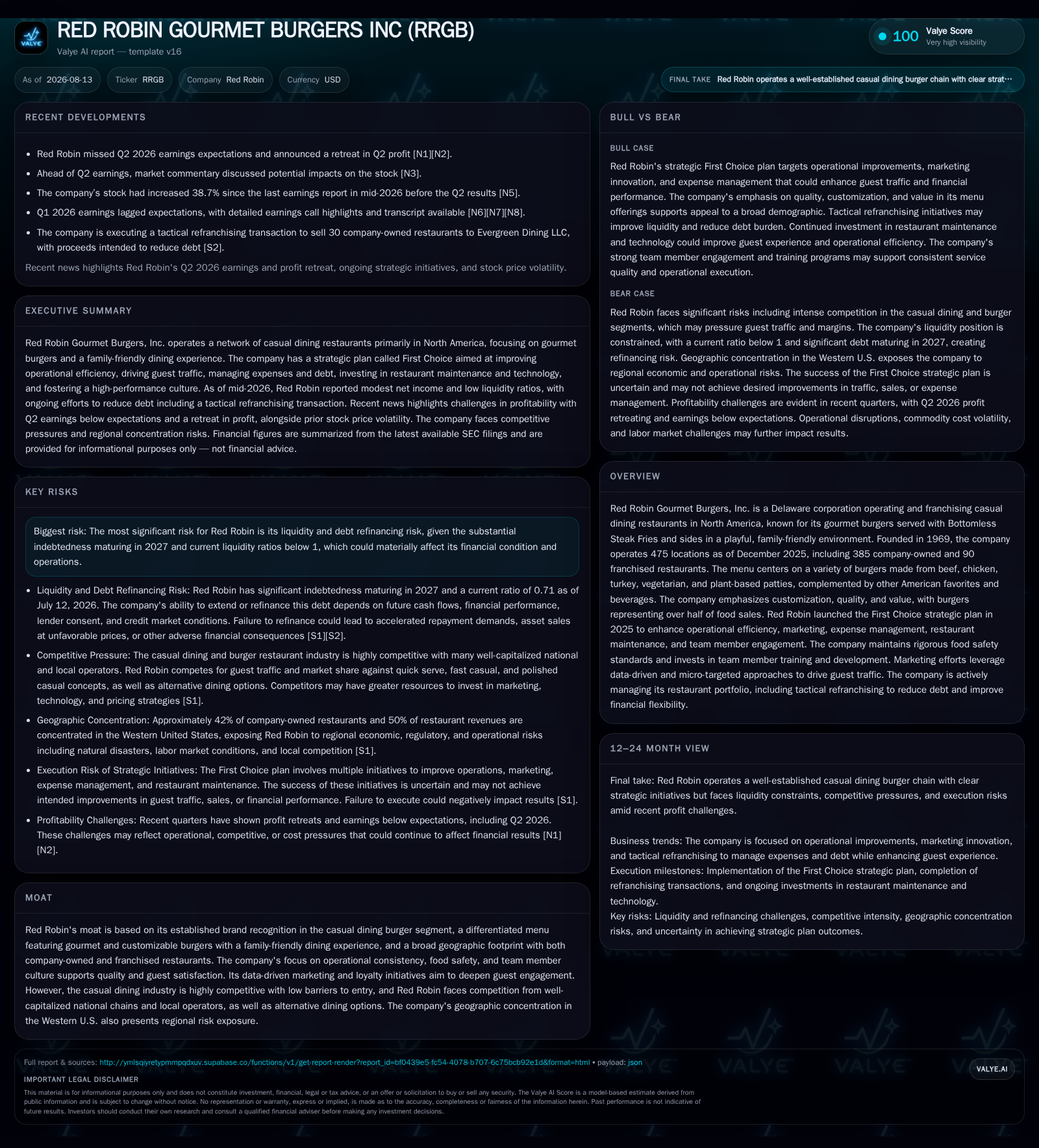
Red Robin Gourmet Burgers reported a disappointing Q2 2026 quarter marked by a decline in same-store sales and guest traffic, which undercut restaurant-level margins despite price and marketing efforts. The company’s emphasis on the First Choice strategic plan—targeting operational efficiency, traffic growth, debt reduction, and restaurant refurbishment—is being tested as costs inflate and refinancing challenges loom. With about 81% of its 475 restaurants company-owned, cash flow remains burdened by capital-intensive operations and a heavy debt load nearing maturity in 2027. Sustained improvements in traffic trends, margin recovery, and successful debt refinancing are critical milestones to monitor.
Q2 Operating Setback Undermines Traction of Strategic Initiatives
In its latest quarterly filing dated August 12, 2026, Red Robin Gourmet Burgers disclosed a setback in operational performance with declining same-store sales underscored by weaker guest traffic, directly pressuring restaurant-level margins [S2][N1]. This deceleration disrupts momentum on the company's First Choice strategic plan launched mid-2025 aimed at securing long-term value through operational efficiencies, traffic generation, cost containment, refranchising select company-owned units, and refurbishing aging restaurant assets [S1]. Notably, inflationary cost pressures outpaced pricing adjustments during Q2 leading to compressed profitability despite the company's marketing investments designed to stimulate visits [N4][S2]. The miss relative to analyst expectations highlights near-term execution challenges localizing around consumer demand hesitancy and rising operating expense headwinds.
Menu Leadership and Customer Experience with Rising Cost Pressures
Red Robin’s core product differentiation centers on its broad array of high-quality gourmet burgers made from beef, chicken, turkey, vegetarian, and plant-based patties paired distinctively with Bottomless Steak Fries—a signature menu element driving over half of food sales [S1]. This customization-centric approach supports pricing power but simultaneously exposes the company to commodity cost inflation that has been intensifying food cost pressures throughout the casual dining sector [S2]. To maintain competitive positioning amidst a family-friendly casual atmosphere, Red Robin invests strategically in addressing deferred maintenance across its physical estate under the 'Fix Restaurants' pillar of First Choice—essential for sustaining guest experience but capital intensive [S1]. As such, these ongoing maintenance investments add to the cost base at a time when revenue leverage is challenged by flat or declining traffic volumes.
Franchise Mix Dynamics Shape Margin Levers amid Expense Controls
A critical driver for Red Robin’s operating leverage is its composition of company-owned versus franchised restaurants. As of year-end 2025, approximately 81% (385) of its total locations (475) are company-owned compared to 90 franchised units concentrated primarily across select states plus one Canadian province [S1]. Company ownership provides direct control over operations but entails higher fixed costs including labor and maintenance expenditures. Conversely, franchised units generate royalty income with much lower operating expense risk but contribute less to system-wide sales volumes. The firm is actively pursuing tactical refranchising transactions—a recent example being two asset purchase agreements announced mid-2026 expected to close near August-October timeframe—which will convert certain company-owned stores into franchised ones improving near-term liquidity while potentially sacrificing some sales concentration effects [S29]. This strategy reflects a tradeoff between margin compression at owned units due to inflationary pressures versus benefits from refranchising's capital-light model reducing debt service burdens.
Casual Dining Competitive Pressures Tighten Marketing Playbook
Operating within the saturated casual dining landscape featuring peers like Applebee's and Chili's as well as fast casual competitors such as Shake Shack or Panera Bread places constant pressure on menu innovation, pricing discipline, and marketing effectiveness. Red Robin leverages data-driven marketing strategies emphasizing loyalty program engagement coupled with expanding digital ordering capabilities to attract new visits and reinforce repeat patronage—a key growth lever supporting same-store sales performance amid fragmented consumer preferences [S1]. However, sustaining differentiated guest experiences requires continuous investment in marketing channels that compete against aggressive promotions by established peers alongside evolving consumer tastes favoring convenience offerings.
Growth Opportunities: Expansion, Digital Channels, and Refranchising
Despite near-term softness, Red Robin retains several strategic growth levers: incremental unit expansion balanced between opening new restaurants primarily through franchise partners while managing owned store portfolio size; amplifying delivery/digital order penetration responding to shifting consumer habits; refining loyalty programs for improved guest lifetime value; and executing targeted refranchising transactions to deleverage balance sheet constraints [S1]. These initiatives align structurally with broader industry trends favoring multi-channel distribution models coupled with capital-efficient footprint management. A successful navigation across these vectors could enhance free cash flow generation underpinning reinvestment capacity.
Liquidity Challenges Cast Shadow Over Capital Strategy Execution
Financially, Red Robin operates under considerable strain with the latest quarter showing a current ratio hover near 0.71 indicated by $129 million in current assets versus approximately $181 million in current liabilities at July-end 2026—a signal of liquidity tightness common among capital-intensive casual dining chains with heavy fixed costs like leases and labor [F1][S2]. Net debt approximates $180 million after subtracting $22.8 million cash balances from reported total debt figures largely unchanged since 2018 per available data metrics [F1]. Liquidity limitation constrains investing capacity especially against deferred maintenance backlogs essential for guest satisfaction.
Risks: Debt Refinancing Crunch, Traffic Volatility, Industry Competition
Key risks crystallize around execution gaps stemming from fluctuating consumer demand impacting traffic resilience alongside pricing power erosion amid intense competition not only from other casual dining operators but increasingly substitutable fast casual or delivery-centric alternatives. Most critically, refinancing risk linked to maturing term loans threatens operational continuity if funding sources prove unavailable or prohibitively expensive thereby forcing potential asset disposals or curtailment of strategic initiatives like marketing spend or refurbishments which are crucial for sustaining competitive positioning [S27][S13][S8]. Regional concentration—with about half of company-owned revenues derived from Western US states—amplifies exposure to localized economic downturns or regulatory changes affecting labor costs or energy prices exacerbating operating margins vulnerability.
Key Upcoming Milestones: Traffic Recovery, Refinancing Progress, Margin Stability
The upcoming fiscal quarters serve as pivotal inflection points where Red Robin must demonstrate stabilization or improvement in same-store sales trends driven by enhanced guest traffic combined with controlled labor and commodity costs translating into higher restaurant-level margins [S3][S2]. Concurrently progress on closing tactical refranchises like those announced mid-year will indicate tangible steps toward deleveraging balance sheet pressures thereby easing refinancing uncertainties. Operational signs such as improved throughput metrics or early signals from digital order volume growth will further validate recovery paths reinforcing investor confidence alongside management’s ability to execute the long-term First Choice vision effectively
Financial Profile Discussion
As of July 12, 2026 quarter-end financial position analysis reveals $22.8 million in cash against total reported current liabilities exceeding $181 million yielding a constrained current ratio around 0.71 that flags liquidity stress typical in capital-intensive chain restaurant models facing cost inflation headwinds [F1][S2]. Total outstanding debt hovers near $203 million based on best-effort available data though filings do not provide comprehensive latest gross debt detail beyond calendar year end reference points earlier than current quarter; net debt estimated at approximately $180 million factoring cash reserves positions the company with significant leverage complicating refinancing attempts [F1]. Monitoring future quarterly free cash flow performance alongside covenant compliance will be essential signal points assessing financial health trajectory.
This analysis is based solely on publicly filed documents from Red Robin Gourmet Burgers Inc., related SEC filings dated through August 12, 2026, and relevant industry knowledge sources without investment research views.
Disclaimer: This is research-only, informational analysis and not investment advice. It may include AI-generated interpretation and general industry context. Always verify important details using primary sources.

Comments