
National Bankshares Strengthens Liquidity and Net Interest Margin with Strategic Portfolio Moves
NKSH's recent portfolio restructuring and steady loan growth support improved profitability within its Virginia community banking franchise.
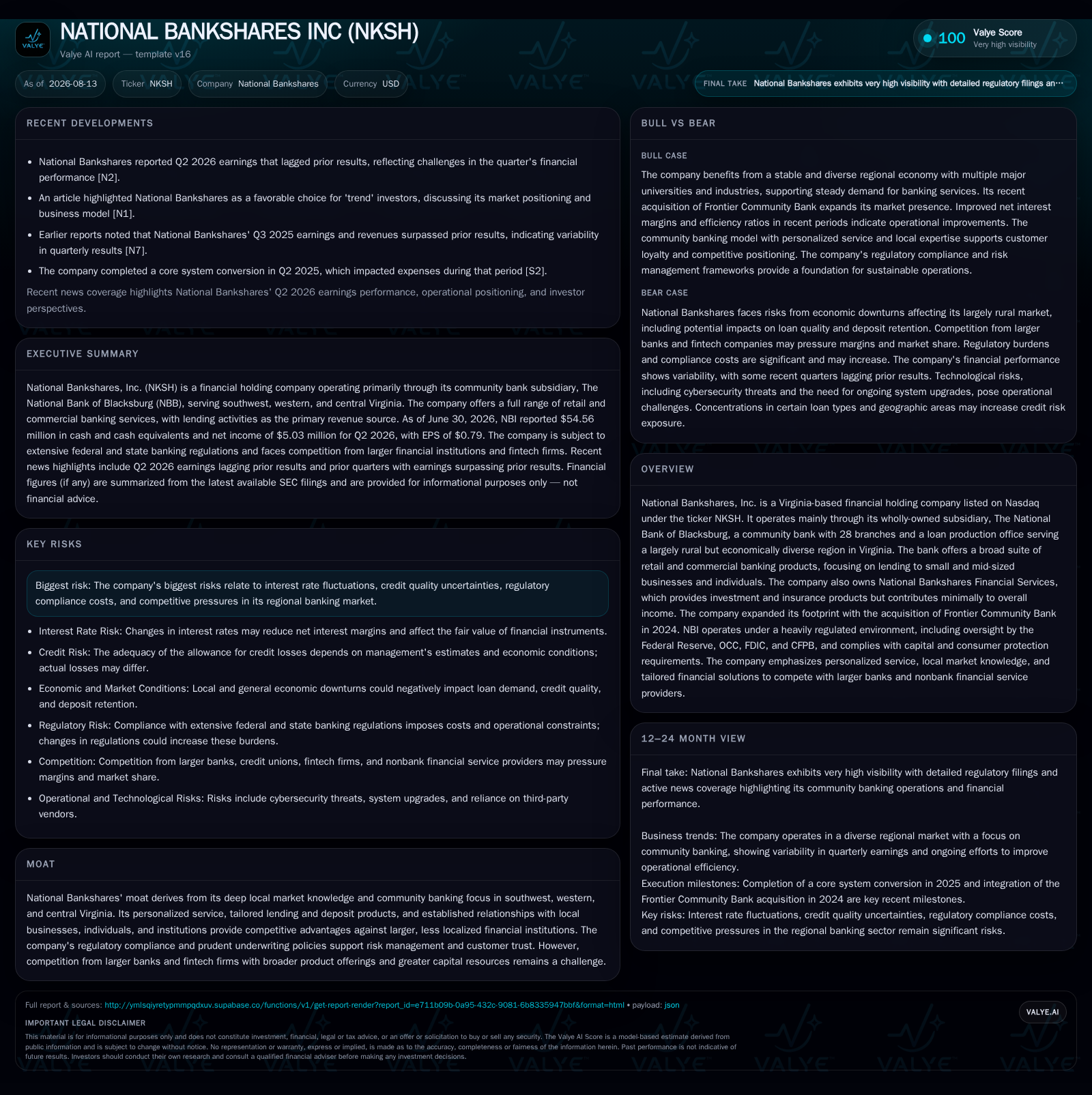
National Bankshares, Inc. reported second-quarter 2026 results highlighting improved net interest margins driven by higher loan yields and lower deposit costs, benefiting from a portfolio restructuring. The company sustains solid liquidity with significant FHLB and Federal Reserve borrowing capacity and maintains conservative credit loss allowances amid stable local economic conditions. Its community-focused banking model, serving rural Virginia with tailored lending to small and mid-sized businesses, benefits from regulatory capital strength and deposit diversification. Competitive pressures from larger banks and fintech players remain challenges to watch.
Recent Operating Update
In parallel, the company restructured a sizeable portion of its securities portfolio during Q2 by selling lower-yielding available-for-sale securities (weighted average yield of 1.80%) totaling approximately $131.87 million and reinvesting about $127.33 million into higher yield securities averaging over 5%, incurring a pre-tax loss of $6.55 million recognized in the quarter but anticipated to be recouped over roughly two years [S3]. This move signals a strategic recalibration to enhance overall asset yield without altering core lending practices.
Business Model Specifics
National Bankshares operates primarily through The National Bank of Blacksburg (NBB), a community bank with a footprint encompassing southwest, western, and central Virginia via 28 branches plus a loan production office in Charlottesville [S1]. The bank’s core revenue stream arises from lending activities targeting small and mid-sized businesses alongside individual retail customers—a typical focus for community banks competing in defined geographic regions.
Loan products include commercial lines of credit, commercial real estate loans, residential mortgages, home equity products, construction loans, and consumer lending varieties all secured predominantly by locally situated real estate collateral—83.7% of loans are mortgage secured as of end-2025—which ties credit risk directly to regional economic conditions [S1,S20]. Conservative underwriting standards adapted to each loan category’s inherent risk profile underpin the bank’s strategy to manage exposure.
The deposit side features a broad suite of interest-bearing and non-interest bearing accounts distributed among individual consumers, businesses, municipalities (comprising around 22% of deposits), with no brokered deposits utilized—a factor that supports stable liquidity without questionable wholesale funding dependencies [S24,S16]. This diversified base lends itself well to the community bank’s local relationship-driven approach but also exposes it to regional economic cycles.
Noninterest income derives minimally from subsidiary National Bankshares Financial Services, which provides investment and insurance products complementary to the bank's traditional offerings rather than driving material revenue leverage [S1]
Industry Structure and Competitive Position
Operating as a community-focused regional bank within Virginia positions National Bankshares in competition with both relatively larger regional players—such as Regions Financial (RF) or First Horizon (FHN)—and growing fintech entrants offering digital-first lending solutions. While larger institutions benefit from scale economies and product breadth extending beyond traditional banking services (e.g., wealth management platforms), NKSH's moat rests in entrenched local market knowledge, personalized customer service, and tailored lending relationships anchored in trust.
However, this moat comes with risks: localized economic downturns weigh more heavily on asset quality; technological investment demands can stretch limited resources; regulatory compliance costs impact margin efficiency; competition for deposits intensifies especially as fintechs attract younger demographics.
Growth Drivers
Growth initiatives center on organic expansion—growing loan portfolios by extending credit prudently to local businesses supported by steady deposit inflows—as well as inorganic strategies such as the acquisition of Frontier Community Bank in 2024 which broadened branch presence within Virginia markets [S1]. Loan growth through June 30, 2026 reached about 1.54% year-over-year reflecting ongoing demand from the target customer base coupled with competitive pricing influenced by current rates [S2].
Technological upgrades completed in recent years—including the core system conversion in 2025—and rollout of treasury management solutions support enhanced commercial deposit services facilitating customer retention while potentially attracting new relationships within municipalities and enterprises [S24]
Interest rate environments remain pivotal; Fed rate cuts enhanced margin in recent quarters but sustained or rising rates could further drive asset yield improvements if loan repricing outpaces deposit cost increases—a key performance indicator for NKSH given its asset-liability mismatch dynamics common in regional banking.
Cross-selling investment and insurance products via NBFS provides diversification opportunities though presently represents a small portion of total income.
Risks and Watchpoints
Key risks include:
- Interest rate volatility: Adverse shifts where deposit costs rise faster than loan yields could compress net interest margin materially given NKSH’s balance sheet composition [S18];
- Credit quality risks: Concentration on small to mid-sized businesses introduces vulnerability to cyclical downturns not smoothed out by diversification typical at larger banks. The allowance for credit losses on loans and unfunded commitments remains modest but will require vigilant monitoring amid any local economic softness or borrower stress signs [S2];
- Regulatory compliance burden: As an entity overseen by multiple federal agencies (Federal Reserve, OCC, FDIC), changes in capital rules or supervisory expectations can increase operational cost or constrict capital flexibility;
- Competitive dynamics: Larger banks’ expanded service capabilities plus fintech innovation challenge NKSH’s share gains particularly among tech-savvy demographics or requirement for digital banking enhancements;
- Liquidity risks: While robust liquidity buffers exist—including over $300 million FHLB borrowing capacity plus $127 million Federal Reserve discount window availability—the company must manage deposit retention effectively amid macroeconomic stress or reputational events that could trigger withdrawals [S7,S8].
What to Watch Next
Important near-term markers include continued evolution of net interest margins as loan repricing progresses into current rate regimes; trend analysis on allowance for credit losses aligned with local economic signals; deposit growth versus attrition—especially uninsured vs municipal components—and actual utilization of off-balance sheet loan commitments which could stress liquidity unexpectedly.
Execution on technology product rollouts such as treasury management suite enhancements will also be critical for competitive positioning within commercial client segments [S24].
Provisioning for credit losses remains stable with an allowance for credit losses on unfunded commitments near historical lows at around 0.16% against committed amounts indicating confidence in portfolio quality though continuous review is emphasized especially given exposure concentration in real estate collateral within local markets susceptible to price fluctuations due to macro factors including climate risk considerations raised recently by management disclosures [S2,S25].
In sum, National Bankshares sustains a financial profile typical of well-managed community banks balancing steady growth aspirations with cautious risk management undergirded by strong capitalization pillars suitable for regulatory expectations.
This analysis reflects information available as of August 13, 2026, sourced primarily from National Bankshares’ SEC filings including their latest quarterly report on Form 10-Q dated August 12, annual Form 10-K dated March 27, 2026, recent Form 8-K disclosures regarding strategic portfolio actions completed in July, and validated numerical financial snapshots. All interpretations herein focus exclusively on documented evidence without speculative forward-looking assertions or investment research views.
Disclaimer: This is research-only, informational analysis and not investment advice. It may include AI-generated interpretation and general industry context. Always verify important details using primary sources.

Comments