
Blueport Acquisition Advances SPAC Merger Process with $57.5M Trust and Experienced Sponsor
Blueport Acquisition, a Cayman Islands-based blank check company, progresses toward completing its business combination after raising $57.5 million via IPO and securing sponsor backing.
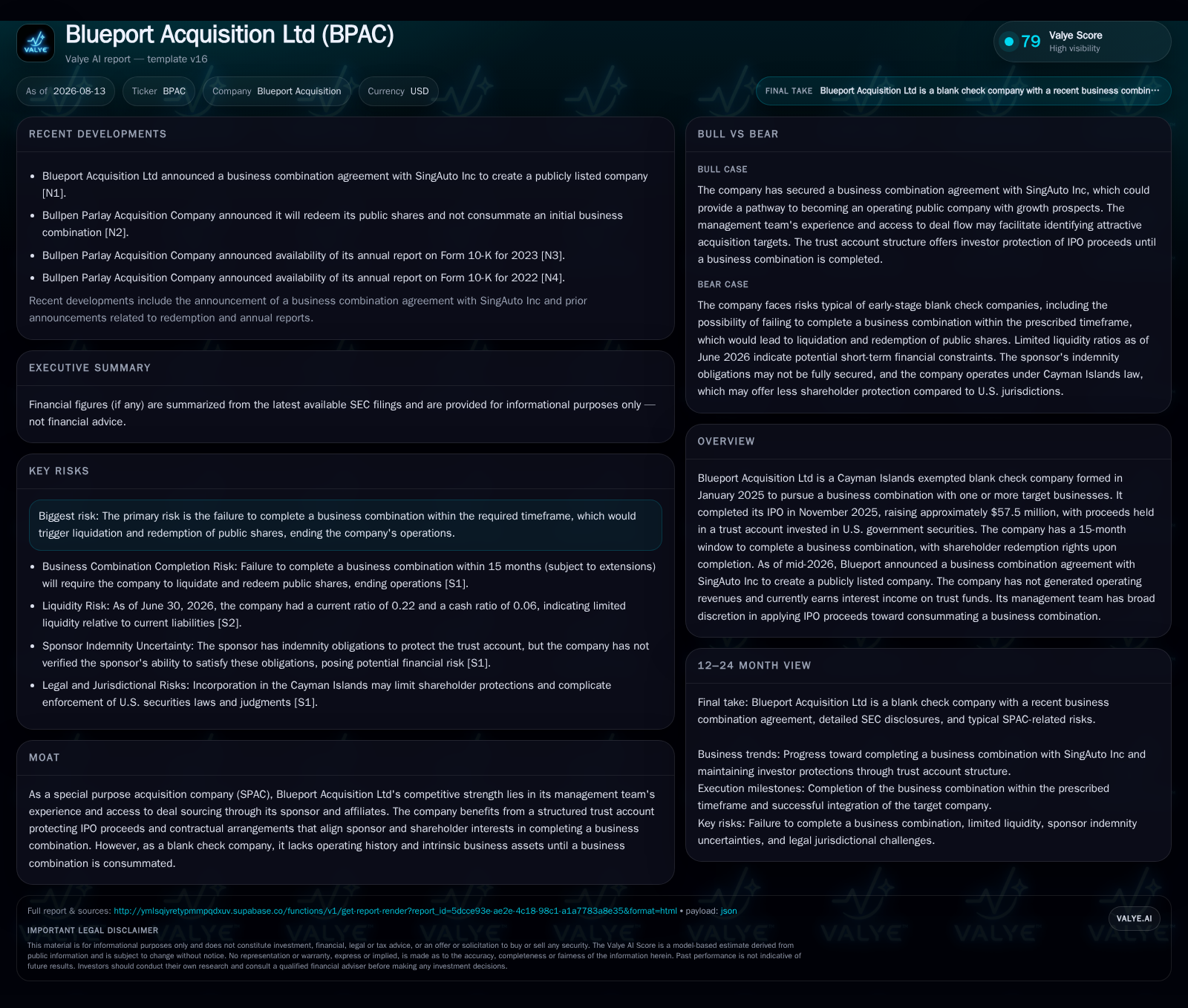
Blueport Acquisition Ltd completed its IPO in November 2025, raising approximately $57.5 million with proceeds held in a trust account to safeguard investor capital until deployment in a business combination. The company operates as a blank check entity with no operating revenues, relying on management’s ability to identify and close a qualifying merger within a 15-month deadline or face liquidation and shareholder redemptions. Blueport has disclosed an agreement to merge with SingAuto Inc, positioning it for transition into a public operating company. Its financial profile reflects trust-account cash preservation, modest administrative expenses, and significant current liabilities consistent with SPAC structures, underscoring the critical importance of deal execution and shareholder approval for value realization.
Recent Operating Update
Blueport Acquisition Ltd successfully completed its initial public offering (IPO) on November 13, 2025, issuing 5.75 million units at $10 per unit, including an additional 750,000 units from the underwriters’ full over-allotment option exercise. This raised gross proceeds of about $57.5 million [S1]. Concurrently, the sponsor subscribed for an additional 197,250 units in a private placement at the same price point, contributing roughly $2 million more to the capital base [S1]. The bulk of these funds are secured in a trust account invested conservatively in U.S. government securities to safeguard principal and ensure investor protection until deployment toward a qualifying business combination.
The company’s current ratio is notably low at 0.22 due to significant current liabilities of about $485.4 million against current assets near $106.5 million [F1]. This balance sheet composition reflects typical SPAC accounting where large liabilities often represent shares subject to redemption as well as deferred underwriting fees or other transaction-related obligations.
Operationally, Blueport generates no revenues from commercial activities; instead, it earns interest income on trust account funds—approximately $284,000 for the fiscal year ended December 31, 2025—while incurring modest general and administrative expenses just over $300,000 annually [S11], [F1]. These figures highlight that pre-merger operations are limited primarily to administrative functions necessary for governance and transaction preparation.
Significantly, Blueport has announced an agreement to merge with SingAuto Inc., marking a key step toward transforming from a blank check company into an operating public entity via a de-SPAC transaction. This planned merger underscores the critical path ahead involving shareholder approvals and regulatory compliance.
Business Model Analysis
As a Cayman Islands-incorporated blank check company formed explicitly for effecting mergers or acquisitions leading private companies public without traditional IPO processes, Blueport’s business model centers on capital preservation within its trust account until a suitable target is identified and acquired [S1]. Units issued during the IPO comprise ordinary shares coupled with fractional warrants (rights), which serve both as investor incentives pre-merger and potential dilution mechanisms post-transaction.
Prior to completing its initial business combination, Blueport generates minimal operating income beyond interest accrued on trust funds; it does not have recurring revenues or operational cash flows independent of transaction activities [S11]. The sponsor’s economic incentive derives largely from promote rights—equity stakes granted at preferential terms upon successful de-SPAC completion—aligning management interests with shareholder value creation.
The company maintains flexibility in structuring transactions using combinations of cash held in trust accounts, new equity issuances such as PIPE financings, debt instruments or share issuances to target owners tailored to optimize deal terms for all parties involved [S4]. However, this latitude is constrained by regulatory timelines mandating completion within approximately 15 months post-IPO to avoid liquidation scenarios.
Industry Structure and Competitive Position
The SPAC sector offers an alternative pathway for private companies seeking liquidity through public markets while circumventing traditional IPO complexities like lengthy regulatory reviews and underwriting processes. Blueport competes among numerous SPAC sponsors ranging from repeat players with established track records to newer entrants relying heavily on management expertise for deal sourcing credibility.
Led by chairman William Rosenstadt—a seasoned corporate attorney with decades-long experience—the management team possesses legal acumen and transactional expertise that bolster capacity for identifying attractive targets and structuring deals favorably [S9]. This expertise potentially differentiates Blueport within an increasingly scrutinized SPAC environment characterized by evolving SEC disclosure requirements aimed at enhancing transparency.
Growth Drivers
The foremost growth catalyst is Blueport’s announced merger agreement with SingAuto Inc., which would convert it into an operational public company capable of generating sustainable revenues tied directly to SingAuto’s business fundamentals. Successful closure unlocks enhanced capital access for SingAuto’s expansion while creating upside potential for sponsors through equity appreciation.
Broader industry tailwinds supporting this growth trajectory include persistent demand among private companies for alternative listing routes avoiding protracted IPO cycles amid market uncertainty; increasing institutional appetite for PIPE investments supplementing SPAC deals; regulatory developments fostering clearer frameworks; and innovations in sponsor incentives mitigating dilution risks.
Historical precedents underscore this outcome as value-destructive for investors.
Market volatility may impede deal consummation by constraining PIPE financing availability or elevating costs associated with transaction structuring. Shareholder redemption rights introduce further uncertainty by potentially reducing available deal capital if redemption rates spike upon announcement.
Dilution risk arises from warrant exercises post-merger alongside sponsor promote allocations requiring scrutiny during proxy solicitations given their impact on shareholder equity value.
Potential conflicts exist between sponsors’ interests—who benefit irrespective of transaction success—and public shareholders necessitating governance vigilance to ensure fairness standards are maintained.
Lastly, absent intrinsic operating assets pre-deal places disproportionate reliance on management team deal sourcing proficiency and execution capabilities rather than product-market fit factors typical in traditional companies.
What To Watch Next
Upcoming milestones include proxy filings detailing the proposed SingAuto merger providing comprehensive disclosures required by SEC regulations facilitating informed shareholder voting decisions [S10].
Monitoring shareholder redemption rates approaching vote deadlines will offer insights into investor confidence levels impacting final transaction economics.
Any requested extensions or amendments addressing regulatory feedback or market conditions will be critical given tight statutory deadlines governing SPAC lifecycles.
Progress updates on PIPE commitments alongside definitive closing timelines will further clarify prospects for successful de-SPAC completion.
Post-merger integration plans communicated by combined management will be essential indicators of strategic coherence underpinning sustainable value creation beyond listing events.
Financial Profile Discussion
The company’s balance sheet as of June 30, 2026, shows current assets of approximately $106.5 million and current liabilities of about $485.4 million, resulting in a current ratio near 0.22x [F1]. This reflects the structural nature of liabilities related largely to anticipated redemption obligations rather than operational liabilities given absence of commercial activities pre-merger [F1].
Operating income remains negative driven primarily by nominal administrative costs (-$304 thousand annualized), while net income losses remain minimal (-$19 thousand), consistent with early-stage blank check company profiles lacking recurring revenue streams [F1]
Overall liquidity appears aligned structurally with anticipated near-term merger-related disbursements though ongoing monitoring is warranted due to concentrated obligations reflected on balance sheet ahead of closing events [F1]
Disclaimer
This analysis is based exclusively on publicly disclosed information including SEC filings through August 12, 2026. It does not constitute investment advice or research views concerning Blueport Acquisition Ltd or its securities.
Disclaimer: This is research-only, informational analysis and not investment advice. It may include AI-generated interpretation and general industry context. Always verify important details using primary sources.

Comments