
ASPAC III Acquisition Corp. Advances SPAC Merger with Bioserica Amid Deadline Extension
ASPAC III Acquisition Corp. extends its business combination deadline to complete a merger with Bioserica International Limited, a bio-based antimicrobial materials company.
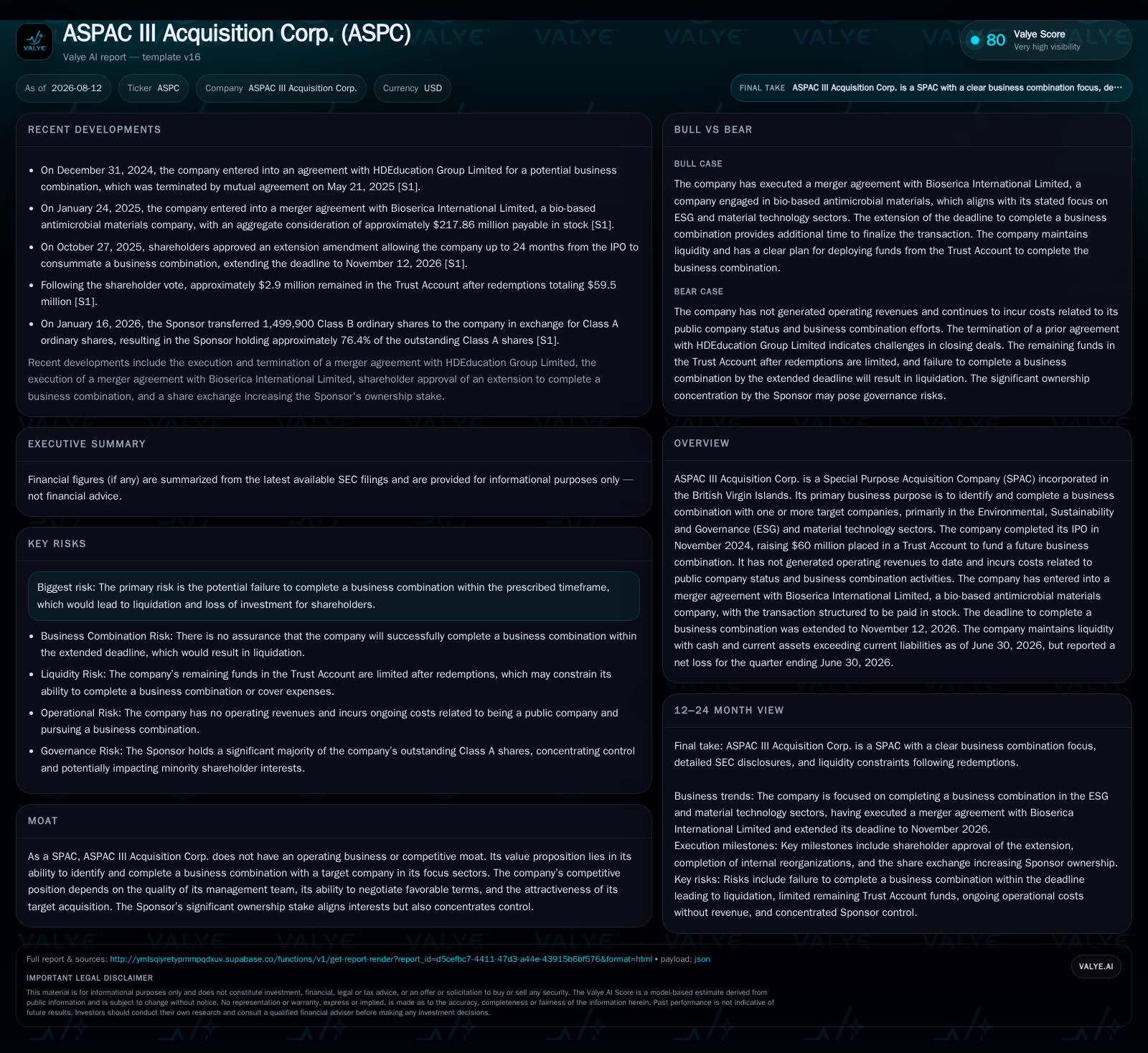
ASPAC III Acquisition Corp., a British Virgin Islands-based blank-check company, remains on track to complete its de-SPAC transaction with Bioserica International Limited. Having raised $60 million in its November 2024 IPO, ASPAC III recently extended the deadline for its business combination to November 12, 2026, allowing more runway to finalize the deal. The transaction is structured as an all-stock merger valued at approximately $218 million and targets the Environmental, Sustainability and Governance (ESG) and material technology sectors. The key risk remains the timely consummation of the merger to avoid liquidation and loss of shareholder value.
Recent Operating Update
ASPAC III Acquisition Corp. filed its latest Form 10-Q for the quarter ended June 30, 2026, reaffirming its status as a Special Purpose Acquisition Company (SPAC) with no operating revenues to date but ongoing expenses associated with maintaining public company compliance and pursuing an initial business combination [S2]. The key development is that ASPAC III extended the deadline for completing its de-SPAC transaction with Bioserica International Limited until November 12, 2026, ensuring more runway to consummate the merger after entering into definitive agreements in mid-2025 [S1][S26].
The proposed transaction remains structured as an all-stock share exchange valued near $217.9 million. Under the May 2025 merger agreement, ASPAC III will merge into its wholly owned subsidiary PubCo, which in turn will acquire Bioserica through a subsidiary merger. The consideration consists entirely of newly issued shares priced at $10 each — including Class A and Class B ordinary shares — implying no immediate cash payment besides funds already held in trust from the IPO proceeds [S1][S26]. This structure preserves liquidity while transferring equity ownership of the combined entity.
Business Model
As a SPAC incorporated in the British Virgin Islands, ASPAC III fundamentally operates as a capital vehicle rather than an operating enterprise. Its business purpose is solely to raise funds via an initial public offering (IPO), currently amounting to $60 million held in a trust account, and seek one or more private companies within specified sectors for merger or acquisition [S1]. Revenue generation does not occur until after the completion of a successful business combination or de-SPAC transaction.
Its monetization mechanism revolves around sponsor shares — which represent founder ownership stakes granted at formation — potential transaction fees contingent on deal success, and any appreciation unlocked upon merging with an attractive target. However, investors holding Class A ordinary shares granted redemption rights can opt out before deal closure by redeeming their shares for their pro-rata trust account balance.
In ASPAC III’s case, it targets companies in Environmental, Sustainability and Governance (ESG) themes alongside material technology industries — sectors currently drawing heightened capital market interest due to sustainability trends. The announced merger partner Bioserica fits this focus by developing bio-based antimicrobial materials, reflecting strategic alignment.
Industry Structure and Competitive Position
Within the SPAC industry ecosystem, ASPAC III operates upstream as a blank check company providing liquidity access routes to small- and mid-sized private firms seeking accelerated public listing through negotiated mergers rather than traditional IPOs. It competes indirectly with conventional IPO underwriters and other SPAC sponsors targeting similar sectors.
Competitive advantage for ASPAC III hinges largely on:
- Quality of management team and sponsor network capable of sourcing high-potential ESG/material tech targets,
- Ability to negotiate favorable pricing and terms reducing shareholder dilution or redemption risk,
- Effective marketing to attract investor participation during IPO and PIPE financing rounds,
- Structuring deals that align sponsor incentives (e.g., sponsor share ownership concentration) while minimizing conflicts.
At approximately 76.4% sponsor ownership post recent share exchange, ASPAC III exhibits typical concentrated control facilitating deal execution but potentially heightening governance scrutiny from public shareholders [S6]. Compared with peer SPACs that have either successfully completed de-SPAC transactions in similar sectors or faced deadline extensions/failures affecting valuation credibility, ASPAC III appears positioned but still early in its transition.
Growth Drivers
Growth potential for ASPAC III lies not in traditional organic expansion but in successful closure of its targeted business combination(s), unlocking:
- Access to growth capital markets for merged target companies operating in fast-evolving ESG/material tech fields,
- Expansion in investor base through post-merger trading liquidity,
- Potential follow-on equity or debt offerings leveraging public company status,
- Enhanced brand recognition among institutional investors monitoring sustainable investment opportunities.
Robust demand persists for alternative listing strategies beyond conventional IPOs amid volatile equity markets.
Furthermore, the company's reported cash & equivalents balance was approximately $670k as of Q1 2026 with a current ratio above unity (1.42), reflecting limited operational burn but also constrained internal resources outside trust funds to cover continuing G&A costs; efficient cost management remains required until transaction closure [F1]
What To Watch Next
Key upcoming milestones include:
- Final shareholder vote approvals on the proposed Bioserica acquisition following proxy statements issuance,
- Monitoring redemption levels announced prior to shareholder meetings indicating public confidence or hesitation,
- Receipt of requisite regulatory clearances applicable given Bioserica’s product domain and geographic registrations,
- Execution of any PIPE financing arrangements supplementing trust account funds ahead of closing,
- Announcement of deal closing timelines confirming achieved conditions stipulated under merger agreements,
- Market reaction upon formal de-SPAC transaction completion including trading volume shifts and price performance benchmarks relative to traditional industry peers.
Successful navigation through these events would confirm ASPAC III’s strategic transition from blank-check vehicle into publicly listed operating company with growth prospects tied closely to Bioserica’s innovation pipeline.
Financial Profile Discussion
As expected from an early-stage SPAC yet to consummate a business combination, ASPAC III's financial statements reveal no operating revenues; losses primarily arise from general administrative expenses linked with maintaining Nasdaq listing status, legal compliance costs involved during deal process phases totaling roughly $827k on an annual basis ending December 31, 2025 [F1]
Liquidity is concentrated almost entirely within the Trust Account established at IPO totaling roughly $60 million raised; however, reported liquid cash outside this restricted pool was about $670k as of March 31, 2026 supporting working capital needs [F1]
Current assets exceed liabilities modestly at quarter-end June 30, 2026 yielding a current ratio around 1.42 indicative of sufficient short-term solvency given minimal recurring obligations [F1]. No long-term debt or off-balance sheet liabilities exist according to filings reinforcing straightforward capital structure common for pure-play SPAC entities [S19].
Post-merger financial performance metrics such as earnings per share are indeterminate pending completion; valuation sensitivities will depend heavily on negotiated price points embedded within share exchange terms coupled with any PIPE proceeds received concurrent to closing.
Disclaimer
This analysis is prepared solely for informational purposes based on publicly available SEC filings as of August 2026 and industry knowledge regarding SPAC structures. It does not constitute investment advice or research views regarding purchase or sale of securities. Prospective investors should conduct independent due diligence before making investment decisions.
Disclaimer: This is research-only, informational analysis and not investment advice. It may include AI-generated interpretation and general industry context. Always verify important details using primary sources.

Comments