
Aptera Motors Advances Solar EV Technology While Managing Legal and Operational Risks
Q2 2026 disclosures highlight Aptera’s steady production progress amid persistent legal scrutiny and operational dependencies.
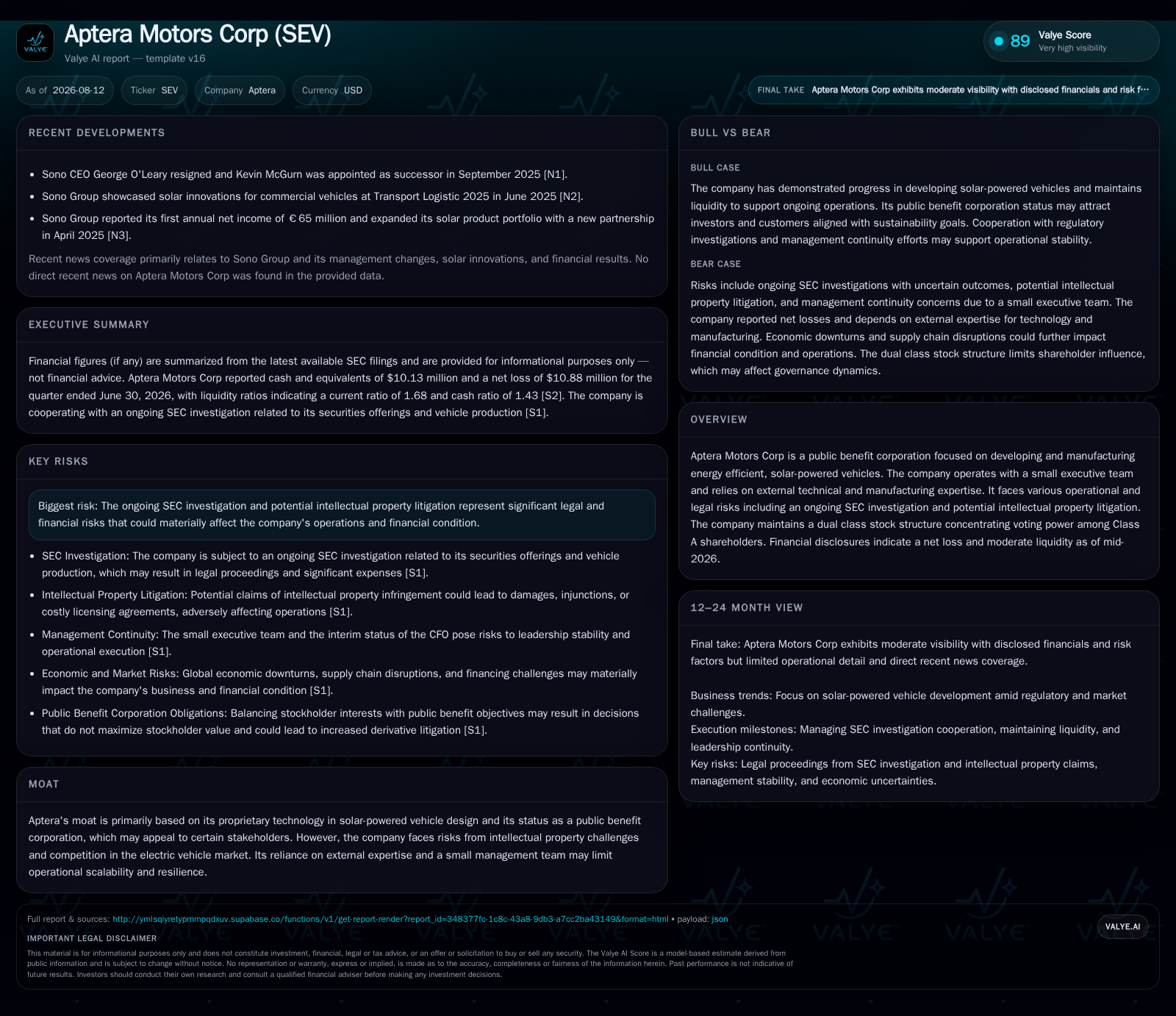
Aptera Motors Corp’s latest quarterly filing reveals incremental advancement in its proprietary solar-powered electric vehicle (EV) program, marked by low-volume production validation despite ongoing SEC investigation and prior intellectual property litigation. The company’s niche positioning in solar integration differentiates it within the early-stage EV landscape but entails reliance on contract manufacturing and external technical expertise, which may affect scalability and timelines. Liquidity remains moderate with a current ratio of 1.68 as of June 2026, supporting near-term operations but underscoring typical capital intensity and cash burn risks.
Q2 Operating Metrics Spotlight Production Progress Amid Risks
Aptera Motors’ fiscal second quarter ending June 30, 2026, reflected continuity rather than fundamental change in the company’s risk profile and operational status. The latest Form 10-Q confirms no material changes to pre-existing risk factors including the ongoing SEC investigation initiated with a subpoena in January 2025 related to securities offerings and vehicle design/production processes [S2], [S1]. Cooperation remains active but outcomes remain undefined, creating regulatory uncertainty that competes for management attention.
Operationally, notable progress includes earlier disclosures that five validation vehicles were driven off Aptera’s low-volume assembly line as of Q1 2026, indicating initial manufacturing execution though on a limited scale that represents an early stage rather than mass production milestone [S10]. The July 2026 announcement of receiving a U.S. Environmental Protection Agency Certificate of Conformity for its Launch Edition model marks an important regulatory step facilitating sales authorization within U.S. markets [S7]. These milestones are tangible markers that the company is transitioning from prototype development toward commercial readiness.
Innovating Solar-Powered EVs: A Niche Business Model with Scalability Questions
Aptera's core competitive differentiator lies in its proprietary solar integration technology which it leverages to improve the energy efficiency and range capabilities of its electric vehicles. This technical approach targets range anxiety — a significant consumer barrier for EV adoption — by supplementing battery power with solar energy harvested via embedded panels integrated into the vehicle body [S1]. Unlike other startups focusing predominantly on raw battery capacity or luxury features (e.g., Lucid Motors) or scale (Tesla), Aptera occupies a specialized niche intersecting green energy technology with vehicle design innovation.
However, this focus also underscores certain vulnerabilities. Aptera relies extensively on external technical expertise and contract manufacturing partners for actual vehicle production rather than owning full vertical integration or large-scale facilities—a common characteristic among smaller EV startups but one that heightens risks relating to supply chain disruptions, quality control variability, and lengthened time to market associated with outsourced production chains [S1]. Given the critical balance between ensuring manufacturing yield and optimizing solar integration efficacy, these dependencies represent focal points that could constrain scaling ambitions or delay delivery commitments.
Competitive Landscape and Intellectual Property Challenges Shape Resilience
The electric vehicle sector is fiercely competitive and fast evolving; Aptera contends with this backdrop alongside legal and operational challenges. It recently resolved a significant intellectual property lawsuit filed by Zaptera USA Inc., settling through the issuance of common stock shares and warrants without admission of wrongdoing—this reduces litigation uncertainty but highlights the latent IP litigation risk endemic to novel technology companies operating at the cutting edge [S6].
By comparison, peers such as Fisker Inc. also emphasize solar or sustainable vehicle concepts yet have pursued broader production deals and strategic partnerships to boost scale; meanwhile Tesla benchmarks offer perspective on the enormous capital and time investment required to compete at mass-market levels in terms of autonomous capabilities and charging infrastructure ecosystems [S1]. Aptera’s small executive team managing complex regulatory environments coupled with concentrated shareholder voting power due to its dual class stock structure suggest governance challenges amidst evolving stakeholder expectations
Growth Opportunities Anchored in Technological Differentiation and Market Dynamics
Broader industry tailwinds support Aptera’s strategic vision. Growing consumer preference for environmentally conscious transportation solutions is complemented by government subsidies incentivizing EV purchases globally. Further technological advances in battery chemistry combined with improvements in solar panel efficiencies promise potential uplifts in total range per charge—critical metrics that will influence customer adoption post-production scaling.
These structural growth drivers align well with Aptera’s proprietary technology emphasis on energy efficiency through solar augmentation. Yet meaningful revenue expansion hinges on successfully transitioning from low-volume validation runs to regular production output that meets commercial demand thresholds—a shift that involves navigating supply chain complexity for batteries, battery management systems, semiconductors, and specialized materials integral to maintaining product quality standards demanded by regulatory certifications such as EPA conformity.
Operational and Legal Risks Limit Execution Confidence
Despite promising technological differentiation, Aptera faces several execution headwinds typical of nascent EV manufacturers coupled with unique pressures from its legal context. The unresolved outcome of the SEC investigation presents reputational risks and potential resource diversion toward compliance costs rather than core R&D or production scale efforts. Furthermore, dependency on external manufacturing means less direct control over critical variables like yield rates or component shortages which could impact timing or cost structures.
Previously settled IP litigation notwithstanding, lingering concerns about intellectual property rights enforcement remain salient given aggressive patent environments within automotive innovation domains. As production ramps up, warranty claims rates following initial deliveries could emerge as an operational performance KPI shedding light on product reliability versus competitor benchmarks.
Next Steps: Milestones to Validate Demand Traction and Production Scaling
Key upcoming milestones to watch involve measurable increases in vehicle production volumes beyond initial validation units alongside public disclosures around order backlogs or customer bookings—which would provide clearer signals on market acceptance levels.
Further regulatory approvals or expansions into adjacent markets will be pivotal too; given receipt of EPA certification for the Launch Edition vehicle occurred mid-2026 [S7], subsequent compliance certifications (e.g., DOT safety standards) would enable broader sales channels closing the gap toward volume manufacturing economics.
Progress on exercising outstanding warrants under recent inducement agreements may also bolster liquidity if executed fully [S21], supporting capex necessary for scaling contract manufacturing setups.
Financial Profile Discussion
As of June 30, 2026, Aptera reported $10.1 million in cash and cash equivalents against current liabilities totaling $7.09 million yielding a current ratio of approximately 1.68—indicating modest liquidity adequacy typical for an early-stage EV manufacturer balancing capital-intensive R&D alongside nascent revenue streams [F1]
The company's net loss position persists consistent with developmental-stage investments focused intensely on product validation rather than profit generation [F1]. Meanwhile, no material changes were reported regarding debt levels or capital structure during Q2 filings which suggests stable financial footing but underlines dependence on successful warrant exercises or fresh capital raises to extend operational runway given cash burn inherent to manufacturing ramp phases [S2], [S3].
In sum, while financial resources currently underpin ongoing operations adequately near term, capital allocation towards smoothing supply chain constraints or accelerating commercialization remains an imperative watchpoint.
This analysis synthesizes publicly reported data from Aptera Motors Corp’s latest quarterly filings augmented by industry context relevant to early-stage electric vehicle manufacturers focused on solar-powered EV innovation. It does not constitute investment advice but aims to provide a detailed appraisal anchored firmly to disclosed metrics and operational facts.
Disclaimer: This is research-only, informational analysis and not investment advice. It may include AI-generated interpretation and general industry context. Always verify important details using primary sources.

Comments