
BayFirst Financial Confronts Loan Portfolio Challenges Amid Strategic Refocus on Community Banking
Recent asset resolution steps and financial restatements highlight BayFirst’s evolving risk management and local market focus in Florida.
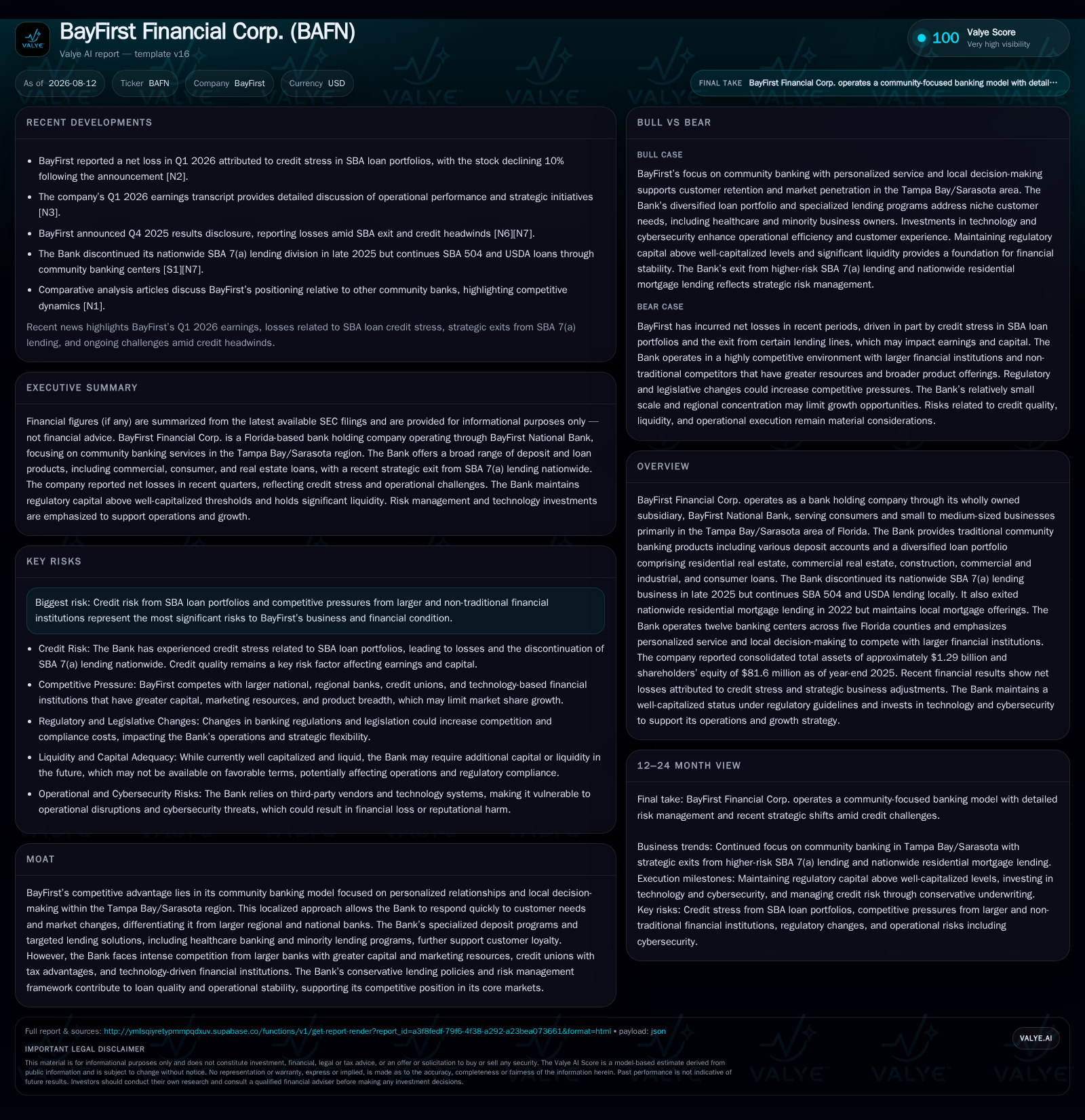
BayFirst Financial Corp., through its wholly owned BayFirst National Bank, serves the Tampa Bay/Sarasota region with a community banking model emphasizing personalized service and local decision-making. Recent quarterly disclosures reveal strategic discontinuations of nationwide SBA 7(a) and residential mortgage lending, coupled with an asset resolution plan addressing impaired loan exposures primarily from government-guaranteed portfolios. These moves underscore credit risks within its portfolio and a pivot toward stabilizing operations locally. The bank's competitive advantage lies in its regional focus and customer relationships but faces pressure from larger banks and fintechs while managing financial restatements impacting earnings. Monitoring loan performance, deposit trends, and remediation execution will be critical to assessing BayFirst’s path back to profitability.
Recent Operating Update Highlights Strategic Adjustments and Credit Resolution
BayFirst Financial Corp.'s May 12, 2026 quarterly filing [S2] reveals active responses to operating challenges centered on credit quality within its loan portfolio. The bank discontinued its nationwide SBA 7(a) lending business by late 2025 and ceased nationwide residential mortgage lending in 2022 [S1], signaling a strategic retreat from higher-risk national SBA exposures during mounting asset quality pressures. Current focus is on SBA 504 and USDA loans offered locally through community banking centers.
A key development is the July 2026 asset resolution plan targeting impairments within government-guaranteed loan portfolios [S3][S17]. This includes approximately $37 million in adjustments related to over 7,000 smaller SBA 7(a) loans that were previously unguaranteed or underperforming. These adjustments affect both amortized cost loans under ASC 326 and fair value measurements under ASC 825. The sizable corrections indicate prior underwriting or monitoring deficiencies.
Compounding financial challenges are restatements covering periods from 2024 through Q1 2026 due to accounting errors involving deferred origination costs and accrued interest on defaulted or non-accrual loans [S15]. These corrections materially reduced reported net income (e.g., lowering 2024 net income from $12.6 million to $11.4 million), raising concerns about internal controls and earnings reliability.
Business Model: Traditional Community Banking Focused on Personalized Service
BayFirst operates as a typical community bank via BayFirst National Bank serving consumers and small-medium businesses primarily in Tampa Bay/Sarasota, Florida [S1]. Its twelve branches across five counties (Pinellas, Hillsborough, Sarasota, Manatee, Pasco) provide localized decision-making capabilities that differentiate it from larger regional banks.
Revenue mainly derives from net interest income earned on a diversified loan portfolio including commercial real estate loans, construction loans, commercial & industrial loans, USDA-backed business loans, and select SBA lending programs. Deposit gathering supports lending activity through specialized consumer accounts such as Essential Checking (targeting customers rebuilding banking access) and youth-focused Cash Kids’ Club savings accounts fostering early client relationships.
Fee income supplements interest revenue via treasury management services including lock boxes, remote deposits, wire transfers, cash management tailored for businesses, merchant processing services among others [S1]. While personalized banking supports loyalty, it requires staffing resources that may affect efficiency compared with larger peers.
Industry Structure and Competitive Position
BayFirst occupies the community banking segment characterized by strong local ties and personalized service. Unlike large regional peers such as Regions Financial or Synovus Financial Corp., BayFirst’s focus is geographically narrow but intense. It faces competition locally from scaled regional banks with broader product suites as well as tax-advantaged credit unions competing aggressively for deposits.
Fintech platforms disrupt traditional deposit-gathering by offering digital-first experiences with instant credit decisions—pressuring BayFirst to incrementally improve digital capabilities.
Discontinuing nationwide SBA lines increases reliance on core strengths: deepening local borrower relationships especially within SBA 504/USDA programs carrying government guarantees that reduce credit risk relative to conventional lending.
Growth Drivers: Stabilizing Credit Quality While Leveraging Localized Programs
Growth depends heavily on restoring loan book health post-resolution plan while maintaining deposit inflows through differentiated retail products. Continued emphasis on government-guaranteed loans is strategically prudent given favorable pricing enabled by federal backing (e.g., USDA guarantees up to 80%) [S1]
Community-tailored products targeting underserved demographics—including specialty checking accounts—aid client acquisition but may compress funding margins.
Longer-term expansion hinges on prudent commercial real estate lending aligned with Tampa Bay’s economic outlook; local business formation rates will inform loan demand potential.
Technology adoption is moderate; online banking supports bill pay and remote deposits but lacks evidence of aggressive digital transformation relative to fintech competitors.
Risks and Watchpoints: Credit Quality Remains Principal Concern Amid Regulatory Scrutiny
Credit risk dominates given substantial mid-2026 adjustments totaling nearly $40 million tied to SBA-related portfolios uncovered recently [S17]. These impairments weigh materially on earnings unless offset by disciplined underwriting going forward.
Capital has eroded significantly as losses reduced equity from $110.9 million at end-2024 to $81.6 million at end-2025 [F1][S29], increasing regulatory scrutiny since capital adequacy affects permissible activities such as brokered deposit acceptance or expansion efforts.
Liquidity remains adequate supported by $134 million cash equivalents at March-end providing operational buffers plus contingency borrowing capacity via Federal Home Loan Bank or Federal Reserve channels if needed [F1][S22]. Nonetheless, liquidity risk persists amid competitive deposit pressures.
Operational risk surfaced through recent restatements linked partly to inadequate internal controls over accrual accounting for problem loans—potentially undermining investor confidence absent transparent remediation plans [S15].
Competitive forces intensify; without scale advantages or rapid digital innovation response, BayFirst risks erosion of core customer segments especially younger demographics favoring digital-first providers.
What To Watch Next: Asset Resolution Execution and Restatement Outcomes
Key near-term milestones include:
- Filing amended consolidated financial statements addressing prior period misstatements expected imminently following August filings [S15][S23].
- Progress in asset resolution execution targeting impaired government guaranteed assets accounting for $37 million in write-downs recognized mid-year [S3][S17].
- Stabilization or improvement in nonperforming loan ratios within SBA-backed portfolios.
- Deposit growth momentum particularly among inclusion-focused products like Essential Checking.
- Net interest margin trends balancing yield enhancement against funding cost trade-offs amid specialty account pricing.
- Regulatory feedback clarifying capital adequacy status affecting strategic flexibility.
- Management updates outlining efforts to restore profitability after documented pandemic-related challenges.
Financial Profile Discussion
As of March 31, 2026, BayFirst held approximately $134.5 million in cash and equivalents supporting liquidity amid ongoing portfolio remediation efforts [F1]. Liquidity management benefits from access to Federal Home Loan Bank borrowings, with operational resilience depending on maintaining depositor confidence amid competitive pressures locally [S22]. Monitoring loan-to-deposit ratio trends alongside efficiency improvements will be critical indicators validating turnaround progress.
In summary, BayFirst Financial’s immediate outlook centers on executing its asset resolution strategy focusing on government-guaranteed exposures while consolidating its community bank identity centered on personalized service amid intensifying competitive dynamics.
Disclaimer: This is research-only, informational analysis and not investment advice. It may include AI-generated interpretation and general industry context. Always verify important details using primary sources.

Comments