
TriLinc Global Impact Fund LLC's Q2 2026 Update Highlights Robust Credit Risk Management and Portfolio Diversification
Latest quarterly filing reveals TriLinc’s disciplined deployment into senior secured loans and trade finance, supported by rigorous valuation practices and active restructuring management.
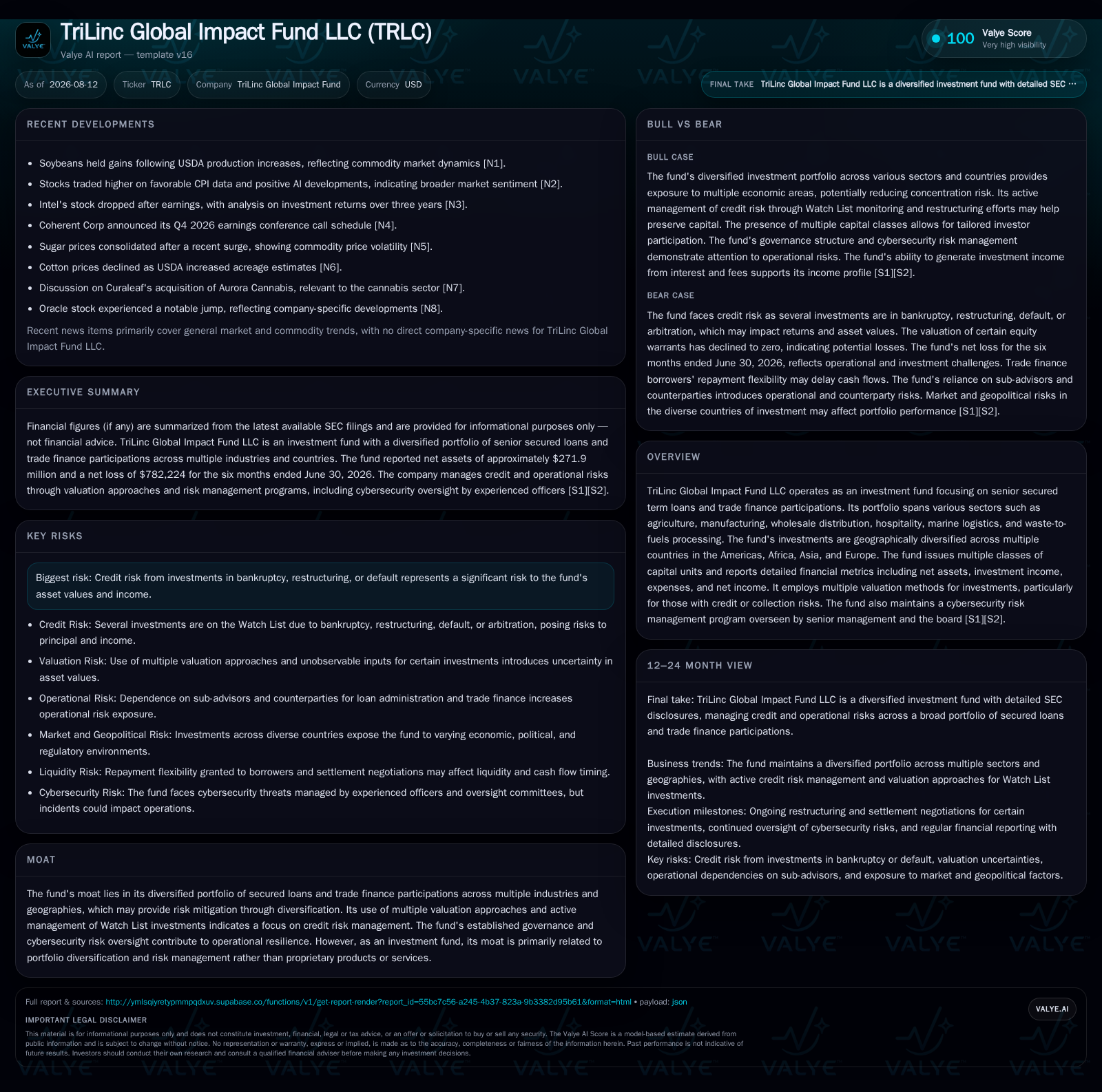
As of June 30, 2026, TriLinc Global Impact Fund LLC reported portfolio assets of approximately $333.8 million, with a weighted average loan size near $10 million and a short weighted average duration of 0.4 years. The fund employs a hybrid valuation approach for watch list investments, blending collateral-based and income-approach methods to accurately reflect credit risk in illiquid debt instruments. Recent borrower restructurings involving convertible notes demonstrate proactive credit risk mitigation. Geographic and sector diversification across emerging markets supports risk dispersion, while governance structures emphasize cybersecurity oversight to protect operational integrity in complex lending environments.
Latest Portfolio Update Demonstrates Active Capital Deployment and Credit Risk Oversight
TriLinc Global Impact Fund LLC reported total portfolio assets of approximately $333.8 million as of June 30, 2026 [S2]. This reflects consistent capital deployment into a diversified mix of senior secured term loans and trade finance participations targeting mid-sized borrowers primarily in emerging or underserved markets [S3]. The weighted average loan size remains around $10 million with a notably short weighted average duration of approximately 0.4 years. Such short loan tenors enable responsive portfolio adjustments aligned with evolving borrower credit profiles and market conditions.
Credit quality indicators remain favorable with non-performing loans near zero for the quarter [S2]. This suggests robust early warning systems and credit monitoring frameworks that allow timely identification of at-risk investments. The fund’s focus on senior secured loans provides collateral coverage that mitigates downside exposure in default scenarios.
Hybrid Valuation Techniques Address Illiquidity and Credit Risk Complexities
Valuation challenges inherent in private debt portfolios are addressed through a hybrid approach combining collateral-based valuations with income approach methodologies [S1][S2]. Collateral-based valuations assess liquidation values of pledged assets to establish recovery potential under distress. Meanwhile, the income approach estimates the present value of expected future cash flows considering restructuring timelines and credit risks.
This dual method is applied selectively within watch list investments: some holdings such as MICD or Trustco rely heavily on collateral coverage ratios due to tangible asset backing, while others like Grupo Surpapel or Agilis Partners depend more on projected cash flows given ongoing restructurings [S1][S2]. This nuanced valuation reflects the fund’s effort to transparently capture credit uncertainties while providing accurate net asset value (NAV) reporting.
Convertible Notes Reflect Proactive Credit Risk Mitigation Through Restructuring
The fund has demonstrated active engagement with borrowers experiencing repayment difficulties by negotiating restructuring agreements that include issuance of Class A and B convertible notes [S1]. For example, Courtyard Farms Limited and Alfa Systems underwent settlements where borrower inventory serves as collateral alongside convertible notes issued in August 2023 as part of workout arrangements [S1].
Such restructurings aim to preserve capital value while providing upside potential should borrowers recover sufficiently to convert notes into equity or fully repay principal. Though restructuring frequency remains limited, these actions are critical in managing portfolio cash flow stability and mitigating losses.
Geographic and Sector Diversification Mitigate Concentration Risks
TriLinc’s portfolio spans several geographies including the Americas, Africa, Asia, and Europe [S3], which helps reduce region-specific economic or political shocks common in emerging market lending. Sector exposures cover agriculture (notably cocoa processing), manufacturing (such as sustainable packaging), chemicals wholesale distribution, marine logistics services, hospitality providers, and waste-to-fuels processors [S1][S3].
While this diversification strategy balances macroeconomic volatility risks, concentration risks persist due to exposure to commodity-sensitive sectors vulnerable to price fluctuations or supply chain disruptions. The fund’s relatively modest weighted loan size supports nimble redeployment capabilities should sectoral pressures intensify.
Multi-Class Capital Units Cater to Diverse Investor Risk Preferences
The fund issues multiple classes of capital units—Class A, C, I, W, Y, Z—allowing it to tailor investor allocations according to varying yield expectations and liquidity needs [S1][S2]. This structure facilitates flexible capital raising by aligning tranche-specific risk-return profiles with institutional investor mandates.
Such segmentation mirrors approaches used by leading direct lending funds that balance capital base stability with portfolio complexity. It also supports fundraising resilience amid ongoing challenges posed by borrower restructurings.
Governance Framework Emphasizes Cybersecurity and Operational Resilience
Operational resilience is bolstered by an Incident Response Team (IRT) coordinated with two Co-Chief Information Officers who oversee cybersecurity risk management policies across the company [S1]. These officers bring over three decades each of information security experience in various organizational contexts.
Regular reporting ensures the board of managers maintains continuous oversight over cyber risks—a critical safeguard given sensitive loan documentation handling across multiple jurisdictions vulnerable to cyber threats. This governance rigor complements credit risk frameworks by protecting operational continuity amidst evolving digital risks.
Industry Tailwinds Support Growth Amid Emerging Market SME Financing Gaps
TriLinc’s business model benefits from structural demand drivers common across impact investment private debt funds: persistent SME financing gaps in emerging markets drive demand for alternative senior secured loans; growing investor interest in ESG-aligned products sustains capital inflows; expanding global trade increases need for specialized trade finance solutions; favorable regulatory environments encourage private credit growth; rising interest rates enhance loan yield profiles [S3]
These factors underscore the fund’s positioning amid broader shifts favoring private debt strategies targeting underserved markets.
Key Metrics To Watch for Portfolio Performance Assessment
Investors should closely monitor several operating metrics in upcoming disclosures: changes in net asset value reflecting watch list investment outcomes; net investment income yields signaling revenue stability; pace and success rate of watch list resolutions via repayments or note conversions; shifts in weighted average loan durations indicating evolving portfolio tenor risk.
Clear visibility on these measures will provide insight into how well the fund navigates the complexities inherent in emerging market private debt investing [S2]
Financial Profile Discussion: Liquidity Position and Net Assets Contextualize Operating Results
As of June 30, 2026, TriLinc held cash and equivalents approximating $388 thousand with no outstanding debt reported through at least end-2023 per available data [F1], indicating reliance on investor capital rather than leverage—typical among impact-focused private debt funds prioritizing idiosyncratic risk control.
Net assets stood just above $329 million reflecting substantial portfolio valuation underpinning [S2]. Operating income reported at around $4.96 million for the latest full year contrasts with a net loss influenced by non-cash impairments related to restructuring activities [F1]. Expense efficiency relative to investment income will be important going forward for assessing operational leverage potential as new investments mature.
Disclaimer: This is research-only, informational analysis and not investment advice. It may include AI-generated interpretation and general industry context. Always verify important details using primary sources.

Comments