
Cannaisseur Group's Strategic Shift From Hemp Retail to AgTech-Enabled Wellness
The latest quarterly filing underscores Cannaisseur Group’s pivot from pure hemp-derived product retail toward a hybrid health and agriculture technology business model.
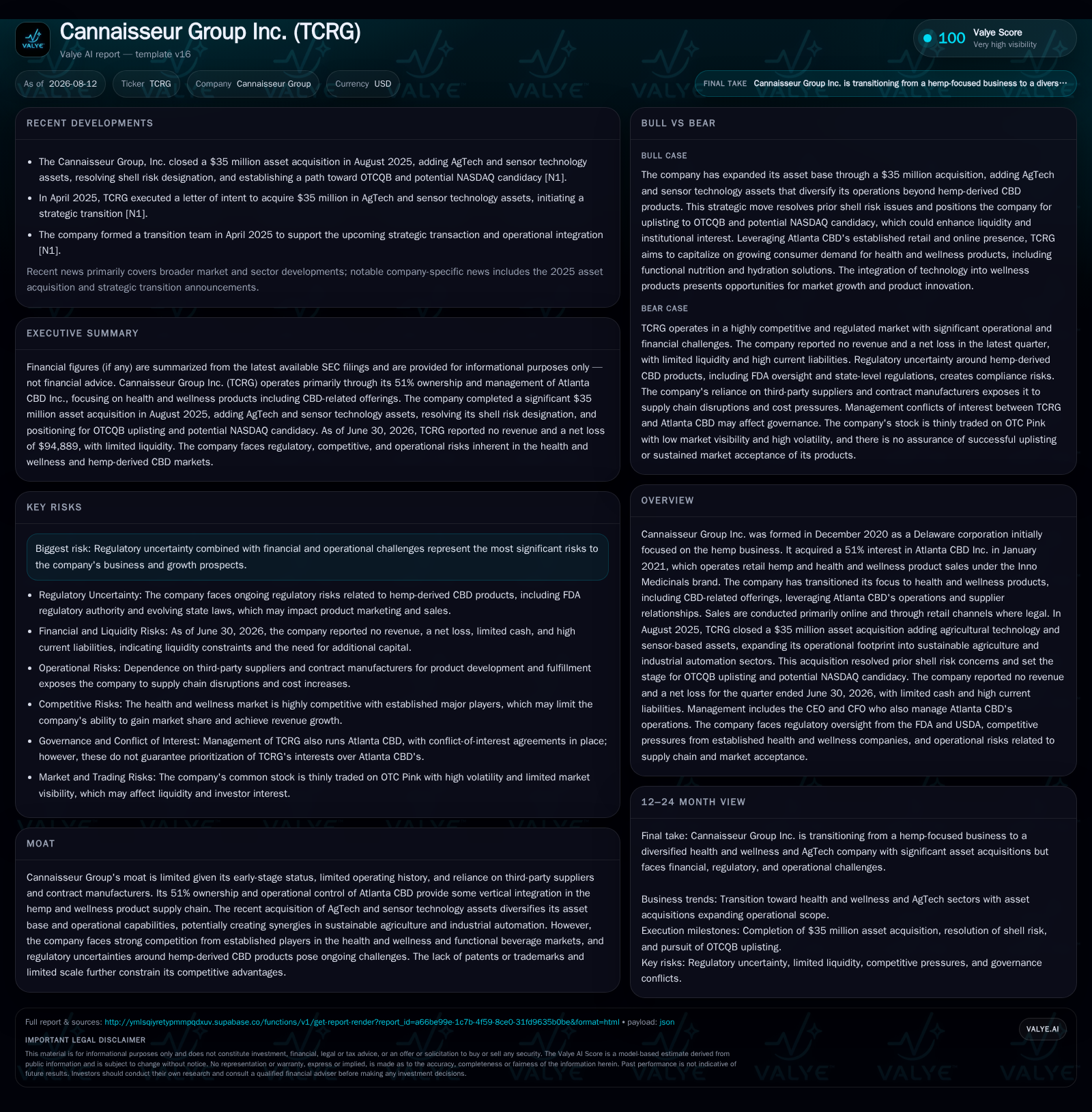
Cannaisseur Group Inc. (TCRG) continues an early-stage transformation marked by its majority stake in Atlanta CBD's retail operations of hemp-derived health products and the August 2025 acquisition of AgTech assets focused on sensor technology. While its core revenue relies on Atlanta CBD’s online and physical retail sales of wellness products supported by third-party suppliers and contract manufacturers, the addition of sustainable agriculture technology aims to diversify growth avenues. However, the company remains pre-revenue with constrained liquidity and faces persistent regulatory uncertainty around CBD formulations and supplier dependencies. Its competitive position is modest compared to larger vertically integrated peers but offers a unique hybrid profile bridging wellness product retail and emerging agricultural technologies.
2026 Q2 Filing Confirms Strategic Pivot Toward AgTech-Enabled Wellness Expansion
Cannaisseur Group’s most recent 10-Q filing dated August 12, 2026 reiterates the absence of reported revenue as of the end of H1 2026 but anchors a pivotal strategic narrative around diversification beyond its original hemp retail focus. The company continues to maintain operational control over Atlanta CBD Inc., its 51%-owned subsidiary which focuses on retailing health and wellness products including hemp-derived CBD items primarily through physical stores in Georgia alongside e-commerce platforms [S2][S1]. Crucially, Cannaisseur’s August 2025 acquisition of agricultural technology assets valued at approximately $35 million—centered on industrial sensor technologies for sustainable farming—marks a deliberate shift toward incorporating a technology-enabled wellness ecosystem projecting operational synergies between wellness products and enhanced supply chain management [S1].
This asset acquisition not only mitigated prior risks associated with the company’s development-stage shell status but also facilitated an uplisting to OTCQB with ambitions toward NASDAQ eligibility. These capital market moves aim to improve investor confidence by establishing a clearer business identity linking traditional health retail with cutting-edge AgTech innovation.
Hemp-Derived CBD Retail: Current Business Model Anchored by Atlanta CBD Control
The cornerstone of Cannaisseur Group’s near-term business model rests on its majority ownership and day-to-day management of Atlanta CBD Inc., which serves as the primary revenue vehicle through its brick-and-mortar Inno Medicinals stores along with online direct-to-consumer sales via the https://innomedicinals.com site [S1]. This operational structure creates a midstream to downstream footprint typical in the health wellness industry focused on hemp-derived CBD offerings targeting consumer demand for natural therapeutic supplements.
Key to this model is heavy reliance on third-party commercial suppliers and contract manufacturing partners responsible for product research & development, formulation, quality assurance testing, production runs, packaging compliance, and fulfillment logistics—including drop shipping options utilized by Atlanta CBD [S1]. This outsourcing approach reflects industry norms where many small-to-mid size players lack capital or scale for vertical integration into cultivation or extraction phases but introduces elevated dependency risks around supplier stability and regulatory adherence
Revenue mechanics center on gross sales achieved through retail channels where legal sell-through occurs. Variations in channel mix between online e-commerce versus physical store purchases will materially affect customer acquisition costs, repeat purchase rates, inventory turnover timing, and ultimately gross margin profiles given differential fulfillment expenses across channels.
Vertical Integration Limits and Contract Manufacturing Dependencies Highlight Operational Risks
While owning 51% affords Cannaisseur operational control over Atlanta CBD’s retail activities, it does not extend to upstream production capacities—an important distinction relative to vertically integrated peers [S1]. The company's exclusion from cultivation or extraction introduces supply chain fragility related to vendor license compliance within tightly regulated hemp markets governed by fluctuating FDA oversight concerning hemp-derived cannabinoids
FDA regulation currently lacks definitive approval standards for food or dietary supplements containing hemp-extracted CBD oil; this ambiguity complicates labeling claims enforcement by the FTC regarding truthful advertising. Noncompliance risks could trigger supplier disruptions or costly legal challenges impacting Cannaisseur’s supply continuities. Additionally, rising ingredient costs driven by agricultural yield variability or labor inflation could further pressure margins absent scale economies.
Furthermore, outsourcing fulfillment also adds complexity to customer experience controls—critical in wellness product sectors where brand trust strongly influences repeat purchase behavior.
Industry Structure Colors Competitive Landscape: Peers Show Varied Degrees of Integration and Scale
Cannaisseur occupies a lower-scale niche within the broader health and wellness industry characterized by notable competitors like Charlotte's Web Holdings or CV Sciences—firms exhibiting stronger brand recognition coupled with more mature distribution footprints spanning wholesale agreements alongside direct consumer outreach. For example, Charlotte's Web integrates proprietary hemp genetics yielding differentiated product formulations enhancing efficacy perceptions.
Meanwhile, vertically integrated enterprises such as Curaleaf Holdings operate multi-state cannabis licenses owning upstream cultivation down through downstream dispensaries offering stronger margin capture potential due to tighter cost control over raw materials.
In contrast, Cannaisseur's recent venture into AgTech sensor technology positions it uniquely amidst an emergent peer subset including firms focused strictly on sustainable farming solutions that leverage data analytics via sensor arrays. This hybrid profile offers promising differentiation but requires reconciling disparate operational demands between wellness product retailing versus industrial ag-tech deployments.
Key Growth Trajectories: Market Expansion, E-Commerce Channel Scaling & Synergistic Technology Assets
Industry growth drivers supporting Cannaisseur's strategic directions include expanding legalization trends broadening geographic market access for hemp-derived products beyond current state restrictions evident at Atlanta CBD’s base in Georgia. Moreover, increasing consumer adoption of e-commerce channels accelerates digital sales volumes while potentially lowering overheads relative to maintaining multiple physical stores.
Product innovation leveraging biotechnology advances or novel formulations can stimulate market pull especially if augmented by data from precision agriculture monitoring enabled by recent AgTech acquisitions enhancing crop quality or ingredient consistency—a critical success factor for premium health products.
Further scaling depends heavily on developing reliable supplier contracts with verified regulatory licensing as well as building consumer loyalty measured via repeat purchase rates—a vital KPI reflecting marketing effectiveness amid intense competition.
Risks Ahead: Regulatory Flux, Supplier Reliance, Financial Strain and Execution Complexity
TCRG faces entrenched uncertainty linked principally to evolving FDA guidelines which may mandate approval pathways currently undetermined for food/dietary supplements containing hemp-CBD components [S1]. Such ambiguities create potential compliance costs as formulations might require reformulation or repackaging alongside advertisement scrutiny under FTC standards exposing risk of enforcement actions.
Additionally, dependency on contract manufacturers elevates execution risk due to possible disruptions from non-compliance or capacity constraints impacting inventory turnover timelines pivotal for mix optimization.
Acquisition integration effort around sensor technology adds complexity requiring cross-disciplinary management capabilities uncommon in early-stage health-wellness pure plays further stretching finite resources.
What Investors Should Monitor Next: Revenue Signals, Compliance Updates, Milestones in Product Innovation
Critical milestones will encompass observable revenue inflection points emanating from growing sales volume at Atlanta CBD stores or e-commerce channels indicating effective market penetration post-strategy shift [S2]. Regulatory landscape developments including formal FDA guidances or FTC action status should be tracked closely as these will impact permissible marketing claims influencing demand elasticity.
Success metrics from newly acquired AgTech assets’ commercial deployment will also provide tangible validation whether diversification yields tangible productivity gains or cost efficiencies feeding back into core wellness supply chains.
Finally, evidence of progressing capital raising activities facilitating working capital replenishment will underscore financial runway versatility necessary before positive cash flow break-even horizons are achieved.
Financial Profile Discussion: Early-Stage Sustainability Under Capital Constraints
Cannaisseur Group presently operates under significant financial constraints characteristic of early-stage firms navigating complex industry transitions. As per latest companyfacts data through mid-2026 [F1], cash reserves have dwindled to approximately $41 thousand juxtaposed against outsized current liabilities amounting to roughly $338 thousand producing a dangerously low current ratio near zero signaling acute liquidity risk absent immediate financing inflows.
Operating loss figures surpass $1.7 million for fiscal year ended December 31, 2025 highlighting ongoing cash burn intensifying funding needs especially given expansion plans into technologically demanding AgTech domains requiring substantial R&D investment flows outlined in prior registration filings [S1]. The company plans ahead using equity issuance vehicles though no finalized sizable capital raises have been confirmed recently suggesting investors should monitor forthcoming financing announcements carefully.
In sum, while Cannaisseur has made notable strides diversifying beyond classic hemp retail through technologically forward asset acquisitions positioning itself uniquely between wellness consumer products and industrial agriculture innovation segments; its operational execution coupled with regulatory navigation under tight financial resource envelopes will dictate viability beyond nascent stage development periods.
Disclaimer: This is research-only, informational analysis and not investment advice. It may include AI-generated interpretation and general industry context. Always verify important details using primary sources.

Comments