
American Fusion’s Reverse Merger Spurs Step-Up in R&D Amid Lingering Liquidity Constraints
Following its reverse merger with Kepler Fusion Technologies, American Fusion accelerates fusion energy R&D while facing critical liquidity challenges.
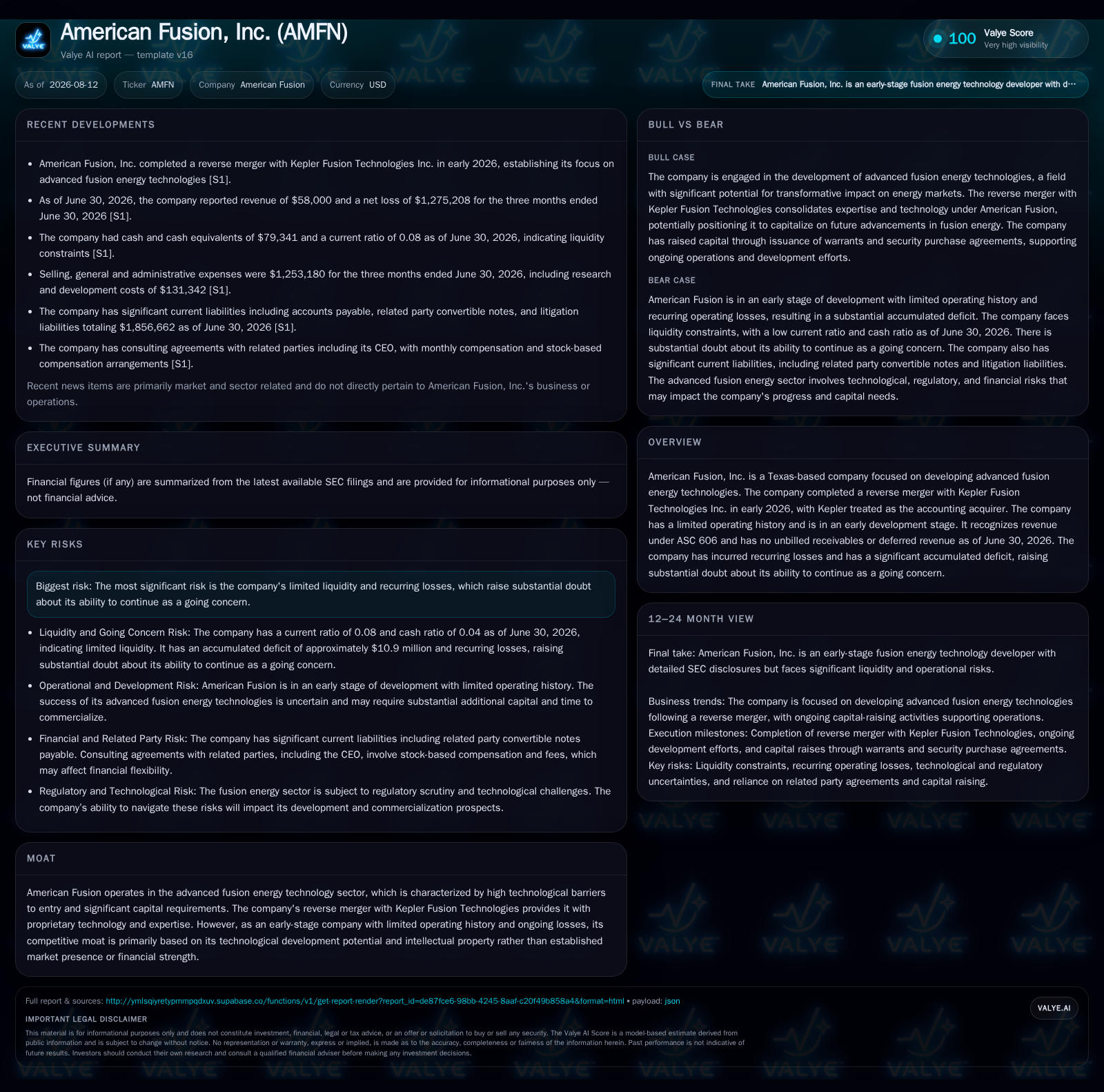
American Fusion, Inc. recently completed a reverse merger with Kepler Fusion Technologies, acquiring proprietary fusion technology and transitioning into advanced fusion energy development. The latest Q2 2026 results reveal a meaningful increase in cash from financing activities that supports higher research and patent capitalization expenses, signaling intensified R&D efforts. However, the company’s liquidity remains severely constrained, highlighted by a current ratio of 0.08 and a significant accumulated deficit exceeding $10 million. With no commercial revenue stream yet and ongoing operating losses, sustaining operations will heavily depend on future capital raises and milestone progress in prototype development.
Q2 Operating Momentum Fueled by Reverse Merger Capital Infusion
American Fusion’s latest quarterly filing (Q2 2026) prominently reflects operational activity tied to its February reverse merger with Kepler Fusion Technologies. The transaction treated Kepler as the accounting acquirer given its dominant ownership post-merger (approximately 89.7% voting rights) and board control, effectively making American Fusion a public vehicle for advanced fusion tech commercialization [S2], [S9]. The merger instantly endowed American Fusion with Kepler’s proprietary nuclear fusion technology focus.
Financially, this strategic step unlocked over $1.16 million in proceeds during Q2 through prefunded warrant issuances ($943K) and security purchase agreements ($225K), driving a sharp jump in cash from $2.5K at year-end 2025 to over $79K at June 30, 2026 [F1], [S5]. Although still modest for a capital-intensive fusion startup, this liquidity resurgence underpins increased research and patent activity. Indeed, nearly $48.5K was capitalized as intangible assets during the quarter, primarily reflecting patent filing costs tied to the company’s evolving intellectual property portfolio—an essential moat-building lever in high-barrier nuclear fusion innovation sectors [S10], [S18].
Revenue recognized remains token at $58K for the quarter with sizable operating losses nearing $1.25 million consistent with early-stage development spending patterns common among upstream advanced energy firms without commercial products or steady contract streams yet [F1], [S5]. This gap illustrates the prevailing challenge: bridging technology advances toward scalable prototypes while managing heavy burn.
Fusion Technology Development Focus and Intellectual Property Buildout
American Fusion’s core value proposition centers on developing advanced nuclear fusion technologies leveraging magnetic confinement methods — a sophisticated engineering challenge involving plasma physics innovations such as tokamak-related designs inherited via the Kepler subsidiary. The company’s capitalization of intangible assets namely patents and website developments attests to an active patent strategy intending to solidify its IP leadership—a critical differentiator given multi-billion-dollar private peers aggressively protecting breakthroughs in plasma confinement and reactor designs.
This aligns with typical KPIs for fusion startups where intellectual property filings, technology readiness levels (TRLs), and prototype progress track momentum more than near-term income generation. Continued investment in these intangibles reflects management’s prioritization of defensible technological advancement alongside building out institutional partnerships potentially valuable for future government contract wins or licensing opportunities.
Research-Driven Business Model Reflecting Government Contract Reliance
Unlike traditional product-driven enterprises, American Fusion operates within a research-heavy business model characterized by revenue generation through government procurement services related to institutional defense or quality testing demands—as introduced via ancillary government procurement activities separately noted post-merger—and research grants rather than open-market sales channels [S3], [S4]. Such reliance dictates conservative revenue recognition practices under ASC 606 due to contingent deliverables tied closely to specific contract milestones.
Consequently, top-line figures remain low relative to expenses as funding typically supports sustained R&D efforts aimed at eventual commercial viability of fusion energy platforms. This model mirrors sector norms where cash influxes largely derive from equity raises or government-sponsored programs instead of recurring commercial revenue streams.
Competitive Landscape: Positioning Among Private Fusion Innovators
Positioned upstream within the fusion energy value chain as a tech innovator focused on prototype engineering rather than utility-scale power generation, American Fusion inhabits a niche alongside private developers such as General Fusion and Commonwealth Fusion Systems which have leveraged substantial private funding rounds but remain pre-commercial.
The public listing achieved via reverse merger affords American Fusion broader access to institutional capital markets despite notable operational drawbacks including nascent revenue base and severe liquidity risks seen less frequently among large private peers flush with venture funds. However, joining this cohort elevates technical credibility by consolidating Kepler's strong IP base under a publicly traded entity structure facilitating wider investor engagement if technology milestones can be evidenced.
Growth Opportunities Aligned with Energy Transition Incentives
The broader macroeconomic tailwinds supporting companies like American Fusion are robust: surging global demand for clean energy technologies amid tightening carbon regulations cultivates governmental policy incentives stimulating clean-tech grants and strategic partnerships. Breakthroughs reducing cost or complexity in nuclear fusion could unlock transformative energy transition possibilities beyond fossil fuels or intermittent renewables.
In this context, American Fusion’s growth depends critically on translating R&D achievements into demonstrable prototype progress attracting further institutional support or licensing deals. Success here could catalyze multiple expansion via investor interest tuned to zero-carbon innovation trajectories.
Structural Risks from Liquidity Deficits and Commercialization Uncertainty
Despite encouraging operational strides post-merger, American Fusion endures acute structural risks typified by liquidity scarcity: current liabilities nearly exceed $1.86 million contrasting starkly against current assets under $150K resulting in an alarmingly low current ratio of approximately 0.08—a severe imbalance suggesting imminent funding requirements if burn rates persist unchecked [F1], [S2].
Additionally, cumulative deficits north of $10 million alongside recurring losses illustrate capital intensity pressures common when expensive plasma confinement experiments fail to yield immediate scalable commercial outcomes. Regulatory uncertainties around safety approvals accompany typical technological feasibility questions sporadically confronting experimental fusion developers.
Litigation contingencies adding material liabilities compound financial strain underscoring operational fragility often experienced by reverse-merger-enabled startups attempting technologically complex pivots within limited time horizons [S21], [S24].
Financial Position Imperiled by Operating Losses but Supported by Recent Capital Raises
American Fusion’s latest financial snapshot outlines a classic early-stage science-driven firm profile: sizeable cash burn fueled predominantly by R&D initiatives funded through convertible notes payable related-party instruments alongside recent warrant-fueled financing activity totaling over one million dollars netted in Q2 alone [F1], [S11].
While recent equity injections temporarily bolster solvency buffers — elevating cash reserves from paltry levels earlier this year — ongoing operating losses (approximately -$1.25 million quarterly) coupled with growing accrued liabilities point toward intensifying pressure on capital adequacy absent near-term inflections either operationally or financially.
Management warnings embedded in filings reinforce existence-threatening going concern issues typical among public fusion industry entrants prompted into market prematurely via SPAC or reverse merger routes without sustainable throughput revenues yet realized.
Continued ability to raise fresh funds will be critical given limited cash runway suggested by working capital deficits unless milestone achievements accelerate partnerships or licensing arrangements providing alternative non-dilutive cash flows emerge.
Financial Profile Discussion
Disclaimer: This is research-only, informational analysis and not investment advice. It may include AI-generated interpretation and general industry context. Always verify important details using primary sources.

Comments