
SideChannel’s Proprietary Enclave and vCISO Services Face Competitive and Financial Hurdles
Latest quarterly filing highlights ongoing operational challenges and strategic growth initiatives amid liquidity constraints and board changes.
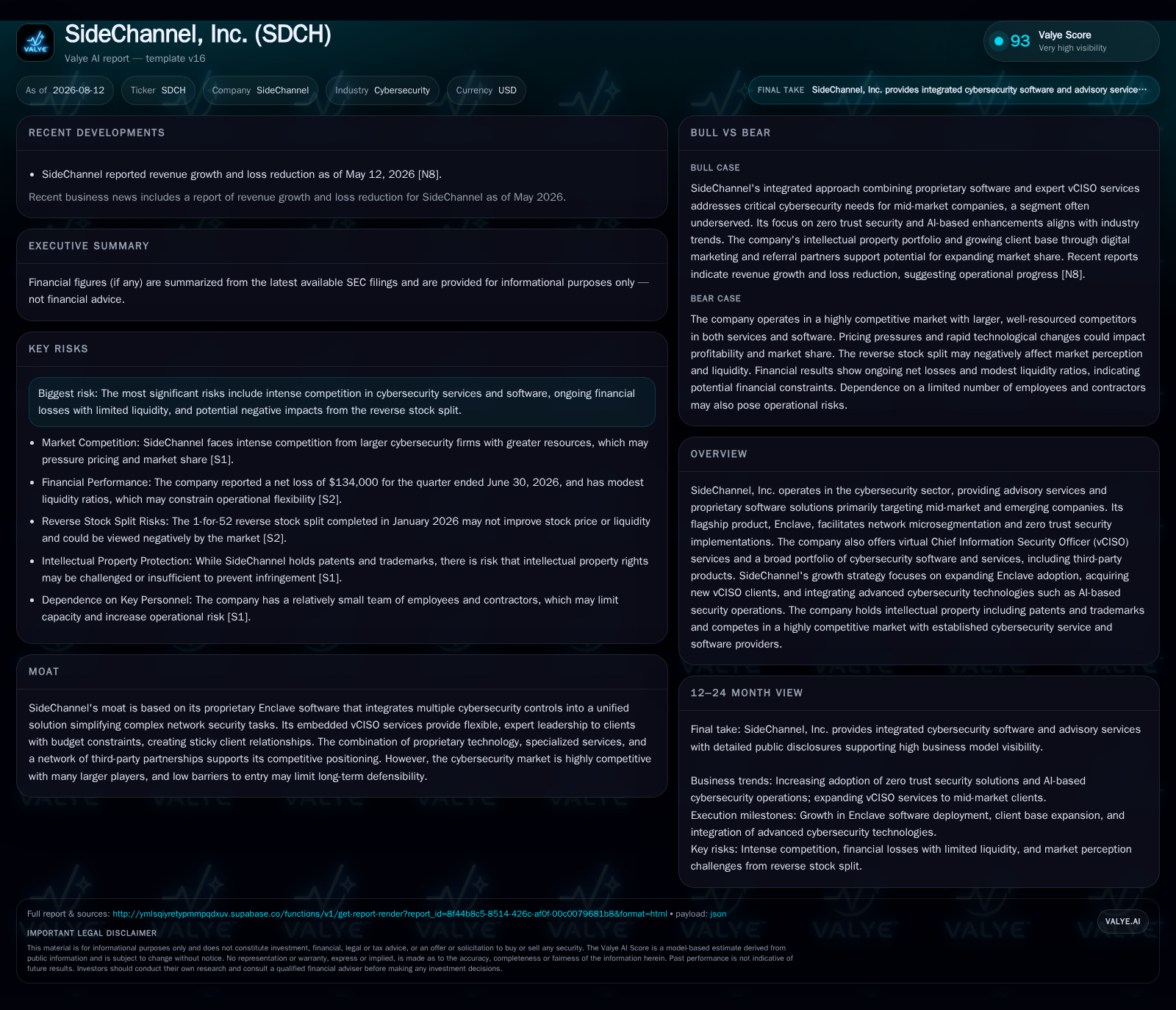
SideChannel, Inc. operates a hybrid cybersecurity business combining its proprietary Enclave software with virtual Chief Information Security Officer (vCISO) advisory services aimed at mid-market and emerging companies. The August 2026 quarterly report reveals no material operational shifts but confirms ongoing financial losses, tight liquidity with a current ratio near unity, and recent corporate governance changes including a board member resignation. SideChannel operates in a highly competitive market with larger firms and low barriers to entry pressuring pricing and growth. Its moat centers on simplifying zero trust network microsegmentation through Enclave software paired with embedded expert advisory services. Key growth drivers include expanded adoption of zero trust architectures and outsourced cybersecurity leadership for mid-market clients, though profitability remains elusive. Investors should monitor customer acquisition trends, vCISO engagement growth, software license uptake, and cash runway indicators.
Recent Operating Update
SideChannel's latest quarterly report filed on August 12, 2026 [S2] reiterates the company's focus on delivering cybersecurity solutions through its proprietary Enclave platform alongside vCISO advisory services targeting mid-market and emerging companies. No material operational changes or new risk disclosures were made beyond the continuation of previously stated risks. A significant corporate event was the resignation of board member Robert Brown as of August 2, 2026 [S3], reducing the board from seven to four members and leaving three vacancies unfilled. This governance shift may influence strategic decision-making flexibility.
Notably, the company implemented a reverse stock split at a large ratio of 1-for-52 in January 2026 [S21], aimed at boosting its common stock price per share to meet exchange listing requirements or improve market perception. However, SideChannel acknowledges the risk that such a move may not enhance liquidity or valuation sustainably and could be perceived negatively by investors [S21].
Business Model Overview
SideChannel operates within the cybersecurity software and services industry by offering both proprietary technology solutions and professional advisory engagements. The core revenue drivers are recurring software licenses for Enclave — a platform designed primarily around network microsegmentation to support zero trust security models — coupled with vCISO services that provide outsourced fractional CISO expertise.
Enclave integrates multiple cybersecurity controls such as access control enforcement, encryption, machine identity management, and segmentation into a unified software solution that simplifies complex network security tasks [S1]. This product targets organizations that are increasingly remote-work enabled but generally lack the internal scale or specialized expertise to establish robust zero trust environments independently.
The vCISO service complements the software by embedding expert leadership into clients’ security teams on a flexible basis. This model is well-suited for cost-conscious mid-market customers navigating evolving regulatory environments requiring compliance readiness and cyber risk management [S1].
Revenue mechanics rely on subscription-based licensing fees for Enclave, supplemented by time- or project-based billings for advisory services. Additional revenue is generated by reselling third-party products through their VAR partners when needed to complete client solutions [S1]. This hybrid model exposes SideChannel to variable margin profiles: typically higher margins from proprietary software offset by lower margins on labor-intensive advisory work.
Industry Structure and Competitive Position
The cybersecurity sector is characterized by rapid innovation cycles and intense competition from entrenched providers boasting extensive resources. SideChannel competes directly with large vendors who offer broader product suites — such as Palo Alto Networks and CrowdStrike in software — as well as consulting giants like Deloitte that provide comparable vCISO offerings [S29].
Low barriers to entry for certain service components accentuate pricing pressure risks. However, SideChannel attempts differentiation through its Enclave technology's tight integration of essential zero trust controls easing deployment complexity for target clients [S8]. This focus aligns well with market trends emphasizing network microsegmentation as a foundational zero trust strategy.
Its embedded advisory practice in the form of virtual CISOs creates sticky relationships critical for customer retention amid commoditized service segments. Nonetheless, sustainability depends heavily on continuous innovation—especially AI-enhanced detection and automated incident response integration—as well as effective sales execution at acquiring new mid-market accounts.
Growth Drivers
Structural demand drivers supporting SideChannel’s growth thesis include:
- The accelerating adoption of zero trust architectures across regulated industries driving demand for integrated microsegmentation solutions.
- Increased reliance on outsourced cybersecurity leadership among mid-market companies lacking full-time CISOs but facing growing compliance mandates.
- Expanded remote workforce deployments heightening network segmentation needs.
- Integration of AI technologies enabling more efficient threat detection automation aligns with sidechannel's announcements around AI adoption in sales and security operations [S15].
- Cross-selling opportunities between Enclave licenses and consulting contracts leveraging existing client relationships.
Monitoring traction via KPIs such as Annual Recurring Revenue (ARR) progression from Enclave licensing, vCISO engagement volume growth, net revenue retention rates reflecting account expansions or churns, license utilization metrics indicating user adoption depth, and average contract values helps track execution against these drivers.
Risks and Constraints
Despite niche positioning advantages, SideChannel faces significant headwinds:
- Persistent operating losses generate funding pressures that have mandated significant equity restructuring including a recent reverse stock split [S21].
- Tight liquidity is evidenced by current assets only marginally exceeding current liabilities (current ratio approx. 1.01 at June 30, 2026), limiting financial flexibility [F1].
- The resignation-induced board vacancies may delay decision-making critical amidst competitive urgency.
- Competition from larger players with broader product portfolios could force unfavorable pricing concessions affecting both top-line growth and margins.
- The cybersecurity landscape’s rapid evolution demands continual R&D investment; failure to maintain pace risks product obsolescence.
- Market perception risks around reverse stock splits can deter investor interest potentially impacting future capital raises needed for scale-up.
What to Watch Next
Key developments to assess going forward include:
- Quarterly updates revealing ARR trends especially from Enclave subscriptions; sustained ARR growth would validate product-market fit.
- Changes in vCISO client count demonstrating success in scaling advisory services complementing SaaS revenue.
- Improvements in gross margins breaking out software vs service segments highlighting progress toward scalable profitability.
- Cash flow dynamics and burn rate modifications indicating whether capital raises or expense restructuring resolve liquidity concerns.
- Board appointments filling the current governance gap potentially influencing strategic initiatives execution.
- Product roadmap milestones related to AI-powered security operations enhancements that could strengthen competitive differentiation.
Financial Profile Discussion
Total debt disclosure remains dated (last available September 2020 figure approximated at $365,430) [F1] with no clear recent refinancing disclosures. The company acknowledges reliance on external capital raises alongside efforts to improve cash flow from operations but concedes uncertainty in securing funds under favorable terms persists [S5].
Operating expenses remain heavily weighted towards research & development focused on Enclave enhancements plus sales & marketing investments targeting mid-market customer acquisition via digital marketing channels, events, direct outreach, and referral partnerships [S8]. While these investments are necessary for growth traction, they contribute to continued negative operating income margins exceeding -90% based on latest filings [F1].
Maintaining adequate capital while balancing growth-oriented spending is critical; failure could impair ability to upgrade software features or scale the vCISO team necessary for competitive relevance.
This analysis synthesizes company disclosures up to August 12, 2026 without investment research views or forward-looking claims beyond provided filings [S1,S2,S3,F1]. It contextualizes SideChannel within broader cybersecurity sector dynamics underpinning its business model challenges and opportunities.
Disclaimer: This is research-only, informational analysis and not investment advice. It may include AI-generated interpretation and general industry context. Always verify important details using primary sources.

Comments