
Aramark Expands Revenue and Margin Amid International Growth and Supply Chain Optimization
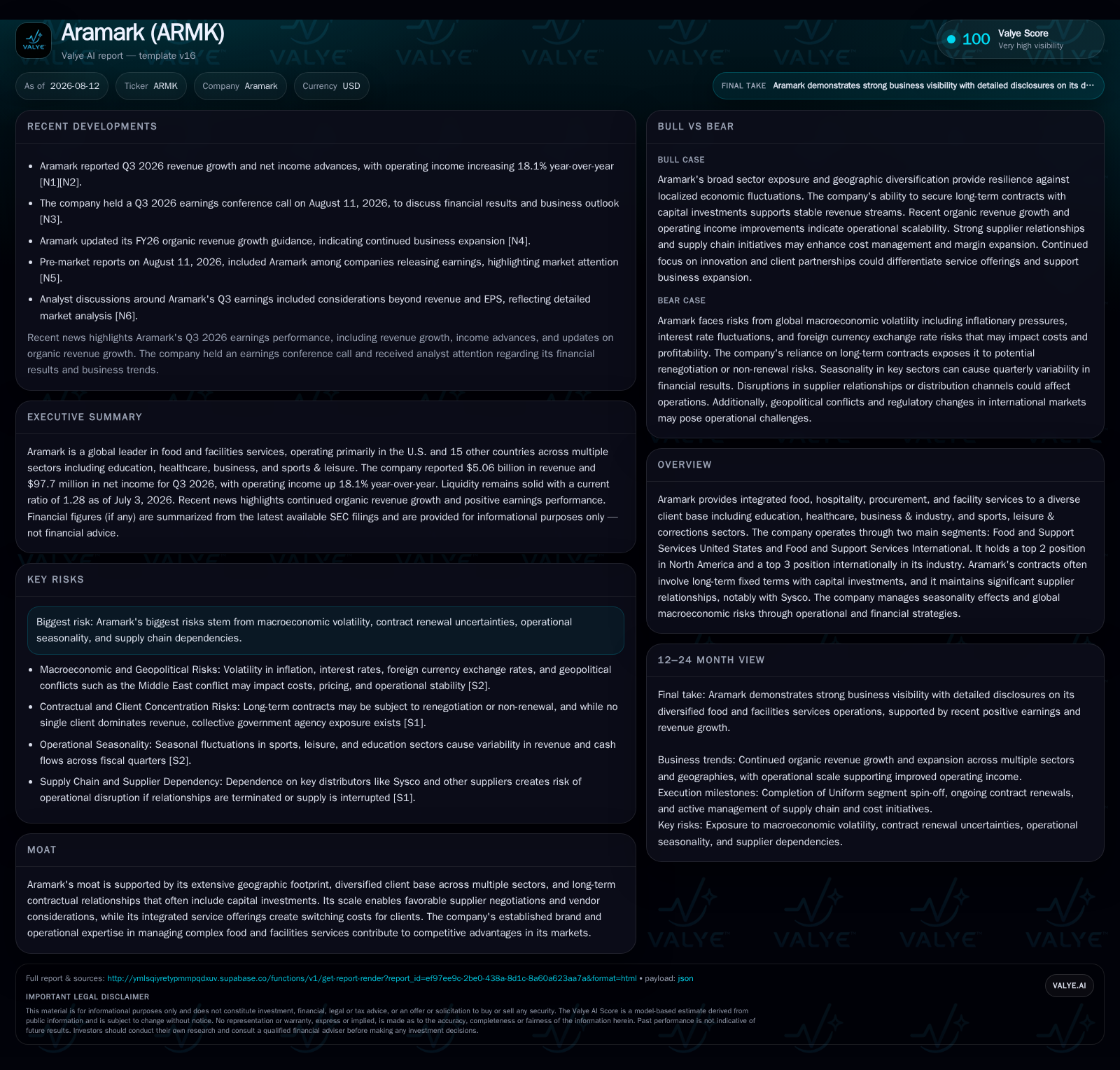
Aramark reported robust Q3 fiscal 2026 results with solid international segment growth, margin improvement, and effective cost management despite macroeconomic uncertainties.
In its latest quarterly filing ending July 3, 2026, Aramark demonstrated a 9.3% consolidated revenue growth supported by gains in both U.S. and international food and support services segments. The company's international operations showed strong momentum driven by new contracts and favorable currency translation, contributing substantially to overall performance. Operating income increased on the back of higher volume and supply chain efficiencies despite inflationary pressures. Aramark's integrated food, hospitality, and facility management model paired with its global footprint and long-term contracts underpin its competitive positioning. Seasonality continues to influence quarterly cash flows, while supply chain and labor cost management remain critical focus areas given current market volatility.
Recent Operating Update
These results underscore Aramark's successful leverage of its diversified service offerings spanning integrated food service operations and facility management delivered through long-term contractual relationships typically involving capital investment commitments with clients across sectors such as education, healthcare, business & industry, sports/leisure, and corrections facilities [S1]. The company confirms ongoing seasonality impacts consistent with historical patterns—lower activity in sports/leisure during the first half fiscal quarters balanced somewhat by education sector demand—and expects these fluctuations to persist in influencing quarterly results as well as cash flow profiles [S2].
Business Model
Aramark's business model centers on comprehensive outsourced food preparation alongside hospitality, procurement services, and facility management under two main reporting segments: FSS United States (71% of FY25 revenue) and FSS International (29%) [S1]. These segments feature contract structures primarily composed of profit-and-loss arrangements where Aramark bears operational risks including labor management, procurement costs from large vendors such as Sysco for food supplies, and service delivery quality under explicit service-level agreements with clients.
Clients benefit from outsourcing non-core services which allows them to focus resources elsewhere while Aramark exploits scale advantages through bulk purchasing power and standardized operating procedures optimized across widely dispersed locations. Capital expenditures at client sites often ameliorate switching costs for clients enhancing retention rates. Volume growth derives from securing additional contracts or expanding existing engagements organically.
Revenue mechanics rely heavily on stable client partnerships that often span multiple years with renewal dynamics critical for sustained earnings visibility during competitive pressures that can attempt margin compression via pricing negotiations or contract terms modifications [S1]. Changes in personnel costs are significant given the labor-intensive nature of operations — wages represent a principal expense alongside food/support services cost ratios which directly correlate to margin absorption.
Industry Structure & Competitive Position
Within the broader Food and Facilities Services industry characterized by multi-sector institutional outsourcing, Aramark holds a top-two position in North America plus a leading international presence ranking among the top three providers within its primary geographies based on revenue share measures [S1]. The fragmented customer base comprising schools, hospitals, businesses, stadiums, parks, correctional institutions along with geographically diverse operations demands expansive infrastructure including on-site trained personnel teams supported by robust procurement systems.
Peers like Compass Group plc and Sodexo share similar integrated food service/facility management profiles but vary regionally—Aramark’s balanced U.S.-international mix reduces singular market risk exposure while adding foreign currency considerations affecting reported financials amid exchange rate volatility. The competitive basis revolves around contract pipeline strength measured through active contract counts, renewal rates reinforced by client satisfaction/service consistency combined with cost control execution especially relating to supply chain disruptions facing all participants.
Growth Drivers
Several structural drivers underpin Aramark’s growth prospects: expanding institutional outsourcing demand fueled by client mandates for operational efficiency; shifting preferences towards integrated offerings combining food catering with facility upkeep that generate switching costs; geographic footprint extension notably within emerging markets augmenting international segment revenues; growing healthcare/education expenditures requiring ancillary services; adoption of sustainable/healthy menu options aligning with evolving customer preferences; continuous incorporation of technology tools advancing operational efficiency including inventory management/distribution logistics; along with steady contract renewals complimented by incremental new account acquisitions across industries served.
Successful navigation amid ongoing global inflationary pressures depends on strategically implementing supply chain initiatives involving vendor negotiations plus calibrated price adjustments sustaining service margins while maintaining client retention—a delicate balancing act highlighted repeatedly in recent disclosures [S2], [N1].
Risks & Watchpoints
Key risks remain anchored around macroeconomic volatility notably impacting client budgets sensitive to government spending patterns or private sector downturns; uncertainties linked directly to contract renewals potentially reducing backlog lifecycles if not timely addressed; pronounced seasonal variations necessitating agile resource planning supporting fluctuating revenue streams; supply chain fragilities exacerbated by raw material price hikes or logistic bottlenecks sustained across global markets; labor market tightness imposing wage inflation acceleration countering margin improvement efforts; regulatory scrutiny particularly encompassing health/safety compliance mandates intrinsic to food service operations; foreign currency translation volatility influencing consolidated earnings given diverse international revenues; potential impairment on capital investments if contract terminations occur prematurely; intensifying competitive pressure on rates or terms possibly constraining pricing power; as well as contractual disputes regarding cost allocations demanding careful resolution analysis impacting near-term earnings clarity.
These risk factors underscore operational complexities compounded during uncertain geopolitical climates such as ongoing Middle East conflicts elevating overall economic unpredictability referenced in filings [S2].
What to Watch Next
Investors should monitor evolving contract pipeline wins/losses impacting forward revenues alongside renewal rate trends providing signal on client satisfaction/stability metrics. Secondarily observing margin trajectory influenced by personnel cost evolution relative to revenues will help interpret operating leverage sustainability amid inflationary headwinds. Currency movements remain important for international segment financial results clarity given recent positive but possibly volatile contribution effects.
Upcoming quarterly filings should disclose progress on supply chain initiatives alongside capital expenditure pacing intended to align asset utilization efficiently within contracted scopes ultimately reinforcing profitability maintenance efforts. Any Board commentary regarding dividend policies should be noted since future payouts depend materially upon operational outcomes balanced with leverage considerations currently showing ample covenant headroom as detailed below.
Financial Profile Discussion
As of July 3, 2026 balance sheet data show $499 million in cash and equivalents against total debt of approximately $6.1 billion, resulting in net debt near $5.6 billion [F1]. Current assets of $3.9 billion and current liabilities of $3.0 billion imply a current ratio of about 1.28 [F1].
Covenant compliance is solid evidenced by a Consolidated Secured Debt Ratio pegged at roughly 2.59x against a maximum allowable threshold of 5.125x ensuring no immediate refinancing distress risk as well as an Interest Coverage Ratio comfortably above minimum requirements (~4.77x vs required 2x) demonstrating debt servicing capacity post operational earnings adjustments including non-cash impacts [S6], [F1].
In sum, Aramark maintains a balanced financial profile offering adequate liquidity combined with covenant headroom facilitating both operational investment needs alongside shareholder return considerations mindful of external risks.
This analysis utilizes exclusively verified SEC disclosures complemented by well-established industry context to provide an informed perspective on Aramark's current operational performance, positioning within the Food & Facilities Services sector, emerging opportunities for growth amid challenges posed by macroeconomic volatility,and prudent management of financial resources supporting sustainable execution strategies without conjecture or unsupported claims.
Disclaimer: This is research-only, informational analysis and not investment advice. It may include AI-generated interpretation and general industry context. Always verify important details using primary sources.

Comments