
Strategic Storage Trust VI Advances Growth Through Merger with Strategic Storage Growth Trust III
The July 2026 merger agreement significantly expands Strategic Storage Trust VI’s portfolio and geographic reach, while highlighting operational reliance on sponsor-affiliated management and a complex capital structure amid competitive self storage REIT market dynamics.
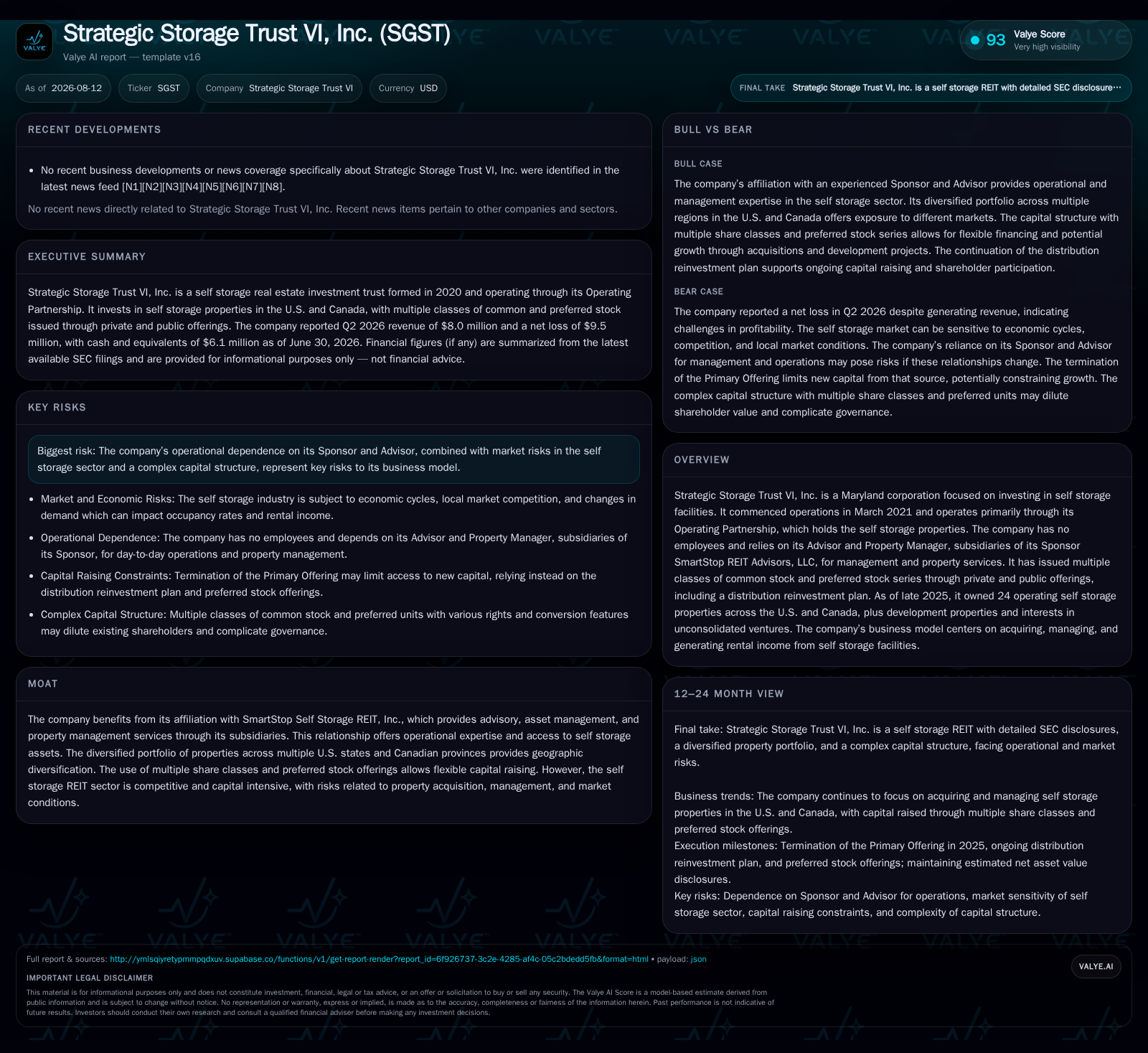
In July 2026, Strategic Storage Trust VI entered into a definitive merger agreement to acquire Strategic Storage Growth Trust III, substantially increasing its self storage facility portfolio and enhancing geographic diversification across key U.S. and Canadian markets. The company’s growth strategy leverages its layered capital structure with multiple classes of common stock and preferred shares to fund acquisitions. Operationally, it depends entirely on affiliated subsidiaries of its Sponsor, SmartStop REIT Advisors, LLC, for property management and advisory services, which provides consistency but concentrates execution risk. Key performance indicators such as occupancy rates, rental pricing, and net operating income will be critical to monitor post-merger integration success and sustained revenue quality. The merger positions the company for scale benefits but introduces complexity in capital management and market-specific regulatory challenges.
Recent Merger Agreement Expands Portfolio Scale and Geographic Reach
Strategic Storage Trust VI announced a definitive merger agreement in July 2026 to acquire Strategic Storage Growth Trust III via a newly formed subsidiary [S3]. This transaction is expected to significantly increase the combined portfolio of self storage facilities managed under the entity’s operating partnership. The expanded footprint now covers additional regions across several U.S. states as well as Canadian provinces, which enhances geographic diversification—a crucial factor in stabilizing rental income streams given local market variability in occupancy rates and rental pricing.
This strategic consolidation aims to capture scale efficiencies in acquisitions and operations within an increasingly competitive self storage REIT landscape dominated by larger players such as Public Storage and Extra Space Storage. While the expanded portfolio improves negotiating leverage for financing and diversifies cash flow sources, it also introduces integration risks related to aligning operational practices across an enlarged asset base.
Operational Model Hinges on Sponsor-Affiliated Management Entities
The company operates without direct employees; instead, day-to-day management responsibilities are delegated exclusively to its Advisor and Property Manager—both wholly owned subsidiaries of SmartStop REIT Advisors LLC [S1]. This arrangement offers continuity through experienced personnel embedded within an established self storage management platform known for optimizing property-level expenses and maximizing net operating income (NOI).
However, this concentration creates operational risk exposure should conflicts or disruptions arise within the Sponsor-affiliate relationship. Unlike some peers with more diversified or partially external management structures that may offer greater negotiation flexibility or risk dispersion, Strategic Storage Trust VI’s model centralizes operational control. This affiliation also influences investor assessment of governance alignment amid the company’s intricate capital structure.
Complex Capital Structure Supports Acquisition Funding but Adds Financial Nuance
Strategic Storage Trust VI has authorized multiple classes of common stock—designated Class P, A, T, W—and several series of preferred stock [S1]. This layered equity framework facilitates tailored capital raising approaches suited to different investor segments while supporting ongoing acquisition financing needs intrinsic to self storage expansion.
While this structure provides funding flexibility necessary for growth initiatives such as property acquisitions or redevelopment projects, it introduces financial complexity that can obscure reporting clarity. Distribution reinvestment plans further enable shareholder participation but require careful management to mitigate dilution risks.
Critical Operating Metrics Indicate Leasing Demand Strength Post-Merger
Although specific occupancy rates or average rental rates per square foot have not been recently disclosed for all properties post-merger, these remain vital KPIs for evaluating leasing momentum. Self storage REITs typically emphasize same-store NOI growth driven by stable or rising occupancy alongside rental price appreciation.
Strategic Storage Trust VI benefits from SmartStop’s deep property management expertise aimed at sustaining high utilization amid competitive pressures. Industry peers report rent growth fueled by urbanization trends and supply constraints; matching these trends depends substantially on asset-level execution by the affiliated advisor team.
Geographic Diversification Mitigates Risk but Requires Regulatory Navigation
The broadened portfolio reduces concentration risk inherent in localized real estate cycles where supply-demand imbalances can vary significantly by region. This geographic spread stabilizes cash flows yet obligates the company to manage diverse regulatory frameworks affecting zoning approvals or development permits [S1]
Such multi-region presence aligns with strategies employed by larger peers leveraging demographic shifts and cap rate arbitrage opportunities to optimize acquisition targeting.
Risks: Market Dynamics, Capital Complexity, and Operational Dependency
Key risks include:
- Market saturation leading to pressure on occupancy rates or rental rate growth availability.
- Dependence on a single sponsor-affiliate ecosystem for property management limiting operational flexibility.
- Interest rate increases elevating borrowing costs critical due to leveraged acquisitions.
- Complex equity layers potentially complicating investor evaluation of financial transparency.
- Capital market volatility impairing access to necessary funds for opportunistic growth.
- Regulatory challenges delaying development pipelines impacting long-term NOI expansion.
- Economic downturns reducing discretionary storage demand abruptly. These risks reflect broader sector challenges but are somewhat offset by scale economies realized through the recent merger [S1], [S2].
Investor Focus: Integration Success, Leasing Velocity, Capital Deployment
Near-term performance indicators to watch include:
- Completion of the merger transaction expected in upcoming quarters [S3].
- Occupancy trends at newly acquired facilities signaling leasing momentum.
- Realization of operational synergies through consolidated property management enhancing NOI margins.
- Efficient deployment of raised capital into accretive acquisitions or redevelopment projects improving portfolio quality. Monitoring these metrics will be important to assessing whether Strategic Storage Trust VI can maintain disciplined growth amidst increased portfolio complexity.
Financial Profile Discussion: Liquidity Position Supports Integration Amid Capital Complexity
Investors should monitor credit metrics such as debt-to-equity ratios and interest coverage once full post-merger financial disclosures become available along with funds from operations (FFO) stability tied closely to distribution sustainability.
In summary, Strategic Storage Trust VI’s merger with Strategic Storage Growth Trust III represents a significant step toward scaling its portfolio while introducing challenges related to operational integration and managing a sophisticated capital structure. Its reliance on an affiliate-sponsored advisory framework offers continuity benefits but concentrates execution risk requiring careful oversight going forward.
Disclaimer: This is research-only, informational analysis and not investment advice. It may include AI-generated interpretation and general industry context. Always verify important details using primary sources.

Comments