
Maze Therapeutics Leverages Genetic Insights to Advance Kidney Disease Pipeline Amid Clinical Progress
Maze Therapeutics’ Q2 2026 update highlights clinical milestone achievements alongside robust liquidity supporting ongoing R&D in kidney disease therapeutics.
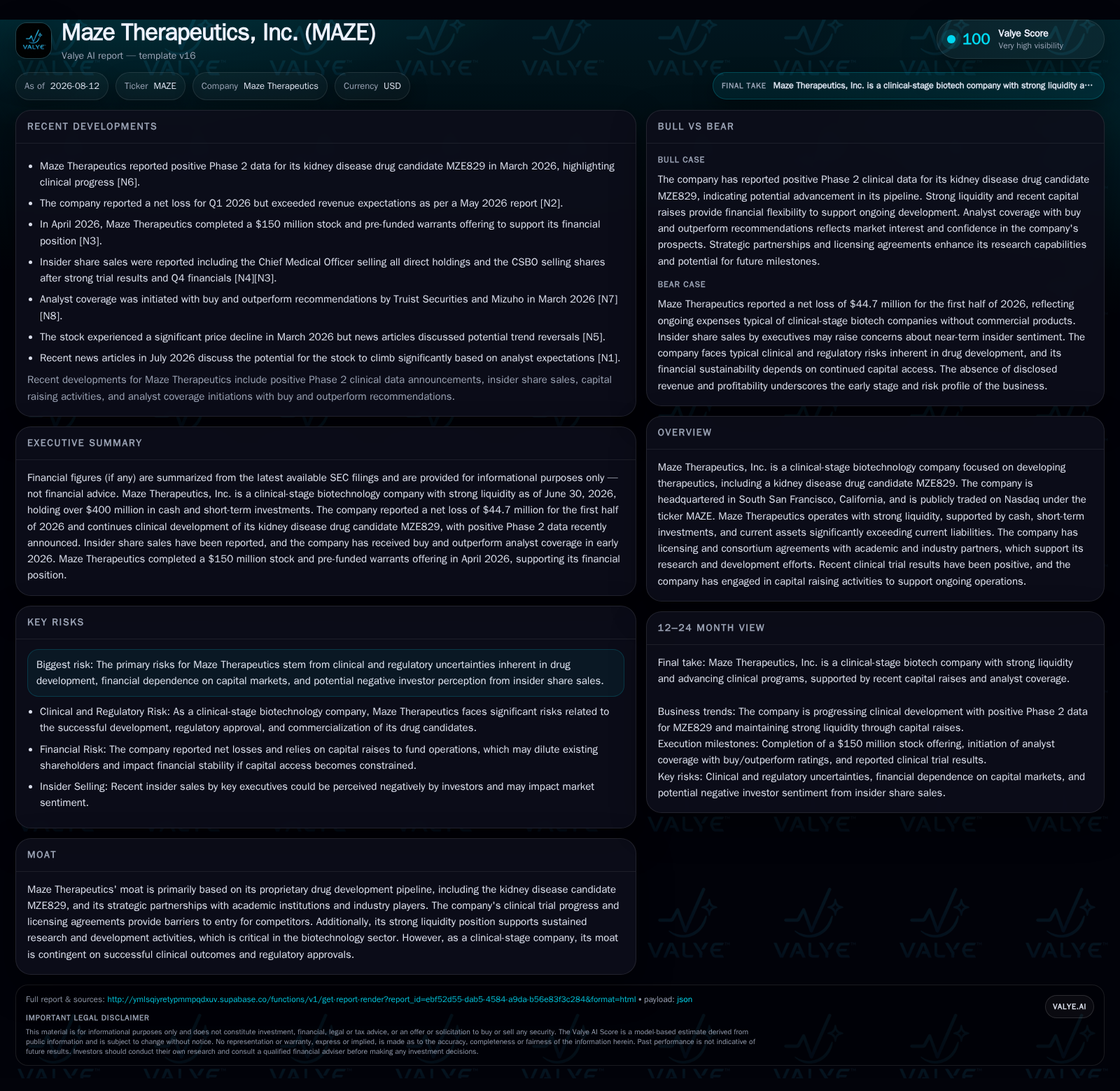
In its August 2026 quarterly filing, Maze Therapeutics underscored positive developments in its lead kidney disease candidate MZE829, including accelerated clinical progress and first-time license revenue recognition. The company’s substantial cash reserves and prudent capital raising offer a secure runway to advance trials amid inherent biotech development risks. Strategic academic partnerships further strengthen Maze’s innovation pipeline beyond lead assets, while regulatory and funding uncertainties remain watchpoints as key milestones approach.
Latest Quarter Stresses Financial Strength While Advancing Clinical Milestones for MZE829
Maze Therapeutics’ Q2 2026 10-Q filing reveals meaningful operational progress coupled with financial prudence [S2]. For the first time, Maze recognized $20 million in license revenue during the first half of 2026 following prior periods of nil license income, signaling material advancement or deliverables achieved under partnership agreements. This revenue recognition shift reflects not only successful de-risking via clinical milestone attainment but also illustrates growing diversification from pure R&D expense burn towards intermittent non-dilutive inflows, albeit still pre-commercial sales [S2]. Meanwhile, the lead small molecule kidney disease candidate MZE829 has shown accelerating clinical trial enrollment and progression through key phases, a critical KPI indicating readiness for subsequent pivotal testing steps. Clinical-stage biotech firms like Maze hinge valuation heavily on such enrollment rates since slow recruitment can delay value inflections substantially compared to peers pursuing similar renal precision therapy mechanisms.
Simultaneously, Maze continues to leverage capital markets effectively under its February 2026 at-the-market offering agreement with Jefferies LLC, maintaining flexible equity issuance capacity up to $200 million. This approach supports cash runway extension while limiting traditional dilutive timing mismatches common in clinical-stage biotech financing cycles [S2]. The interplay between milestone-driven revenue recognition and disciplined capital raises underlines a balanced liquidity management strategy essential to funding prolonged late-stage trials without urgent refinancing risks.
'Precision Medicine' Model Centered on Small Molecule Therapeutics in Kidney Disease Innovation
Maze’s business model is deeply embedded in genetically-informed drug discovery focused primarily on unmet medical needs associated with kidney and metabolic diseases [S1],[S2]. The proprietary nature of MZE829—targeting the APOL1 pathway implicated in various nephropathies—positions Maze within the high-growth niche of small molecule precision therapeutics differentiated by genetic evidence. Unlike broader biologic or antibody programs common among peers, Maze’s small molecule approach aims for orally available agents potentially improving patient compliance and market uptake upon approval.
The clinical safety and tolerability profile emerging from early phase trials further refine receptor or pathway targeting choices. Mechanism-of-action clarity is a crucial differentiator as competitors advance alternative modalities against APOL1 or indirect pathways [S1]. This scientific rigor feeds directly into the company's R&D prioritization and licensing potential, embodying a high-risk/high-reward profile typical of pre-commercial biotechs whose long-term value accrues from eventual regulatory approvals rather than immediate product revenues.
'Unlocking Value Through Partnerships': Consortium Agreements Bolster Early Discovery Pipeline Support
Beyond its lead asset MZE829, Maze harnesses academic collaborations to sustain its innovation pipeline amid costly drug development cycles. Consortium agreements, notably with the University of Helsinki, permit shared access to genetic data sets and research resources vital for early-stage candidate identification [S1],[S2]. Such partnerships not only lower upfront discovery costs but also enhance intellectual property breadth—a key asset that can translate into licensing revenues or co-development deals reducing financial exposure during costly later-stage trials.
This strategy aligns with industry best practices where mid-size clinical-stage biotechs mitigate full program risk by sharing early discovery work through academic consortiums. Licensing milestone payments realized increasingly during 2026 underscore how these collaborations may produce tangible economic benefits prior to drug commercialization thresholds [S2]
'Capitalizing on Growth Drivers': Clinical Trial Enrollment Acceleration and Revenue Recognition Trends
Clinical trial enrollment rate improvements reported indirectly via milestones correspond closely to potential acceleration towards phase transitions or primary endpoint assessments [S2],[F1]. Heightened enrollment pace supports forward-looking optimism relative to peers who often face elongated recruitment in rare kidney diseases due to limited patient pools. Achieving clinical endpoints promptly becomes a core value driver that influences overall timeline compression and market positioning.
The $20 million license revenue recognized in H1 2026 contrasts sharply with zero revenue in comparable prior periods [S2], capturing how contract terms that hinge on defined trial progress or data delivery milestones materially impact interim financials without yet relying on product sales. This dynamic is common among developmental-stage biotechs balancing significant R&D expense burn—reflected in ongoing net losses—with sporadic licensing inflows enhancing effective cash burn ratio.
'Navigating Risks': Funding Reliance, Regulatory Outcomes Uncertainty, and Insider Transactions Watchlist
Maze retains intrinsic funding dependency risks typical of clinical-stage biotech companies burning through cash at rates commensurate with complex trial demands absent approved products or large recurring revenues [N1],[S1],[S2].
Regulatory uncertainty extends beyond clinical outcomes to evolving FDA expectations around novel mechanism validation and biomarker endpoints in kidney disease—a challenging area generally marked by incremental therapeutic advances rather than paradigm shifts. Concurrently, the company must manage transfer pricing complexities related to licensing fees recognized internationally under consortium agreements.
Investor perception may be sensitive to recent insider share sales reported mid-2026 [N1], which though not uncommon, could signal varying confidence levels internally. While this activity does not currently alter operational trajectories, it merits continued monitoring for any widening gap between management behavior and market expectations common in speculative biotech stocks.
'What Comes Next': Milestones, Trial Progress Updates, Regulatory Filings, and Cash Management Focus Ahead of Q3 Earnings Confirmation
Looking forward, investors should closely monitor upcoming clinical data releases tied to MZE829’s enrollment status and safety/tolerability readouts. Success at predefined interim endpoints would validate mechanism relevance while improving probability of subsequent regulatory approval submissions [S2],[S3].
Additional near-term catalysts include new licensing arrangements or milestone recognitions originating from both lead program advancements and broader consortium outputs which could enhance non-dilutive revenue amidst ongoing R&D expenditures.
Cash runway sustainability will remain a focal point alongside potential additional capital market transactions under the existing at-the-market program depending on timing of clinical progress vis-à-vis expenditure levels. Regulatory filings initiated or planned involving APOL1-targeted therapies also serve as important signposts toward commercialization feasibility.
Liquidity Resilience Supports Sustained R&D Investment – Financial Profile Discussion
At June 30, 2026, Maze Therapeutics held approximately $203 million in cash and equivalents against total debt near $40 million, yielding a net cash position exceeding $160 million [F1],[S2]. Its current ratio stands notably high at over 18x — an exceptional liquidity cushion enabling continued execution of costly clinical trials without imminent capital constraints [F1].
Despite consistent net losses characteristic of early-stage biopharma driven by concentrated R&D spending (including trial costs and personnel), intermittent licensing revenue generated this year softens cash flow dependency on pure equity infusion cycles [F1],[S2]. The ability to prudently extend operating runway through disciplined capital raises combined with milestone-driven inflows mitigates near-term dilution risk relative to many peer clinical-stage biotechs facing capital access volatility.
This financial setup provides strategic optionality but does not diminish fundamental development risks borne by unproven novel targets nor replace importance of regulatory success as ultimate value drivers.
This analysis is based exclusively on public filings and industry context without investment advice. Investors should conduct independent diligence considering future regulatory developments and macroeconomic factors influencing biotech valuations.
Disclaimer: This is research-only, informational analysis and not investment advice. It may include AI-generated interpretation and general industry context. Always verify important details using primary sources.

Comments