
Interface Expands Global Flooring Sales with Sustainability and Product Diversity Driving Growth
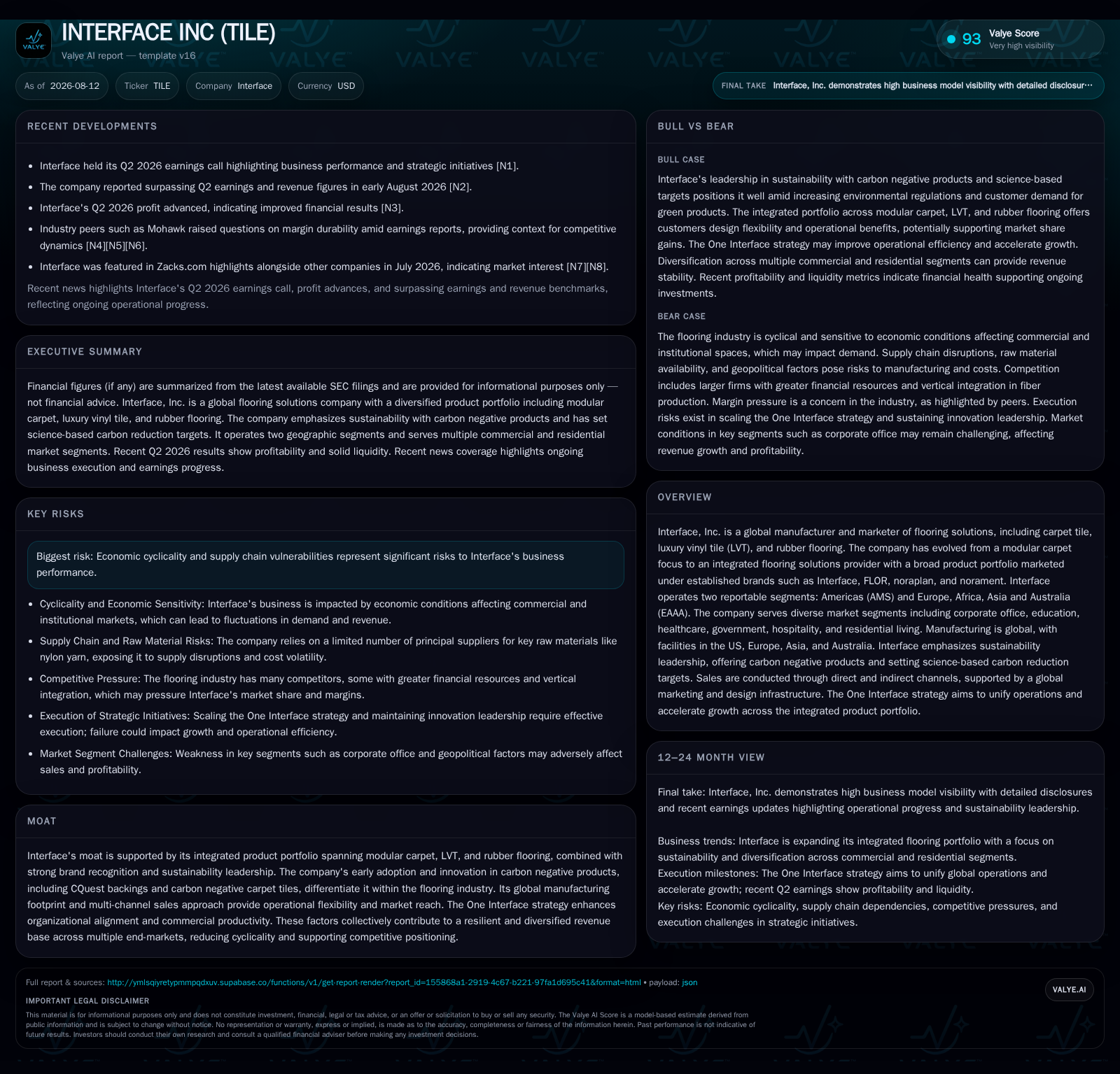
Interface’s Q2 performance reflects growth in Americas and EAAA segments supported by integrated carpet, LVT, and rubber flooring amid economic cyclicality and competitive pressures.
In its latest quarter, Interface Inc (TILE) continued to expand sales across its Americas and EAAA segments, supported by its diversified product mix spanning carpet tile, luxury vinyl tile (LVT), and rubber flooring. The company’s strategic pivot from a modular carpet specialist to an integrated global flooring solutions provider is underpinned by sustainability leadership and innovation in carbon negative products. While economic cyclicality and supply chain factors pose risks, Interface benefits from a multi-channel global footprint across commercial end-markets including healthcare, education, and hospitality. Monitoring order backlog trends, segment performance differential, and margin trends will be key to assessing durability of growth amid competitive pressures.
Latest Operating Update Highlights
Interface Inc's second quarter filing dated August 11, 2026 provides the most recent operational snapshot revealing continued growth trajectory in its two geographic reporting segments: Americas (AMS) and Europe, Africa, Asia & Australia (EAAA) [S2]. The company reported sales advances driven by robust demand for their integrated flooring portfolio. Adjusted operating income figures exclude purchase accounting amortization related to their 2018 nora systems GmbH acquisition as well as restructuring or impairment charges to allow focus on normalized operations [S4][S5]. These adjustments enhance comparability with peers that have not undergone similar acquisitions recently.
Looking beyond raw revenue growth, Interface emphasizes currency-neutral sales growth metrics to neutralize the impact of foreign exchange fluctuations given its global footprint. This approach clarifies operational momentum particularly relevant to the EAAA segment with exposure to volatile FX rates [S4]. A scheduled presentation at the Midwest IDEAS Investor Conference later this month will provide investors with deeper perspective on growth strategy progress and market positioning [S3].
Business Model Nuances
Interface operates within the global flooring manufacturing value chain primarily focused on the manufacturing and marketing stages. Its product offerings cover carpet tiles under recognized brands Interface® and FLOR®, luxury vinyl tile (LVT), marketed also under Interface®, as well as rubber flooring through noraplan® and norament® brands acquired via nora systems GmbH [S1]. This broad portfolio addresses varied customer specifications across commercial sectors such as corporate office spaces, healthcare facilities, educational institutions, government properties, hospitality venues, and residential living environments.
Revenue is generated from direct sales teams supplemented by indirect distribution channels targeting architects, interior designers, facility managers, contractors, and end-users who prioritize quality alongside environmental credentials. Price realization depends on product category (carpet vs LVT vs rubber), project scale, contract terms, geographic market dynamics, and prevailing raw material costs. Volume variance is tied closely to construction cycles, retrofit projects, renovation demands, and evolving design trends.
Interface's strategic transition away from an exclusive modular carpet focus began around 2016 with the addition of LVT offerings worldwide followed by the nora rubber flooring acquisition in 2018 [S1]. This diversification reduces cyclical revenue swings linked solely to carpet tile demand while leveraging cross-selling potential across floorcovering options. Importantly, Interface's sustainability initiatives—such as delivering cradle-to-gate carbon negative carpet tile backings since 2020—create differentiated value that appeals increasingly to eco-conscious customers aiming for green building certifications like LEED
Industry Structure and Competitive Positioning
The flooring manufacturing sector is intensely competitive with many regional and global firms competing across carpet, vinyl/resilient flooring, rubber mats/products categories. Peers such as Mohawk Industries and Shaw Industries primarily compete on scale advantages encompassing global manufacturing capabilities, broad product suites including complementary hard surface options beyond carpet or vinyl tiles. Meanwhile Tarkett distinguishes itself through sustainability innovation resembling Interface’s strategies.
Interface's moat stems from its integrated product portfolio combined with early mover advantage in carbon negative materials production which competitors have struggled to replicate credibly. Its One Interface organizational initiative enhances commercial alignment facilitating agility across its brand architecture and geographic segments [S1]. Further structural support comes from a geographically balanced manufacturing footprint spanning four continents allowing proximity to key markets reducing logistics time/cost while managing capacity utilization effectively.
However, risks persist notably economic cyclicality wherein downturns in commercial real estate development or institutional renovation dampen order backlogs impacting near-term volumes. Increased competitor capacity expansions can trigger pricing pressure compressing gross margins if offsetting price increases are unfeasible due to tender-based contract environments or substitute adoption.
Growth Drivers
Principal long-term growth drivers include rising adoption of sustainable low-carbon flooring products aligned with increasing regulatory mandates for emission reductions in building materials procurement. Interface’s carbon negative product lineups exceed industry standards fostering customer loyalty among corporate clients seeking measurable climate impact improvements. Expansion into resilient flooring segments like LVT caters to growing commercial preferences for versatile durable floors combining aesthetic appeal with maintenance efficiency.
Moreover, geographic expansion particularly within emerging markets in Asia or infrastructure-intensive regions in EAAA broadens market reach beyond traditional US corporate office dependency which faces secular headwinds due to hybrid work trends. Diversification into non-office sectors such as healthcare, education public spaces smooths demand cyclicality enhancing revenue stability.
Innovation in circular design principles manifested through the ReEntry® program promotes recycling take-back initiatives closing material loops supporting both sustainable sourcing goals and potential cost reductions over time by recapturing raw materials internally [S1]. Finally continual enhancement of product designs responding rapidly to shifting customer style preferences sustains competitive differentiation underpinning volume retention.
Risks and Constraints
Economic downturns present primary risk factors reflected in softening build-out or retrofit cycles adversely affecting order backlog momentum especially in AMS where approximately 61% of sales emanate [S1][F1]. Raw material price volatility coupled with global supply chain challenges may constrain margin expansion requiring proactive procurement management or selective price adjustments which risk customer pushback.
Competitive landscape intensifies as large rivals optimize production efficiency potentially exerting downward pricing pressure necessitating compelling value propositions from Interface centered on sustainability features that competitors might match over time diminishing differentiation [S1]. The goodwill balance related largely to EAAA operations warrants attention given prior impairment charges triggered by macroeconomic stressors such as inflationary cost pressures or currency fluctuations signaling vulnerability under deteriorating market conditions
Dependency on key personnel including senior management teams responsible for design innovation programs underscores human capital risk which if unmitigated could cause transient disruption in portfolio advancements or execution effectiveness.
What To Watch Next
Investors should monitor Q3 order backlog data segmented by AMS vs EAAA along with detailed gross margin variance commentary indicating raw material cost pass-through effectiveness or pricing power resilience amid ongoing inflationary scenarios. New product introductions especially within LVT or rubber categories signaled during upcoming investor presentations could reveal acceleration in adoption accelerating segment revenue share shift from traditional modular carpets.
Further clarity on sustainability goal progress including specific carbon footprint reduction metrics tied to cradle-to-gate assessments would enhance transparency around environmental leadership credentials strengthening Interface’s premium positioning relative to peers pursuing similar agendas more recently.
Lastly capital allocation priorities detailed in future filings especially relating to potential bolt-on acquisitions enhancing regional market penetration or expanding circular economy initiatives deserve scrutiny for their impact on long-term organic growth prospects versus short-term financial leverage implications.
Financial Profile Discussion
As of July 2026 quarter-end reported balance sheet items indicate a healthy liquidity position characterized by $81.5 million cash & equivalents against current liabilities of approximately $248 million providing a current ratio near 2.53 reflective of strong working capital buffer supporting operational flexibility [F1]. Total debt stands at about $204.5 million yielding net debt of roughly $123 million after cash offset indicative of modest leverage suitable given business scale ([F1]).
Capital expenditures remain moderate supporting capacity upkeep rather than significant expansions consistent with deliberate scaling aligning with prevailing demand trends within existing facilities reducing fixed-cost absorption risk during cyclical fluctuations.
Overall cash flow generation cadence combined with judicious debt management positions Interface adequately for sustaining R&D spending necessary for maintaining technological leadership while navigating industry cyclicality tactically.
This analysis synthesizes Interface Inc's latest publicly-filed filings including its Q2 2026 Form 10-Q alongside its FY2025 Form 10-K disclosures without providing investment directions but aiming to clarify strategic positioning amid sector dynamics concerning sustainable integrated flooring solutions.
Disclaimer: This is research-only, informational analysis and not investment advice. It may include AI-generated interpretation and general industry context. Always verify important details using primary sources.

Comments