
NextNav Advances Terrestrial PNT with 5G Integration Amid Scaling and Profitability Challenges
NextNav’s latest quarterly results highlight its dual challenge of evolving NextGen positioning services while managing ongoing losses and capital needs.
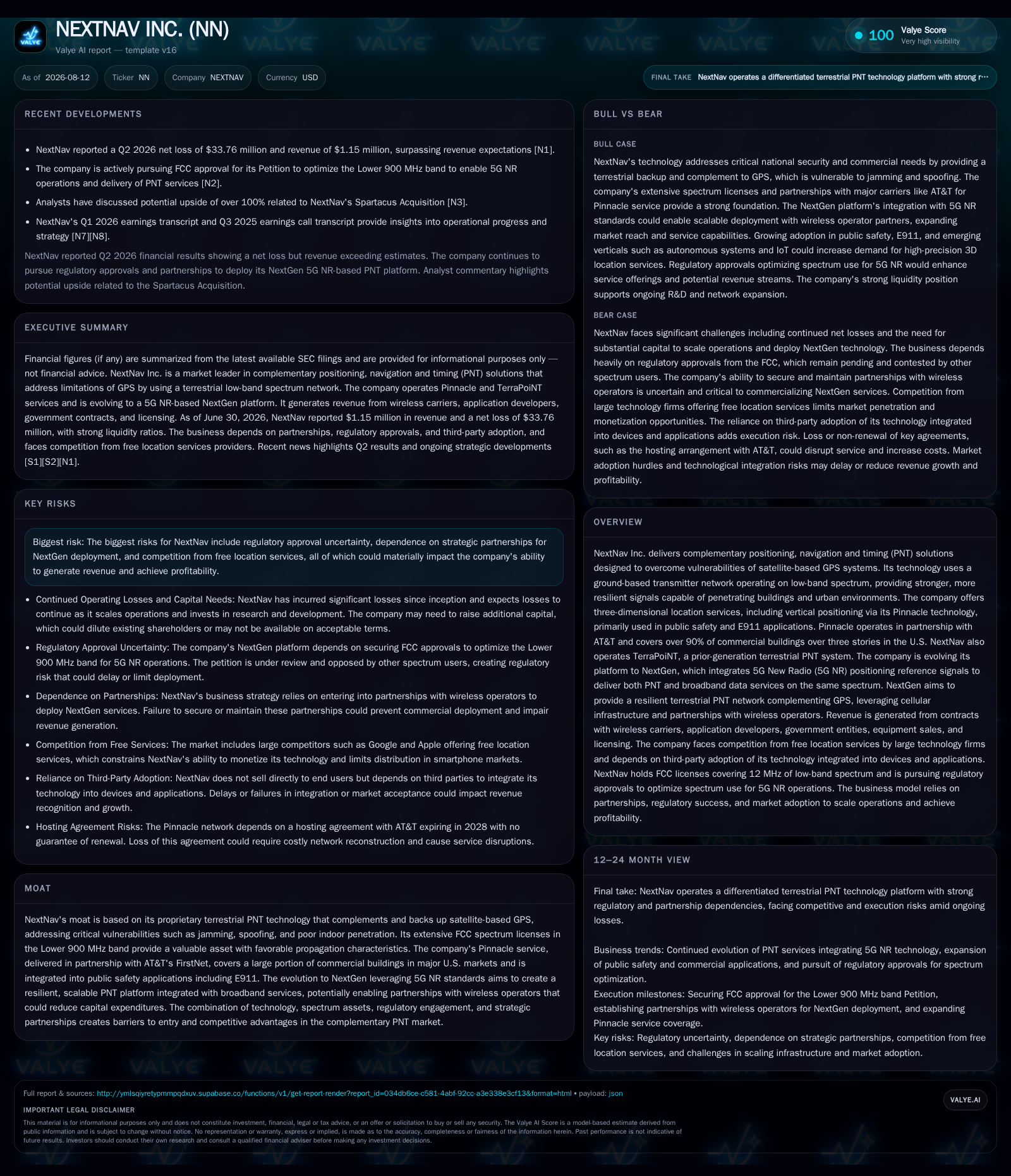
NextNav operates a proprietary terrestrial positioning, navigation, and timing (PNT) network leveraging low-band spectrum to provide resilient indoor and urban location data, supplementing satellite GPS. Its Pinnacle service covers over 90% of multi-story U.S. commercial buildings via a partnership with AT&T’s FirstNet public safety network. Recent filings reveal sustained net losses and increased R&D spending to develop its NextGen platform integrating 5G NR Positioning Reference Signals, aiming for scalable PNT and broadband offerings. While the company boasts valuable spectrum assets and strategic alliances, regulatory uncertainties and capital intensity pose risks to profitability and growth.
Recent Operating Update
Despite these losses, NextNav asserts sufficient liquidity via cash reserves of approximately $77.7 million as of end-June 2026 against total debt obligations nearing $267 million as of March 31, yielding a substantial net leverage position [F1][S2]
Financially, the company disclosed increasing R&D expenses driven by NextGen development efforts (+17% YoY in 2025) alongside expanded general and administrative costs (+18% YoY), underscoring the dual pressures of technological innovation and organizational growth [S21]. The firm does not expect near-term profitability or cash flow positivity given ongoing outlays.
Business Model
NextNav's core business derives from its role as both a technology provider and terrestrial network operator within the PNT value chain. It monetizes through licensing its specialized low-band spectrum assets alongside subscription or usage-based fees for location services delivered primarily in public safety domains such as Enhanced 911 (E911).
Its pioneering Pinnacle service leverages an extensive FCC license portfolio: an contiguous 8 MHz block around the lower 900 MHz band covering over 90% of U.S. commercial buildings taller than three stories plus an additional recently acquired complementary spectrum block totaling up to 12 MHz [S1]. Operating terrestrially—as opposed to relying purely on satellites—gives it signal strengths capable of penetrating urban canyons and building interiors where satellite GPS frequently underperforms.
A critical feature differentiating NextNav is its three-dimensional positioning capability that incorporates barometric sensor data from end-user devices enabling vertical "z-axis" location estimation. This capability is vital for first responders requiring precise indoor floor-level identification during emergencies [S1].
Technological evolution centred on the NextGen platform integrates global standards-based 5G New Radio (5G NR) Positioning Reference Signals (PRS). This hybrid terrestrial-5G approach aims to improve scalability and reduce operational expenditure by leveraging wireless carriers’ existing infrastructure while broadening application cases beyond PNT to include broadband data services on the same licensed spectrum [S1]. As such, the business model is shifting toward collaborative deployment partnerships with major carriers like AT&T.
Industry Structure and Competitive Position
The PNT industry sits at a complex nexus involving satellite GNSS systems (e.g., GPS), terrestrial network operators like NextNav, wireless carriers embedding integrated positioning technologies, public safety communications networks, device manufacturers embedding or supporting PNT tech, and regulatory bodies managing critical spectrum assets.
NextNav occupies a differentiated niche primarily delivering complementary terrestrial PNT services that address GPS vulnerabilities such as signal jamming, spoofing risks, poor urban canyon reception, and lack of vertical positional resolution—all significant pain points in both consumer applications and mission-critical public safety use cases.
Its closest peers include GPS-centric providers like Garmin or Trimble who offer devices but lack comprehensive terrestrial networks; wireless carriers (AT&T/Verizon) that may adopt or integrate PNT capabilities but typically do not operate dedicated PNT transmitters; as well as emerging hybrid solution makers focused on GNSS augmentation technologies.
Regulatory complexity is heightened by ongoing litigations surrounding certain spectrum licenses acquired through transactions with Telesaurus/Skybridge Spectrum Foundation which remain subject to petitions for reconsideration [S1]. Maintaining exclusive control over low-band spectrum is a strategic moat given its favorable propagation characteristics compared to higher frequency bands prone to indoor attenuation.
Growth Drivers
Several structural demand drivers underpin NextNav’s growth prospects:
- Public Safety Mandates: Regulatory requirements such as E911 vertical location accuracy create mandatory adoption pathways for public safety agencies reliant on precise indoor/outdoor positioning.
- Indoor & Urban Location Demand: Increasing use cases spanning autonomous drones, IoT device tracking, mobile app services depend on reliable three-dimensional location data impervious to GNSS signal degradation indoors or in dense urban canyons.
- 5G Network Expansion: Integration into widely deployed global standard-based PRS within cellular networks offers operational synergies potentially reducing capex burden while enhancing service density and reach.
- Security Concerns: Escalating risks around GPS spoofing/jamming raise national security relevance reinforcing investment viability for complementary terrestrial systems.
- Strategic Partnerships: Alliances with wireless carriers like AT&T enable broader commercial distribution leveraging existing communication infrastructures and access to end users including commercial enterprises.
Risks and Growth Constraints
Key challenges facing NextNav reflect typical sector risks but also specific company hurdles:
- Regulatory Uncertainty: Ongoing petitions regarding certain spectrum licenses could disrupt planned network expansions or impact asset valuations negatively if unfavorable rulings occur [S1].
- Financial Sustainability: Persistent operating losses coupled with high debt emphasize reliance on future capital raises; failure to improve revenue scale versus operating cost growth could impair liquidity longer term [S2][F1].
- Competitive Pressure: Free satellite GNSS services provided ubiquitously on smartphones compete directly on basic location functionalities; differentiating sufficiently via vertical positioning accuracy remains critical.
- Technology Integration: The complexity of evolving legacy Pinnacle tech toward fully integrated NextGen delivery incorporating standardized 5G NR PRS demands successful execution across software/hardware innovation cycles plus ecosystem compatibility with carriers’ infrastructure.
- Customer Adoption: While footprint coverage across commercial buildings is broad (>90%), actual penetration rates at end-user device or application level will determine sustainable revenue ramp.
- Capital Intensity: Network buildout requires continual infrastructure investment; scalability depends on ability to leverage partnerships rather than purely own buildout costs.
What To Watch Next
For market observers assessing NextNav's trajectory:
- Updates on regulatory rulings concerning spectrum licenses from Skybridge/Telesaurus petitions provide clarity on core asset stability.
- Announcements regarding milestones achieved in commercial rollouts or carrier partnership expansions of the NextGen platform integrating 5G NR PRS technology will indicate progress toward scalable service models.
- Adoption metrics used in public safety sectors or emerging autonomous system clients will serve as leading demand indicators.
- Quarterly financial performance focusing on revenue growth rate relative to controlled operating expense increases will gauge path toward improved profitability margins.
- Any capital markets activity such as equity or debt issuances may shed light on liquidity outlook amid continued operating cash burn.
Financial Profile Discussion
As of mid-2026 latest disclosures depict a company still investing heavily in developing proprietary PNT technology platforms without near-term profit realization [F1][S4][S5]. The firm carried $77.7 million in cash equivalents balanced against $267 million total debt – reflecting significant leverage from senior secured convertible notes issued in March 2025 maturing mid-2028 but carrying effective interest rates around the mid-teens due to amortization effects.
This financial profile typifies emerging infrastructure tech firms prioritizing long-cycle R&D and platform scaling ahead of steady-state commercialization efficiencies. Success hinges significantly on converting technical capabilities into recurring service contracts embedded into critical public safety ecosystems supported by wireless carrier partners who facilitate broader monetization channels while mitigating upfront build costs.
This analysis synthesizes publicly filed SEC documents alongside sector-specific frameworks relevant to positioning navigation timing infrastructure providers. It refrains from forward-looking investment research views focusing instead on operational context evaluation supported by cited evidence central to understanding NextNav's strategic positioning within the evolving terrestrial PNT industry ecosystem.
Disclaimer: This is research-only, informational analysis and not investment advice. It may include AI-generated interpretation and general industry context. Always verify important details using primary sources.

Comments